Spot silver fell as much as 1%: Can the dollar's rebound continue? Which will prevail: the Fed's "no guidance" policy or geopolitical risks?
2026-07-31 13:52:50
On Friday (July 31) during Asian trading hours, spot silver fell by more than 1% to $58.28 per ounce. The US dollar index rebounded slightly to around 100.25, attempting to end a three-day losing streak, putting short-term pressure on silver. However, the downside for silver may be limited—the Federal Reserve kept interest rates unchanged on Wednesday and pledged a "no forward guidance" policy, making the dollar's outlook fragile. Furthermore, the ongoing US-Iran conflict, leading to limited global energy supply and pushing up oil prices, restricts the upside for silver but also provides a geopolitical risk floor for silver prices. 
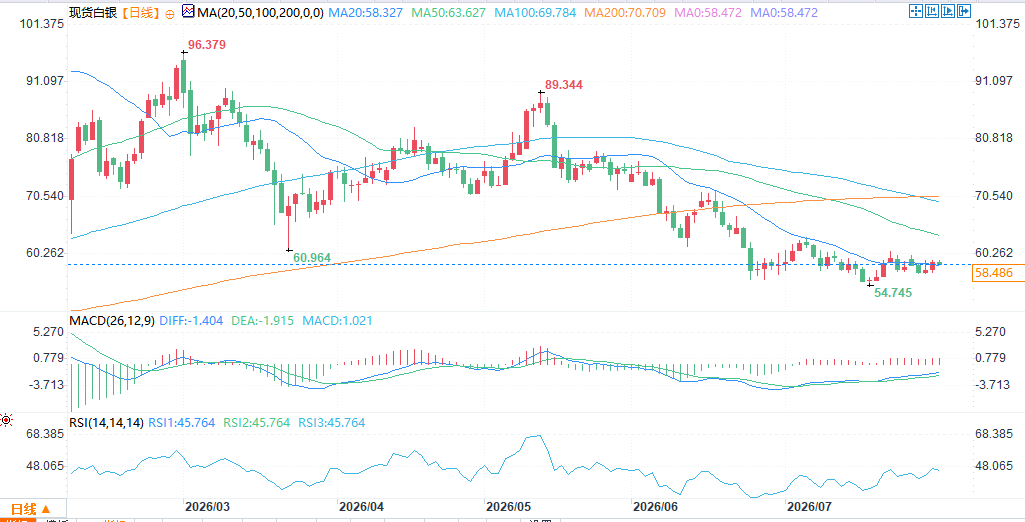 (Spot silver daily chart, source: EasyTrade) At 13:50 Beijing time on July 31, spot silver was trading at $58.34 per ounce.
A rebounding dollar pressured silver, but the Fed's "no-guide" policy made the dollar's outlook fragile.
The main driver of silver's weakness was a slight rebound in the US dollar, with the dollar index rising about 0.25% to around 100.25, attempting to end a three-day losing streak. However, AllianceBernstein strategists pointed out that the dollar's "sharp decline had two reasons": first, "the market unwound the remaining 30% probability of a July rate hike"; and second, Fed Chairman Warsh "failed to translate hawkish inflation rhetoric into credible policy." AllianceBernstein warned that Warsh "may now find himself in a more consequences-laden game with the market—which could further push up long-term yields, weaken the dollar, and force the Fed to make a more painful response." This assessment implies that the dollar's medium-term outlook remains fragile, providing potential support for silver.High oil prices are limiting silver's upside, but geopolitical risks are providing support at the bottom.
The ongoing military conflict between the US and Iran has constrained global energy supplies, and high oil prices have significantly limited the upside potential of silver. Rising oil prices have pushed up global inflation expectations, forcing major central banks to maintain or tighten monetary policy, raising real interest rates. This environment has significantly suppressed non-interest-bearing assets like silver, weakening their investment appeal. However, the continued existence of geopolitical risks also provides a floor for silver's safe-haven demand. The unresolved US-Iran conflict means that global uncertainty remains. If the situation escalates again or a new supply shock occurs, safe-haven funds may quickly flow back into precious metals, providing a temporary floor for silver prices.Institutional Views
A report released by Commerzbank on July 28th lowered its year-end target for silver from $80 to $67, and its year-end target for 2027 from $90 to $80. The report pointed out that despite factors such as accelerated solar energy substitution and import restrictions in India suppressing demand, the silver market has experienced a supply deficit for the fifth consecutive year, and the expected decline in supply this year will still exceed demand, leading to a continued deficit. A rebound in gold prices is expected to be the main driver of silver price increases. The institution believes that tight fundamentals coupled with the correlation with gold prices suggest that silver prices still have room to rise in the coming months, although the magnitude will be more cautious than previously anticipated. Overall, structural shortages remain the core logic supporting medium-term prices. Bank of America analysts believe that if gold prices strengthen again, silver prices could return to above $100 in the fourth quarter, but the upward trend will be difficult to sustain due to slowing industrial demand. Key sectors such as solar energy have seen "silver-saving" or even silver-free technology substitutions, potentially leading to a significant narrowing of the deficit this year, or even a temporary surplus driven by investment selling. Bank of America expects silver prices to potentially fall back to around $75 in the second quarter of 2027. The overall view is that there is still room for a rebound in the short term, but in the medium term, we need to be wary of the supply and demand rebalancing caused by demand disruption, and the price center will be lower than the high point at the beginning of the year.Silver seeks a balance between a rebounding dollar and geopolitical risks.
Silver prices fell to around $58.55, pressured by a rebounding dollar, but the Fed's "no forward guidance" policy makes the dollar's medium-term outlook fragile, and AllianceBernstein warned that Warsh may face "a more consequences-oriented game with the market." High oil prices limited silver's upside, but the ongoing US-Iran conflict provided geopolitical risk support for silver prices. (Spot silver daily chart, source: EasyTrade) At 13:50 Beijing time on July 31, spot silver was trading at $58.34 per ounce.- Risk Warning and Disclaimer
- The market involves risk, and trading may not be suitable for all investors. This article is for reference only and does not constitute personal investment advice, nor does it take into account certain users’ specific investment objectives, financial situation, or other needs. Any investment decisions made based on this information are at your own risk.