Ship-to-ship transshipment, a clandestine operation, has allowed Persian Gulf oil exports to rebound to 15 million barrels per day, potentially resolving the Hormuz stalemate.
2026-09-01 08:28:03
Middle Eastern oil-producing countries are maintaining crude oil exports amid the ongoing threat from the Strait of Hormuz through ship-to-ship transshipment and other methods. Data from Kpler and Goldman Sachs shows that Persian Gulf oil exports had rebounded to approximately 15-16 million barrels per day by mid-August, still about 7-8 million barrels per day lower than pre-war levels, but 5-6 million barrels per day higher than the March low. "Ship-to-ship transshipment" refers to Gulf oil tankers using shuttle tankers to transport crude oil through the most dangerous section of the strait, transferring it at sea to buyer tankers in the Gulf of Oman. 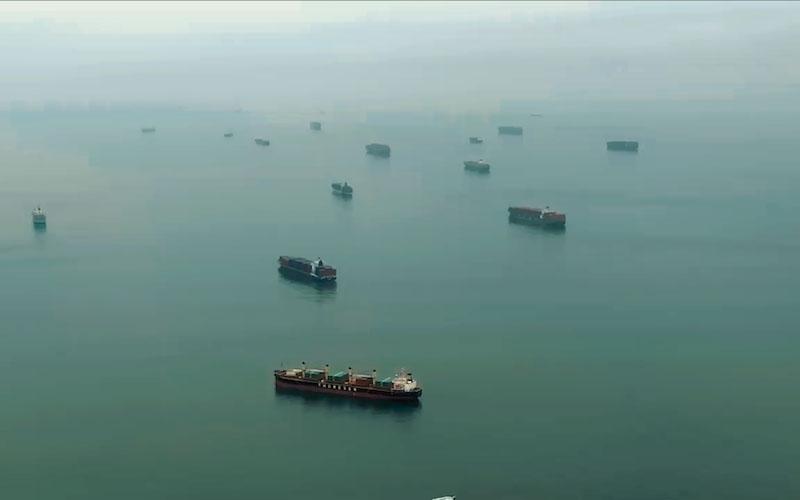
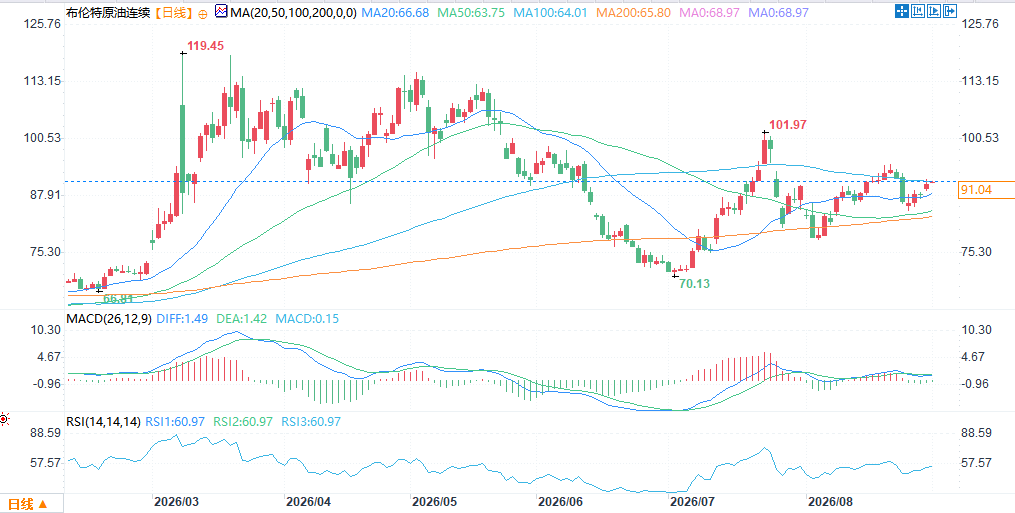 (Brent crude oil futures, source: EasyTrade) At 8:19 Beijing time, Brent crude oil futures were trading at $91.05 per barrel.
Ship-to-ship transport: a relay race around the Hormuz
Middle Eastern oil-producing countries are maintaining crude oil exports amid ongoing threats to the Strait of Hormuz through flexible methods such as ship-to-ship transshipment. According to data from Kpler and Goldman Sachs, Persian Gulf oil exports had rebounded to approximately 15-16 million barrels per day by mid-August. This level is still about 7-8 million barrels per day lower than pre-war levels, but 5-6 million barrels per day higher than the March low, indicating a significant improvement in logistical adaptability. Ship-to-ship transshipment is essentially a relay race: Gulf states (especially Kuwait, Qatar, the UAE, and Saudi Arabia) use state-owned or high-freight-paid shuttle tankers, taking the risk of traversing the most dangerous sections of the strait to transport crude oil to the relatively safer waters of the Gulf of Oman, where it is then transferred at sea to larger buyer tankers. State-owned oil companies are more willing to take this risk because their fleets and insurance arrangements are relatively flexible, while international commercial shipowners often refuse to directly enter high-risk areas. Many shuttle tankers operate in "dark mode" (disabling AIS tracking signals) to further reduce the probability of being monitored and attacked. This model has evolved from an emergency measure into a routine logistics solution. The UAE was among the first to initiate shuttle transport and restore high export levels, followed by Kuwait and Qatar, which recovered exports to approximately 70% of pre-war levels. Around 7-10 million barrels of oil are transported through the Straits daily, still below normal levels, but this has significantly alleviated the initial panic of a complete disruption. While ship-to-ship transshipment increases loading and unloading time and costs, it effectively bypasses the risk of direct blockades, becoming a key resilience mechanism for maintaining global crude oil supply.Market pricing disruptions will continue until 2027.
Goldman Sachs points out that the rapid adaptation of shipping companies and oil-producing countries indicates that the market is pricing in supply disruptions continuing into 2027, rather than a complete resolution in the short term. The increased scale of "dark voyages" by specialized carriers and the rise in ship-to-ship transshipment activities suggest that all parties have incorporated the protracted conflict into their operational expectations, and the physical market is reconstructing trade routes around the "semi-blockade" state. The continued "dark voyages" complicate actual flow estimates. Significant discrepancies often exist between commercial tracking agencies and official data: the US Energy Secretary stated that the US military has assisted in transporting over 15 million barrels of oil and products out of the Strait, with total regional exports, including pipelines, approaching 20 million barrels per day, and the 7-day moving average flow in the Strait exceeding 8 million barrels per day; it is claimed that the US military has effectively controlled most of the Strait of Hormuz. However, estimates from independent shipping analysts based on visible signals and satellite imagery often underestimate the impact because many ships have their transponders switched off. This data gap itself reflects the market's pricing in long-term disruptions. Goldman Sachs and other institutions believe that even if the disruption continues, the increase in dark voyages and transshipment will limit further upside potential for crude oil prices. Analysis indicates that in some scenarios, the flow of crude oil through the Strait of Hormuz may only recover to 40%-60% of pre-war levels by 2027, resulting in a continued deficit in the global crude oil market. The market has shifted from a binary judgment of "whether to completely shut down" to a more nuanced pricing strategy based on "how many barrels can pass through each day and for how long," thus keeping the forward curve relatively tight.Refining margins hit record highs as supply bottlenecks shift downstream.
Despite improved crude oil flows, weekend clashes near the Straits of Hormuz still pushed WTI and Brent crude up nearly 3% on Monday. Brent rose about 3% in August, and WTI about 1.4%. Analysts point out that the more serious bottleneck has shifted from crude oil availability to downstream refining. Refining margins (crack spreads) for gasoline, heating oil, and diesel have climbed to record highs. The US diesel crack spread once exceeded $100 per barrel, and European and Asian middle distillate margins also hit record highs. This is mainly due to a combination of shocks: disruptions to the Hormuz and Red Sea shipping lanes led to a sharp decline in Middle Eastern refined product exports, a significant drop in refinery operating rates in the Gulf region, continued attacks on Russian refineries restricting diesel supply, and low global refined product inventories. Crude oil itself can gradually recover through shuttle and transshipment, but refined product logistics are more complex and costly, resulting in a significantly slower recovery. The supply bottleneck has therefore shifted from "whether there is crude oil" to "whether refined products can be refined and shipped out in a timely manner." The United States is hoping that an agreement with Venezuela will increase additional crude oil supplies to alleviate domestic gasoline price pressures and is attempting to partially offset global refined product shortages by increasing the utilization rate of its domestic refineries. In the short term, high refining margins will incentivize global available refining capacity to operate at full capacity. However, if Middle Eastern refineries and export channels cannot substantially recover, the tight situation in the refined product market may persist for a longer period, providing sustained support for end-fuel prices.Brent crude oil: Ship-to-ship transshipment ensures stable supply expectations, but geopolitical risk premiums remain high.
The widespread adoption of ship-to-ship transshipment has had a dual impact on Brent crude oil prices. On the one hand, Persian Gulf exports have rebounded to 15-16 million barrels per day, effectively alleviating extreme market concerns about a complete disruption of the Strait of Hormuz and helping Brent crude establish a temporary equilibrium around $90 per barrel. Goldman Sachs points out that the market has shifted from a narrative of "short-term supply shocks" to a long-term pricing framework of "disruptions lasting until 2027," meaning that the current price level of $90 per barrel may be seen as the "new normal" rather than a temporary risk premium. On the other hand, ship-to-ship transshipment cannot completely replace normal strait traffic. Current flow is still 7-8 million barrels per day lower than pre-war levels, and ship-to-ship transshipment involves higher transportation costs, insurance premiums, and time delays—costs ultimately reflected in oil prices. More importantly, refining margins have climbed to record highs, indicating that the supply bottleneck has shifted from crude oil availability to refining capacity. This means that even if crude oil flow remains stable, refined product supply may still be tight, indirectly supporting Brent crude oil prices. Weekend clashes near the Straits of Vale pushed Brent crude futures up nearly 3% on Monday. In the short term, the "stabilizing" effect of ship-to-ship transshipment and the "risk premium" effect of geopolitical conflict are locked in a tug-of-war. If the conflict escalates further, Brent crude futures may break through to $95-100 per barrel; if the conflict maintains its current intensity, oil prices may fluctuate at a high level in the $88-92 per barrel range. The evolution of refining margins and alternative supply sources will be key variables determining the central level of oil prices. (Brent crude oil futures, source: EasyTrade) At 8:19 Beijing time, Brent crude oil futures were trading at $91.05 per barrel.
- Risk Warning and Disclaimer
- The market involves risk, and trading may not be suitable for all investors. This article is for reference only and does not constitute personal investment advice, nor does it take into account certain users’ specific investment objectives, financial situation, or other needs. Any investment decisions made based on this information are at your own risk.