Will the Bank of Japan really continue raising interest rates? Bank of Japan officials provide guidance.
2026-10-15 13:52:20
On Thursday (October 15) during Asian trading hours, the US dollar fell as much as 0.45% against the Japanese yen to around 157.58, a one-week low, and is currently trading around 157.87. Hawkish comments from Bank of Japan board member Junko Koeda drew market attention. Speaking to local business leaders in Kumamoto on Thursday, Koeda stated that given the significant upside risks to prices and still ample financial conditions, the Bank of Japan should not be overly cautious about raising interest rates. She pointed out that the neutral interest rate is likely well above 1%, while the current policy rate is only around 1.25%, suggesting that further rate hikes are still under consideration. This hawkish statement provided some support for the yen and may push up Japanese government bond yields. 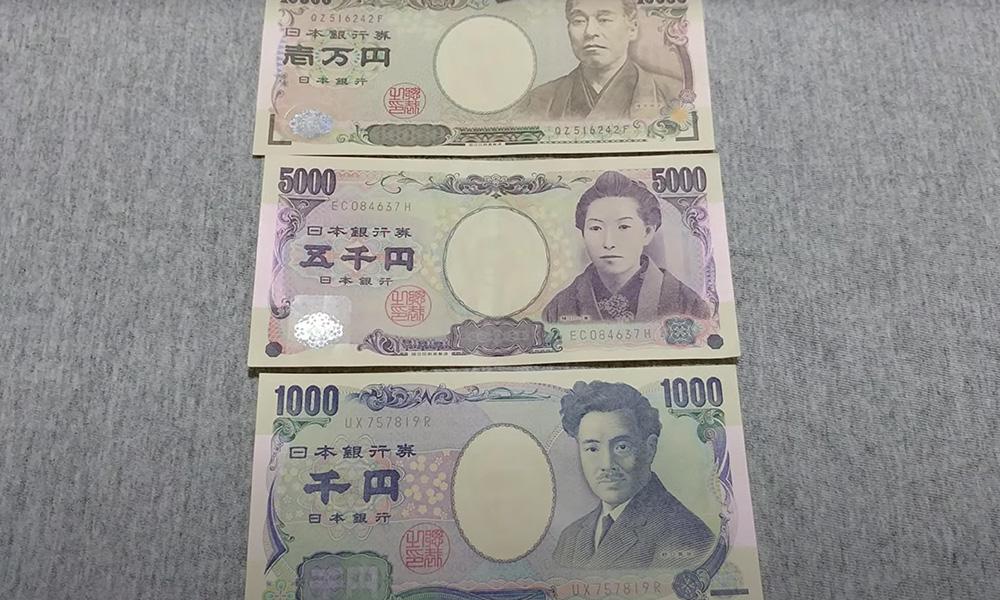
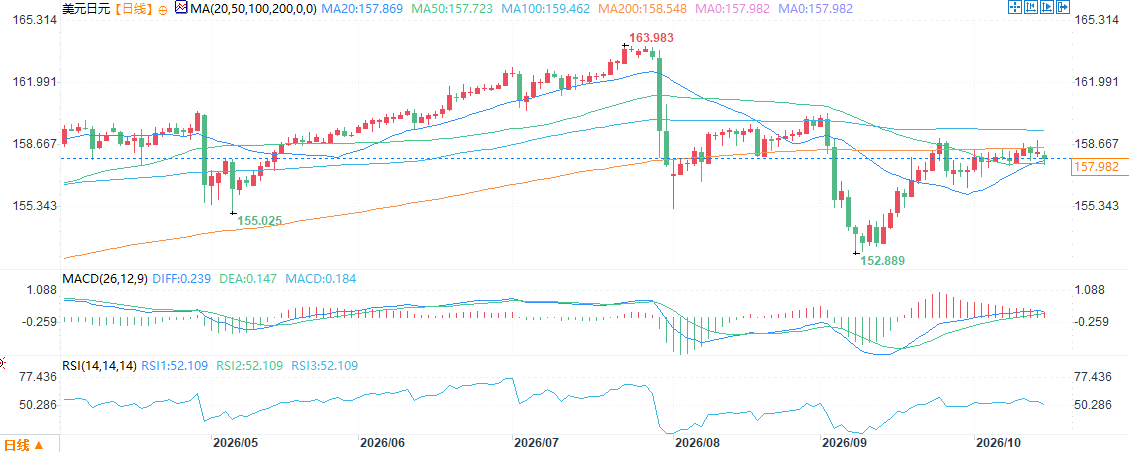 (USD/JPY daily chart, source: EasyForex) At 13:50 Beijing time, USD/JPY was trading at 157.87/88.
The neutral interest rate is much higher than the current policy interest rate.
Junko Koeda stated that the Bank of Japan should adjust its policy rate in a timely manner, while also referencing the estimated range for the neutral interest rate—a level that neither stimulates nor inhibits the economy. She believes the neutral interest rate is likely "well above 1%," with 1% roughly the lower limit of this estimated range; one estimate based on potential growth rates suggests the neutral interest rate could exceed 2%. The Bank of Japan's own estimates imply a nominal neutral interest rate between 1.1% and 2.5%. Following the Bank of Japan's September rate hike, the overnight call rate is currently around 1.25%. According to Koeda's logic, this means there is still room for further rate hikes. She emphasized that 1.25% is not the final destination, and the Bank of Japan should not allow caution to slow its progress towards the neutral interest rate.Underlying inflation is trending toward anchoring at 2%, with significant upside risks.
Junko Koeda points out that Japan's underlying inflation appears to be anchoring around the 2% target, consistent with the Bank of Japan's price stability objective. This is evidenced by: over 70% of the more than 500 items in the Consumer Price Index (CPI) showing year-on-year increases; a general upward shift in the distribution of price changes; and steady wage growth, making persistent inflation more robust than before. She specifically highlights several sources of upside risks to prices. First, geopolitical shocks, including the evolution of the Middle East situation since this spring, have repeatedly pushed up oil and commodity prices. Second, the yen's safe-haven appeal has weakened; during the previous escalation of the Middle East situation, the yen weakened rather than strengthened, and soaring oil prices increased import costs. Furthermore, strong growth in demand related to artificial intelligence has added further upward pressure on inflation.The overall economy is sound, and the normalization of balance sheets cannot be ignored.
Junko Koeda's overall assessment of the Japanese economy is positive: corporate profits are high, equipment investment is growing moderately, and wages continue to rise. She stated that rising interest rates are not expected to significantly dampen household consumption, and corporate financing conditions remain favorable. She also emphasized the necessity of continuing to normalize the Bank of Japan's balance sheet, noting its large size and underestimation. The Bank of Japan is gradually reducing its monthly government bond purchases and plans to maintain monthly purchases at approximately 2 trillion yen from April 2027.Market Impact: Hawkish signals support the yen, potentially putting upward pressure on government bond yields.
Junko Koeda's remarks were generally hawkish. Placing the neutral interest rate above the current policy rate of 1.25% and warning against excessive caution suggests that further rate hikes are still on the table. This should provide some support for the yen, especially given rising expectations of a Fed rate hike and narrowing interest rate differentials. Her observation that the yen has partially lost its safe-haven role is particularly important for currency traders—meaning that geopolitical shocks may hurt the yen by pushing up oil import costs rather than strengthening it. If market pricing moves towards the neutral interest rate path more quickly, Japanese government bond yields may face upward pressure.The expectation of narrowing interest rate differentials is rising, putting pressure on the USD/JPY exchange rate.
From an interest rate differential perspective, the USD/JPY exchange rate movement largely depends on the interest rate differential between the US and Japan. Koede placed the neutral interest rate above the current 1.25% policy rate and explicitly warned against excessive caution, fueling market expectations for further interest rate hikes by the Bank of Japan. Simultaneously, expectations for a Federal Reserve rate hike have also risen recently, but the simultaneous strengthening of expectations for a Bank of Japan rate hike means that the downside potential for USD/JPY in terms of interest rate differentials is compressed—the yen is no longer solely pressured by the widening US-Japan interest rate differential. More notably, Koede pointed out that the yen has partially lost its role as a safe-haven currency. In past geopolitical crises, the yen typically strengthened due to safe-haven buying; however, during the recent escalation of tensions in the Middle East, the yen weakened as soaring oil prices increased Japan's import costs. This shift is significant for USD/JPY traders: if another geopolitical shock occurs in the future, the yen may be pressured by deteriorating terms of trade rather than receiving safe-haven support, potentially giving USD/JPY upward momentum. In summary, Koeda's remarks are bearish for USD/JPY in the short term, but the weakening of the yen's safe-haven appeal provides potential downside support for the pair. Future trends will depend on the specific evolution of the policy paths of the Bank of Japan and the central banks of the US and Japan, as well as geopolitical risks.Summarize
Junko Koeda's core message is clear: 1.25% is not the end point, and the Bank of Japan should not allow caution to slow its rate hike pace. In her view, core inflation is trending towards 2%, upside risks to prices are significant, the economy is generally robust, and the neutral interest rate is far higher than current levels; therefore, further rate hikes are both reasonable and necessary. These hawkish remarks will provide short-term support for the yen and may push up Japanese government bond yields, while also reminding the market that the Bank of Japan's policy normalization process is far from over. (USD/JPY daily chart, source: EasyForex) At 13:50 Beijing time, USD/JPY was trading at 157.87/88.
- Risk Warning and Disclaimer
- The market involves risk, and trading may not be suitable for all investors. This article is for reference only and does not constitute personal investment advice, nor does it take into account certain users’ specific investment objectives, financial situation, or other needs. Any investment decisions made based on this information are at your own risk.