Behind the Canadian dollar's six-week high: narrowing interest rate spreads are the main reason; how long can oil prices hold up?
2026-10-30 14:04:23
The US dollar fell to a six-week low against the Canadian dollar during Asian trading hours on Friday (October 30), briefly touching 1.3958 before trading around 1.3970. This followed the Bank of Canada's initiation of a tightening cycle, which helped narrow the spread between Canadian and US bond yields. The spread between the yield on two-year Canadian government bonds and the yield on comparable US Treasury bonds narrowed by 4.7 basis points to approximately 128 basis points, still favoring US Treasuries. Earlier this month, the spread had reached as high as 160 basis points, the widest since February 2025. On Wednesday, the Bank of Canada raised its key interest rate by 25 basis points to 2.50%, indicating that further rate hikes might be necessary to prevent soaring energy costs from driving broader inflation; while the Federal Reserve kept its policy rate unchanged. Amo Sahota, director at Klarity FX in San Francisco, said the change in the yield spread "gave traders confidence to chase further gains in the Canadian dollar." He added, "Oil prices also remained high, providing some support for the Canadian dollar." U.S. crude oil futures fell 0.8% on hopes for U.S.-Iran peace talks, but remained above $102 per barrel. Oil is one of Canada's main exports. 
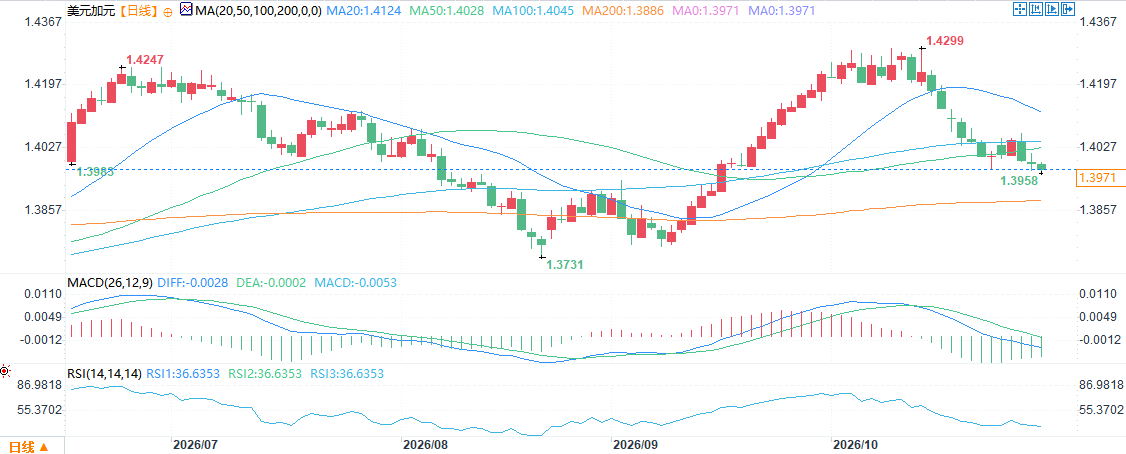 (USD/CAD daily chart, source: EasyForex) At 14:01 Beijing time, USD/CAD was trading at 1.3970/71.
Narrowing interest rate spreads are the core driver, with the Bank of Canada and the Federal Reserve exhibiting policy divergence.
The core logic behind the recent strength of the Canadian dollar lies in the divergence in monetary policy. The Bank of Canada raised interest rates by 25 basis points to 2.50% on Wednesday, leaving open the possibility of further tightening, while the Federal Reserve held rates steady. This relative change in short-term interest rates between the two countries directly narrowed the two-year interest rate spread between Canada and the US. The spread narrowed from 160 basis points earlier this month—the widest since February 2025—to approximately 128 basis points. This change provided traders with directional confidence to chase the Canadian dollar. It's important to note that 128 basis points still significantly favors US Treasuries; the narrowing spread is a marginal improvement rather than a reversal of the overall trend. The rise in the Canadian dollar is more of a valuation repair driven by a correction in expectations.High oil prices provide a second layer of support, but the US-Iran peace talks are causing disruptions.
Oil prices provide a second layer of support for the Canadian dollar. While US crude oil futures fell 0.8% due to hopes for US-Iran peace talks, they remained above $102 per barrel. Oil is Canada's main export commodity, and high oil prices directly improve Canada's terms of trade and export revenue. However, it should be noted that if progress in US-Iran peace talks continues, the risk premium for oil prices may further diminish, at which point this support will weaken marginally. The Canadian dollar currently benefits from both narrowing interest rate differentials and high oil prices; a reversal of either factor could weaken its upward momentum.Fiscal outlook: Ontario's widening deficit poses a medium-term variable.
A noteworthy medium-term variable has emerged on the fiscal front. Ontario, one of the world's largest subsistence borrowers, projected a larger budget deficit and a delayed return to break-even in its fiscal update. This is attributed to tax breaks for businesses and support for sectors heavily impacted by U.S. tariffs. While the expansion of provincial finances has a somewhat indirect impact on the Canadian dollar, the pressure on the fundamentals of Canadian exports from tariff shocks is a crucial factor in assessing the Canadian dollar's medium-term trajectory.in conclusion
The Canadian dollar's strong performance was primarily driven by the narrowing of the two-year Canada-US interest rate differential from 160 basis points to approximately 128 basis points following the Bank of Canada's rate hike, coupled with trade support provided by oil prices remaining high at $102 per barrel. However, the interest rate differential still significantly favors US Treasuries, and the narrowing is a marginal improvement rather than a reversal of the overall trend; if US-Iran negotiations progress, the support from oil prices will weaken. The short-term trend of the Canadian dollar depends on the Bank of Canada's subsequent rate hike path and the sustainability of the divergence between its policies and those of the Federal Reserve, while Ontario's widening deficit and the impact of tariffs constitute medium-term variables. (USD/CAD daily chart, source: EasyForex) At 14:01 Beijing time, USD/CAD was trading at 1.3970/71.
- Risk Warning and Disclaimer
- The market involves risk, and trading may not be suitable for all investors. This article is for reference only and does not constitute personal investment advice, nor does it take into account certain users’ specific investment objectives, financial situation, or other needs. Any investment decisions made based on this information are at your own risk.