Before the Federal Reserve meeting, silver decided to lie low for a few days and see how the market would develop.
2025-12-08 21:54:55
Monday, December 8th. Spot silver prices remained in a narrow range during the North American session, trading around $58.20 per ounce, continuing the consolidation trend of the previous few trading days. Market sentiment was predominantly cautious, with traders generally adopting a wait-and-see approach, awaiting the results of this week's Federal Reserve monetary policy meeting to further assess the future evolution of the global liquidity environment.
The current macroeconomic backdrop presents a complex interplay of signals: on the one hand, while US inflationary momentum has slowed, the trend is not yet stable, and employment market data shows structural divergence; on the other hand, geopolitical tensions continue to escalate locally, potentially supporting safe-haven assets. Against this backdrop, the pricing logic of the precious metals market is transitioning from being driven solely by interest rate expectations to a multi-factor game, and spot silver, as a commodity with both industrial and financial attributes, exhibits a more complex internal structure in its price fluctuations.
Recent US economic data shows signs of a marginal slowdown in the decline of inflation. As the price indicator most closely watched by the Federal Reserve, the personal consumption expenditure deflator, while showing a narrower year-on-year increase from its previous high in the latest statistical period, still saw a month-on-month growth rate higher than market expectations, reflecting continued strong price stickiness in the service sector. Meanwhile, the labor market exhibits a weak supply and demand pattern—the number of new private sector jobs is lower than the previous value, while initial jobless claims have declined. This seemingly contradictory data combination has increased the difficulty for policymakers in assessing future growth prospects. In this environment, market expectations for the pace and magnitude of the Fed's current rate-cutting cycle have shifted, with the previously widely anticipated scenario of continuous and rapid rate cuts being replaced by a more gradual easing path. This shift has pushed the yield on 10-year US Treasury bonds up slightly from its lows, and the US dollar index has also shown signs of stabilization, thus exerting temporary downward pressure on non-yielding precious metals.
Spot silver has been trading within the $57-$59 range over the past five trading days, exhibiting typical sideways consolidation characteristics in terms of technical pattern. COMEX silver futures non-commercial net long positions have decreased slightly compared to last week, indicating that large institutional traders are moderately reducing their risk exposure. This aligns with the neutral-to-low implied volatility in the options market, both pointing to the uncertainty surrounding the short-term direction.
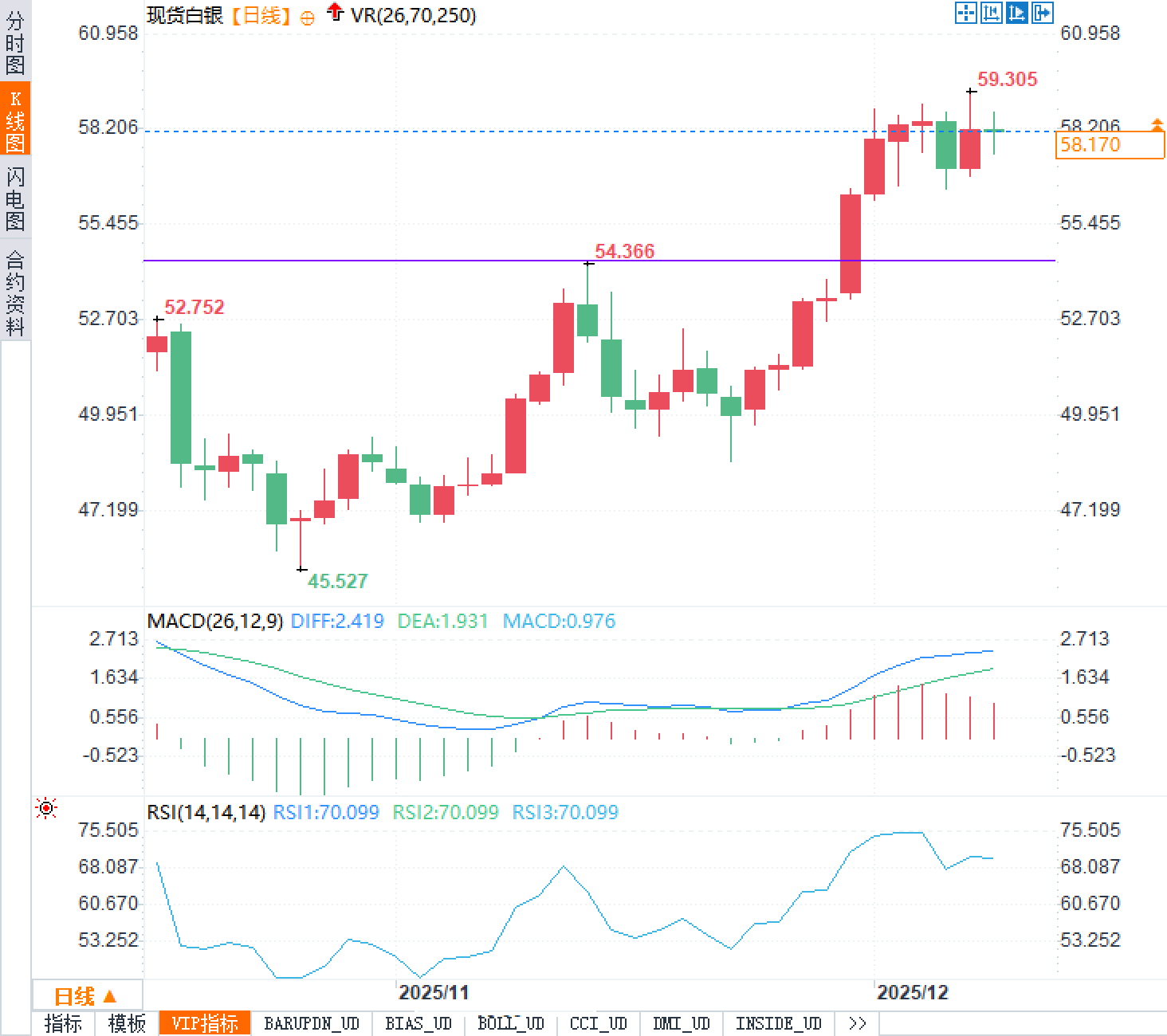
From the daily chart, spot silver has been in an upward trend since the low of around 45.527. After breaking through the previous consolidation zone, it accelerated, reaching a high of around 59.305. It then consolidated at higher levels, currently trading around $58.20. The candlestick body and upper shadow are intertwined, indicating repeated testing of the 58-59 range by both bulls and bears. The MACD lines are spreading above the zero line, and the histogram remains positive, reflecting that medium-term momentum still dominates; however, the RSI is around 70, entering a relatively high range, suggesting that short-term sentiment may be overheated, and a period of consolidation is more likely in a strong uptrend. Watch for resistance around 59.3 and 60; on the downside, focus on the stability of support around 55.5 and 52.7. The overall bullish trend remains intact, but increased turnover at high levels and sensitivity to news suggests that the pace may be shifting from a "fast-paced" to a "digestion" phase.
The core logic of the current commodity market remains a game between two main themes: "policy expectation correction" and "geopolitical risk premium." The upcoming interest rate decision and subsequent policy statement from the Federal Reserve will be a key litmus test for the rationality of market assumptions about the future path of interest rate cuts. If the official statement confirms a cautious and gradual approach to interest rate cuts, it may further solidify the attractiveness of dollar assets, thereby limiting the upside potential of precious metals; conversely, if a clearer easing signal is released, it could reignite market enthusiasm for asset revaluation in a low-interest-rate environment.
Meanwhile, the conflict between Russia and Ukraine continues to drag on, and diplomatic relations in parts of Southeast Asia are becoming increasingly tense. Although these events have not triggered a systemic crisis, their cumulative effects are gradually increasing the risk premium requirements of global capital, especially reflected in the prices of hard assets with safe-haven functions such as gold and silver.
The current macroeconomic backdrop presents a complex interplay of signals: on the one hand, while US inflationary momentum has slowed, the trend is not yet stable, and employment market data shows structural divergence; on the other hand, geopolitical tensions continue to escalate locally, potentially supporting safe-haven assets. Against this backdrop, the pricing logic of the precious metals market is transitioning from being driven solely by interest rate expectations to a multi-factor game, and spot silver, as a commodity with both industrial and financial attributes, exhibits a more complex internal structure in its price fluctuations.
Recent US economic data shows signs of a marginal slowdown in the decline of inflation. As the price indicator most closely watched by the Federal Reserve, the personal consumption expenditure deflator, while showing a narrower year-on-year increase from its previous high in the latest statistical period, still saw a month-on-month growth rate higher than market expectations, reflecting continued strong price stickiness in the service sector. Meanwhile, the labor market exhibits a weak supply and demand pattern—the number of new private sector jobs is lower than the previous value, while initial jobless claims have declined. This seemingly contradictory data combination has increased the difficulty for policymakers in assessing future growth prospects. In this environment, market expectations for the pace and magnitude of the Fed's current rate-cutting cycle have shifted, with the previously widely anticipated scenario of continuous and rapid rate cuts being replaced by a more gradual easing path. This shift has pushed the yield on 10-year US Treasury bonds up slightly from its lows, and the US dollar index has also shown signs of stabilization, thus exerting temporary downward pressure on non-yielding precious metals.
In terms of performance
Spot silver has been trading within the $57-$59 range over the past five trading days, exhibiting typical sideways consolidation characteristics in terms of technical pattern. COMEX silver futures non-commercial net long positions have decreased slightly compared to last week, indicating that large institutional traders are moderately reducing their risk exposure. This aligns with the neutral-to-low implied volatility in the options market, both pointing to the uncertainty surrounding the short-term direction.
From the daily chart, spot silver has been in an upward trend since the low of around 45.527. After breaking through the previous consolidation zone, it accelerated, reaching a high of around 59.305. It then consolidated at higher levels, currently trading around $58.20. The candlestick body and upper shadow are intertwined, indicating repeated testing of the 58-59 range by both bulls and bears. The MACD lines are spreading above the zero line, and the histogram remains positive, reflecting that medium-term momentum still dominates; however, the RSI is around 70, entering a relatively high range, suggesting that short-term sentiment may be overheated, and a period of consolidation is more likely in a strong uptrend. Watch for resistance around 59.3 and 60; on the downside, focus on the stability of support around 55.5 and 52.7. The overall bullish trend remains intact, but increased turnover at high levels and sensitivity to news suggests that the pace may be shifting from a "fast-paced" to a "digestion" phase.
Overall
The core logic of the current commodity market remains a game between two main themes: "policy expectation correction" and "geopolitical risk premium." The upcoming interest rate decision and subsequent policy statement from the Federal Reserve will be a key litmus test for the rationality of market assumptions about the future path of interest rate cuts. If the official statement confirms a cautious and gradual approach to interest rate cuts, it may further solidify the attractiveness of dollar assets, thereby limiting the upside potential of precious metals; conversely, if a clearer easing signal is released, it could reignite market enthusiasm for asset revaluation in a low-interest-rate environment.
Meanwhile, the conflict between Russia and Ukraine continues to drag on, and diplomatic relations in parts of Southeast Asia are becoming increasingly tense. Although these events have not triggered a systemic crisis, their cumulative effects are gradually increasing the risk premium requirements of global capital, especially reflected in the prices of hard assets with safe-haven functions such as gold and silver.
- Risk Warning and Disclaimer
- The market involves risk, and trading may not be suitable for all investors. This article is for reference only and does not constitute personal investment advice, nor does it take into account certain users’ specific investment objectives, financial situation, or other needs. Any investment decisions made based on this information are at your own risk.