The dollar attempted to recover its 50-day moving average ahead of the Federal Reserve meeting week.
2025-12-09 01:32:23
The dollar index edged higher in early U.S. trading on Monday (December 8), as traders attempted to recover the key 50-day moving average level of 99.169—holding this level would provide stability to the dollar's short-term momentum during the crucial Fed meeting week. Despite widespread market expectations that Wednesday's rate cut was already priced in, dollar positioning remained robust.
The 200-day moving average at 99.476 is putting downward pressure on the US dollar. Price movements remain highly sensitive to new policy signals and changes in US Treasury yields, and these factors continue to influence intraday fund flows in the US dollar.

Fundamental drivers: Can a "hawkish rate cut" strengthen the dollar's performance?
The market is well-prepared for a Federal Reserve rate cut, but analysts expect the Fed to adopt a hawkish tone, potentially offsetting the impact of this easing measure. If the Fed signals a more hawkish stance on the threshold for future rate cuts, it will support the dollar—this will narrow market expectations for the future path of easing and enhance the dollar's relative yield advantage. Internal divisions within the Fed have exacerbated uncertainty, with dissenting voices expected from both sides, reflecting a lack of consensus among policymakers on the pace of easing.
Speculative traders hold the largest long dollar positions since before the Trump-era tariffs. This strong positioning has supported the dollar index, with demand continuing despite three consecutive weeks of slight declines. Current US economic growth remains resilient, inflation remains above the 2% target, and fiscal stimulus from the latest government legislation is expected to provide further support. These factors reduce the urgency for further Fed rate cuts and are likely to limit the downside potential of the dollar index.
Foreign currency developments: Euro supported by yields, Canadian dollar holds steady, Japanese yen weakens.
The euro rose as high as 1.1672 against the dollar, driven by rising eurozone yields, with the yield on German 30-year bonds hitting its highest level since 2011. However, the euro subsequently gave back some of its gains. Rising European yields may attract capital outflows from the dollar, but the European Central Bank's stance of not ruling out further interest rate hikes complicates the overall environment.
The Canadian dollar remained solid after strong Canadian jobs data was released, reinforcing expectations that the Bank of Canada would maintain current interest rates, but the dollar's gains quickly faded. The yen weakened, pushing the dollar up to 155.986 against the yen; the pound held steady around 1.3325, while the Swiss franc slipped slightly. Despite traders assessing policy risks from various central banks, volatility in these cross-currency pairs provided broad support for the dollar.
Yields and Risk Environment: Treasury Yield Curve Stabilizes Ahead of Fed Meeting
U.S. Treasury yields rose across the board, with the 10-year yield near 4.182% and the 2-year yield at 3.606%. Rising yields typically support the dollar as they increase the relative returns of U.S. assets. Driven by weak labor market indicators and robust GDP expectations, the market is currently pricing in an 87% probability of a 25-basis-point rate cut by the Federal Reserve, up from 67% a month ago. Strong holiday season spending guidance has further solidified the overall U.S. economic fundamentals.
Technical Analysis: Focus on Key Moving Averages
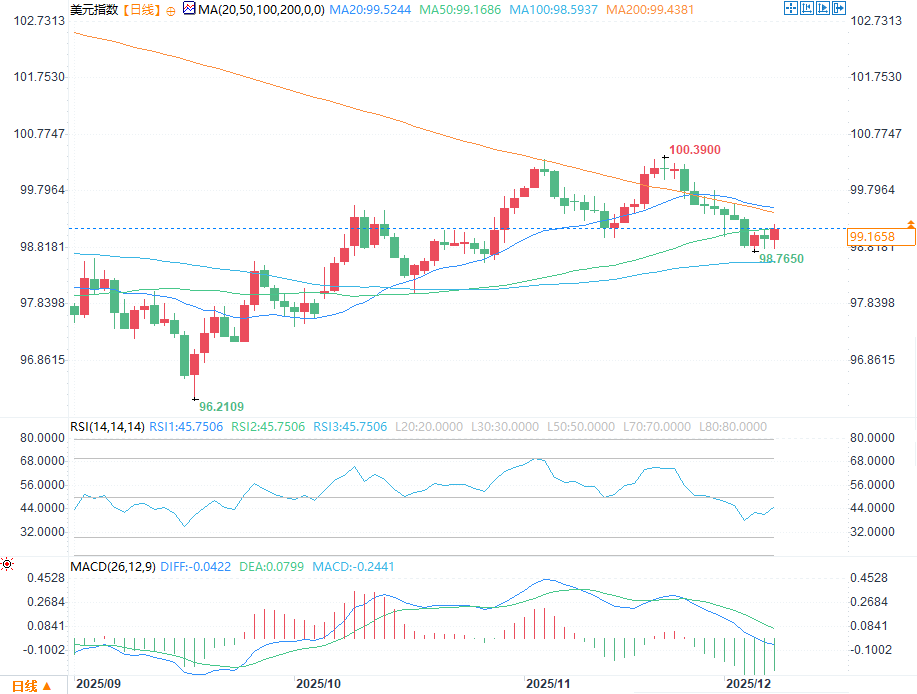
(US Dollar Index Daily Chart Source: FX678)
The US dollar index is currently testing the 50-day moving average at 99.169. A full recovery above this level would alleviate recent downward pressure, with the 200-day moving average at 99.476 acting as immediate resistance. Short-term support is at last week's low of 98.765; a break below this level would target 98.565, followed by a test of the 98.307-97.814 range. On the upside, the retracement range formed by the new trading range (100.395-98.765) is 99.580-99.772.
Forecast: If the US dollar holds its support level and recovers the 50-day moving average, its bullish momentum will remain intact.
Given the stabilization of US Treasury yields, strong dollar holdings, and market expectations of a hawkish rate cut, the overall outlook for the US dollar index would be moderately bullish if it could hold the 98.765 support level and recover the 50-day moving average. A recovery above this moving average would stabilize short-term momentum and maintain buying interest; failure to hold the support level would weaken the current trend structure, putting the dollar index under renewed selling pressure.
The 200-day moving average at 99.476 is putting downward pressure on the US dollar. Price movements remain highly sensitive to new policy signals and changes in US Treasury yields, and these factors continue to influence intraday fund flows in the US dollar.
Fundamental drivers: Can a "hawkish rate cut" strengthen the dollar's performance?
The market is well-prepared for a Federal Reserve rate cut, but analysts expect the Fed to adopt a hawkish tone, potentially offsetting the impact of this easing measure. If the Fed signals a more hawkish stance on the threshold for future rate cuts, it will support the dollar—this will narrow market expectations for the future path of easing and enhance the dollar's relative yield advantage. Internal divisions within the Fed have exacerbated uncertainty, with dissenting voices expected from both sides, reflecting a lack of consensus among policymakers on the pace of easing.
Speculative traders hold the largest long dollar positions since before the Trump-era tariffs. This strong positioning has supported the dollar index, with demand continuing despite three consecutive weeks of slight declines. Current US economic growth remains resilient, inflation remains above the 2% target, and fiscal stimulus from the latest government legislation is expected to provide further support. These factors reduce the urgency for further Fed rate cuts and are likely to limit the downside potential of the dollar index.
Foreign currency developments: Euro supported by yields, Canadian dollar holds steady, Japanese yen weakens.
The euro rose as high as 1.1672 against the dollar, driven by rising eurozone yields, with the yield on German 30-year bonds hitting its highest level since 2011. However, the euro subsequently gave back some of its gains. Rising European yields may attract capital outflows from the dollar, but the European Central Bank's stance of not ruling out further interest rate hikes complicates the overall environment.
The Canadian dollar remained solid after strong Canadian jobs data was released, reinforcing expectations that the Bank of Canada would maintain current interest rates, but the dollar's gains quickly faded. The yen weakened, pushing the dollar up to 155.986 against the yen; the pound held steady around 1.3325, while the Swiss franc slipped slightly. Despite traders assessing policy risks from various central banks, volatility in these cross-currency pairs provided broad support for the dollar.
Yields and Risk Environment: Treasury Yield Curve Stabilizes Ahead of Fed Meeting
U.S. Treasury yields rose across the board, with the 10-year yield near 4.182% and the 2-year yield at 3.606%. Rising yields typically support the dollar as they increase the relative returns of U.S. assets. Driven by weak labor market indicators and robust GDP expectations, the market is currently pricing in an 87% probability of a 25-basis-point rate cut by the Federal Reserve, up from 67% a month ago. Strong holiday season spending guidance has further solidified the overall U.S. economic fundamentals.
Technical Analysis: Focus on Key Moving Averages
(US Dollar Index Daily Chart Source: FX678)
The US dollar index is currently testing the 50-day moving average at 99.169. A full recovery above this level would alleviate recent downward pressure, with the 200-day moving average at 99.476 acting as immediate resistance. Short-term support is at last week's low of 98.765; a break below this level would target 98.565, followed by a test of the 98.307-97.814 range. On the upside, the retracement range formed by the new trading range (100.395-98.765) is 99.580-99.772.
Forecast: If the US dollar holds its support level and recovers the 50-day moving average, its bullish momentum will remain intact.
Given the stabilization of US Treasury yields, strong dollar holdings, and market expectations of a hawkish rate cut, the overall outlook for the US dollar index would be moderately bullish if it could hold the 98.765 support level and recover the 50-day moving average. A recovery above this moving average would stabilize short-term momentum and maintain buying interest; failure to hold the support level would weaken the current trend structure, putting the dollar index under renewed selling pressure.
- Risk Warning and Disclaimer
- The market involves risk, and trading may not be suitable for all investors. This article is for reference only and does not constitute personal investment advice, nor does it take into account certain users’ specific investment objectives, financial situation, or other needs. Any investment decisions made based on this information are at your own risk.