Gold Outlook: Spot gold struggles to move amid pressure from the bond market.
2025-12-09 02:15:44
Gold prices were relatively calm at the start of the week during the US session on Monday (December 8), with traders reluctant to open new positions ahead of the Federal Reserve's interest rate decision on Wednesday.
The US dollar index (DXY) traded around 99.07 during the session, having briefly fallen to 98.79 in the early Asian trading session before rebounding slightly. Meanwhile, US Treasury yields generally trended upward, with the benchmark 10-year Treasury yield currently approaching 4.180%, its highest level since September 26.
Last week, international gold prices remained relatively stable, consolidating recent gains as investors awaited clear direction from central bank interest rate meetings in the coming weeks. While gold is currently in an upward trend, uncertainty surrounding its future outlook is gradually increasing due to growing bearish factors (including rising bond yields).
The interplay between the seasonal weakening of the US dollar in December and the hawkish stance of central banks.
The seasonal weakness of the US dollar in December provided some support for gold prices to maintain their strength; however, at the same time, global market pricing in central bank interest rate hikes has also driven bond yields higher. Further increases in yields will inevitably weaken investors' willingness to increase their holdings of gold, a non-interest-bearing asset. Market focus has now shifted to the interest rate meetings of major central banks that begin this week.
Last week's US economic data was mixed, with some bright spots, but overall insufficient to shake the Federal Reserve's decision to cut interest rates this week. Currently, gold prices are partly supported by market expectations of imminent policy easing; therefore, the actual rate cut itself is unlikely to push gold prices higher this week—as this outcome has largely been priced in by the market. The market is more eager for the Fed to signal a more dovish policy stance in 2026, which could very well be the trigger for market disappointment. In fact, as the year draws to a close, a core consensus is gradually forming in the market: many G10 central banks have either reached the bottom of their interest rate cycle or are approaching it. Apart from the Bank of Japan maintaining its independent hawkish stance, the market has fully priced in expectations of 25 basis point rate hikes by the central banks of Australia, New Zealand, and Canada next year. Considering the recent hawkish comments from some European Central Bank officials and the recovery in Eurozone economic data, the Eurozone should also be included in this group.
Gold Outlook: Where Will This Rally End?
The recent rise in gold prices has been largely driven by multiple factors: the ongoing geopolitical tensions between Russia and Ukraine, the growing rhetoric of "de-dollarization," and the steady increase in gold holdings by central banks worldwide. However, once these well-known market drivers are removed, few other forces remain to support the upward trend in gold prices. This inevitably raises the question: how long can this rally last? Personally, I tend to believe that gold prices will experience a correction. The key question is: what will trigger this correction?
The next move by the People's Bank of China (PBOC) is a major uncertainty. If, given the current high gold prices, the PBOC begins to slow its gold purchases, leveraged long positions may be rapidly adjusted, and this process is unlikely to be gentle. Meanwhile, there are initial signs of easing geopolitical tensions: the peace negotiations in Ukraine are progressing slowly, a ceasefire agreement was recently reached in Gaza, and the trade dispute between China and the US has subsided. Theoretically, these factors should weaken gold's safe-haven premium, but gold prices have shown little reaction.
While a weak dollar has provided solid support for gold prices, the overall market atmosphere is unusually calm, as if everyone is quietly awaiting a larger upheaval. Furthermore, the movements in the Japanese market warrant attention. Rising expectations of a Bank of Japan interest rate hike are pushing up Japanese government bond yields, raising concerns that turmoil in the Japanese bond market could spread to global stock markets. Any unwinding of carry trades could easily spill over into the precious metals market, exerting double downward pressure on both gold and silver prices.
Technical Analysis and Trading Strategies
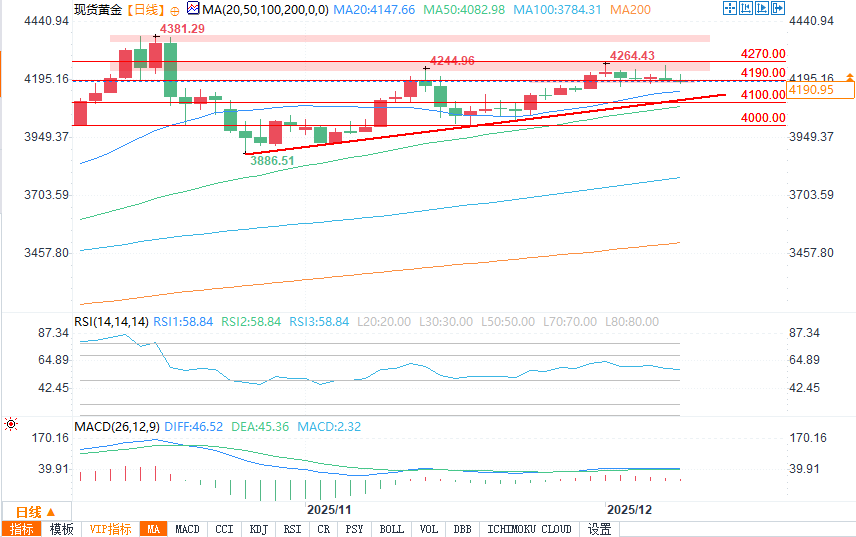
(Spot gold daily chart source: FX678)
From a technical perspective, while gold remains in an upward trend, its momentum is undoubtedly weakening, casting a shadow over its future outlook. If key support levels are breached, gold prices are highly likely to enter a period of short-term volatility.
The key focus on the current gold chart is the $4175-$4190 range, which represents the body of the gold price action and the lows of the past few trading days. If the price breaks below this range, the short-term trendline and the $4100 psychological level will re-emerge as the market focus – this price level is not only an important psychological barrier but also the starting point of the current rally. A daily closing price below $4100 would constitute a clear bearish signal, potentially leading to a test of the $4000 level.
On the upside, resistance lies in the $4220-$4270 range. This range was the starting point of gold's previous decline, and multiple attempts to recover this area have failed. Only if the bulls can strongly break through this resistance range can gold prices potentially challenge new historical highs again.
The US dollar index (DXY) traded around 99.07 during the session, having briefly fallen to 98.79 in the early Asian trading session before rebounding slightly. Meanwhile, US Treasury yields generally trended upward, with the benchmark 10-year Treasury yield currently approaching 4.180%, its highest level since September 26.
Last week, international gold prices remained relatively stable, consolidating recent gains as investors awaited clear direction from central bank interest rate meetings in the coming weeks. While gold is currently in an upward trend, uncertainty surrounding its future outlook is gradually increasing due to growing bearish factors (including rising bond yields).
The interplay between the seasonal weakening of the US dollar in December and the hawkish stance of central banks.
The seasonal weakness of the US dollar in December provided some support for gold prices to maintain their strength; however, at the same time, global market pricing in central bank interest rate hikes has also driven bond yields higher. Further increases in yields will inevitably weaken investors' willingness to increase their holdings of gold, a non-interest-bearing asset. Market focus has now shifted to the interest rate meetings of major central banks that begin this week.
Last week's US economic data was mixed, with some bright spots, but overall insufficient to shake the Federal Reserve's decision to cut interest rates this week. Currently, gold prices are partly supported by market expectations of imminent policy easing; therefore, the actual rate cut itself is unlikely to push gold prices higher this week—as this outcome has largely been priced in by the market. The market is more eager for the Fed to signal a more dovish policy stance in 2026, which could very well be the trigger for market disappointment. In fact, as the year draws to a close, a core consensus is gradually forming in the market: many G10 central banks have either reached the bottom of their interest rate cycle or are approaching it. Apart from the Bank of Japan maintaining its independent hawkish stance, the market has fully priced in expectations of 25 basis point rate hikes by the central banks of Australia, New Zealand, and Canada next year. Considering the recent hawkish comments from some European Central Bank officials and the recovery in Eurozone economic data, the Eurozone should also be included in this group.
Gold Outlook: Where Will This Rally End?
The recent rise in gold prices has been largely driven by multiple factors: the ongoing geopolitical tensions between Russia and Ukraine, the growing rhetoric of "de-dollarization," and the steady increase in gold holdings by central banks worldwide. However, once these well-known market drivers are removed, few other forces remain to support the upward trend in gold prices. This inevitably raises the question: how long can this rally last? Personally, I tend to believe that gold prices will experience a correction. The key question is: what will trigger this correction?
The next move by the People's Bank of China (PBOC) is a major uncertainty. If, given the current high gold prices, the PBOC begins to slow its gold purchases, leveraged long positions may be rapidly adjusted, and this process is unlikely to be gentle. Meanwhile, there are initial signs of easing geopolitical tensions: the peace negotiations in Ukraine are progressing slowly, a ceasefire agreement was recently reached in Gaza, and the trade dispute between China and the US has subsided. Theoretically, these factors should weaken gold's safe-haven premium, but gold prices have shown little reaction.
While a weak dollar has provided solid support for gold prices, the overall market atmosphere is unusually calm, as if everyone is quietly awaiting a larger upheaval. Furthermore, the movements in the Japanese market warrant attention. Rising expectations of a Bank of Japan interest rate hike are pushing up Japanese government bond yields, raising concerns that turmoil in the Japanese bond market could spread to global stock markets. Any unwinding of carry trades could easily spill over into the precious metals market, exerting double downward pressure on both gold and silver prices.
Technical Analysis and Trading Strategies
(Spot gold daily chart source: FX678)
From a technical perspective, while gold remains in an upward trend, its momentum is undoubtedly weakening, casting a shadow over its future outlook. If key support levels are breached, gold prices are highly likely to enter a period of short-term volatility.
The key focus on the current gold chart is the $4175-$4190 range, which represents the body of the gold price action and the lows of the past few trading days. If the price breaks below this range, the short-term trendline and the $4100 psychological level will re-emerge as the market focus – this price level is not only an important psychological barrier but also the starting point of the current rally. A daily closing price below $4100 would constitute a clear bearish signal, potentially leading to a test of the $4000 level.
On the upside, resistance lies in the $4220-$4270 range. This range was the starting point of gold's previous decline, and multiple attempts to recover this area have failed. Only if the bulls can strongly break through this resistance range can gold prices potentially challenge new historical highs again.
- Risk Warning and Disclaimer
- The market involves risk, and trading may not be suitable for all investors. This article is for reference only and does not constitute personal investment advice, nor does it take into account certain users’ specific investment objectives, financial situation, or other needs. Any investment decisions made based on this information are at your own risk.