The market awaits guidance from the Federal Reserve's interest rate cut and Powell's speech, causing the dollar index to decline slightly.
2025-12-11 00:18:19
The US dollar index edged lower during the US trading session on Wednesday (December 10). The market is preparing for the Federal Reserve's final policy meeting of the year, with widespread expectations that policymakers will cut interest rates by 25 basis points as anticipated, lowering the benchmark rate to a range of 3.5%–3.75%. For dollar traders, the key focus is not the rate cut itself, but rather the tone of Fed Chairman Jerome Powell's speech—he will clarify whether current policy is tight enough and whether further easing would lead to a rebound in inflation.
Prior to the decision, U.S. Treasury yields were generally flat, with the 10-year yield hovering around 4.178% and the 2-year yield around 3.602%. The stabilization of yields limited the dollar's upward momentum in early trading, but traders anticipated volatility in interest rates once Powell clarified the threshold for further policy adjustments.
The Fed's policy statement guides the dollar's future.
The market has already priced in a 90% probability of this rate cut, but internal disagreements within the Federal Open Market Committee (FOMC) have sown the seeds of market volatility. Some members hope to use policy adjustments to provide a buffer for the weakening labor market—October nonfarm payrolls fell by 218,000 while layoffs increased by 73,000—yet inflation remains stable at 2.8%.
For the foreign exchange market, this policy game has increased the discussion on "hawkish rate cuts," meaning that while cutting rates, the Federal Reserve will release a clear signal that the possibility of further easing in the short term is extremely low.
If Powell's remarks are more cautious, it will reinforce market expectations that "US real yields will not decline rapidly," thus supporting the dollar. Conversely, if he tacitly approves of further rate cuts in 2026—investors currently expect 2-4 rate cuts next year—it could put downward pressure on the dollar due to narrowing interest rate differentials.
Non-US currencies fluctuate in line with expectations of a Federal Reserve rate cut.
Cross-currency fund flows still depend on whether the Federal Reserve signals a prolonged pause in policy. A hawkish stance from the Fed typically puts pressure on high-beta currencies, prompting investors to seek more stable returns and thus supporting the dollar. However, if Powell's statements reveal greater flexibility, foreign exchange funds may flow back to risk-sensitive currency pairs, putting downward pressure on the dollar index.
Yields and risk sentiment constrained trading sentiment in the US dollar.
As of December, the stock market remained resilient, which to some extent curbed demand for the US dollar as a safe haven. Nevertheless, the options market still reflects high uncertainty, with market volatility expected to be closely linked to the Federal Reserve's policy statement and Powell's press conference.
Technical Analysis
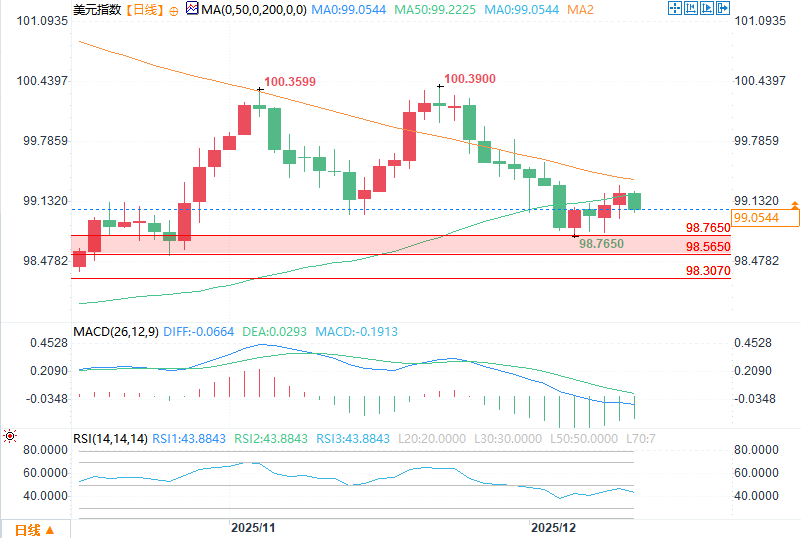
(US Dollar Index Daily Chart Source: FX678)
On the daily chart, the US dollar index is currently under pressure below the 50-day moving average (99.223). A decisive break above this level would likely lead to a further move towards the 200-day moving average (99.406), a key level considered a crucial signal for a potential acceleration in the dollar index's upward movement. Failure to break the 50-day moving average could see the index test the 98.765–98.565 support zone. A break below 98.565 would then further test the 98.307–97.814 support area.
Market forecast: Cautiously bullish on the US dollar in the short term.
Given the potential for a hawkish rate cut and Powell's possible emphasis on maintaining a tight monetary policy stance, the dollar's short-term trend is likely to be moderately bullish. Traders should be wary of the risk of two-way market volatility, but overall policy signals still point to limited easing, and yields are expected to provide support for the dollar.
At 00:16 Beijing time, the US dollar index was at 99.0428/594, down 0.19%.
Prior to the decision, U.S. Treasury yields were generally flat, with the 10-year yield hovering around 4.178% and the 2-year yield around 3.602%. The stabilization of yields limited the dollar's upward momentum in early trading, but traders anticipated volatility in interest rates once Powell clarified the threshold for further policy adjustments.
The Fed's policy statement guides the dollar's future.
The market has already priced in a 90% probability of this rate cut, but internal disagreements within the Federal Open Market Committee (FOMC) have sown the seeds of market volatility. Some members hope to use policy adjustments to provide a buffer for the weakening labor market—October nonfarm payrolls fell by 218,000 while layoffs increased by 73,000—yet inflation remains stable at 2.8%.
For the foreign exchange market, this policy game has increased the discussion on "hawkish rate cuts," meaning that while cutting rates, the Federal Reserve will release a clear signal that the possibility of further easing in the short term is extremely low.
If Powell's remarks are more cautious, it will reinforce market expectations that "US real yields will not decline rapidly," thus supporting the dollar. Conversely, if he tacitly approves of further rate cuts in 2026—investors currently expect 2-4 rate cuts next year—it could put downward pressure on the dollar due to narrowing interest rate differentials.
Non-US currencies fluctuate in line with expectations of a Federal Reserve rate cut.
Cross-currency fund flows still depend on whether the Federal Reserve signals a prolonged pause in policy. A hawkish stance from the Fed typically puts pressure on high-beta currencies, prompting investors to seek more stable returns and thus supporting the dollar. However, if Powell's statements reveal greater flexibility, foreign exchange funds may flow back to risk-sensitive currency pairs, putting downward pressure on the dollar index.
Yields and risk sentiment constrained trading sentiment in the US dollar.
As of December, the stock market remained resilient, which to some extent curbed demand for the US dollar as a safe haven. Nevertheless, the options market still reflects high uncertainty, with market volatility expected to be closely linked to the Federal Reserve's policy statement and Powell's press conference.
Technical Analysis
(US Dollar Index Daily Chart Source: FX678)
On the daily chart, the US dollar index is currently under pressure below the 50-day moving average (99.223). A decisive break above this level would likely lead to a further move towards the 200-day moving average (99.406), a key level considered a crucial signal for a potential acceleration in the dollar index's upward movement. Failure to break the 50-day moving average could see the index test the 98.765–98.565 support zone. A break below 98.565 would then further test the 98.307–97.814 support area.
Market forecast: Cautiously bullish on the US dollar in the short term.
Given the potential for a hawkish rate cut and Powell's possible emphasis on maintaining a tight monetary policy stance, the dollar's short-term trend is likely to be moderately bullish. Traders should be wary of the risk of two-way market volatility, but overall policy signals still point to limited easing, and yields are expected to provide support for the dollar.
At 00:16 Beijing time, the US dollar index was at 99.0428/594, down 0.19%.
- Risk Warning and Disclaimer
- The market involves risk, and trading may not be suitable for all investors. This article is for reference only and does not constitute personal investment advice, nor does it take into account certain users’ specific investment objectives, financial situation, or other needs. Any investment decisions made based on this information are at your own risk.