Ahead of the Fed Meeting: Global Markets "Rapidly" Price Indicators! Is the Dollar's Hegemony Facing a Challenge?
2025-12-09 09:20:35
Global markets are entering the final sprint ahead of the Federal Reserve's policy meeting on December 9-10, with markets increasingly convinced that the Fed is preparing to shift to an easing policy.
Federal Reserve watchers increasingly believe that interest rates, at their most restrictive level in over 20 years, are no longer suitable for an economy that is losing momentum on multiple fronts. Positioning in the stock, bond, and currency markets reflects this belief that data now more strongly suggests the need for policy readjustment.
The labor market—a long-standing argument for the Federal Reserve to maintain high interest rates—is showing more pronounced signs of cooling. While overall nonfarm payrolls remain positive, underlying indicators suggest that demand for workers is weakening .
Job vacancies have fallen sharply from their pandemic-era highs, hiring activity has eased, and wage growth across industries is slowing. Businesses have shifted from aggressive hiring to cautious adjustments, consistent with a labor market that is easing rather than overheating.
Given the long lag effect of monetary policy, forward-looking indicators are more important than retrospective aggregate statistics, which reinforces the view that a restrictive policy stance carries risks and may unnecessarily become a procyclical factor .
As the most resilient pillar of the U.S. economic recovery, household consumption is also showing signs of strain. The process of reducing excess savings accumulated during the pandemic has largely ended, and with borrowing costs remaining high, consumers are becoming more reliant on credit.
Rising delinquency rates and more discerning non-essential spending indicate that while the consumption engine continues to drive overall economic activity, it is no longer accelerating. This shift represents a turning point: the balance of risks has shifted from overheated inflation to policy tightening, which could exert a greater restraining effect on demand than policymakers anticipated .
Inflation dynamics have also changed significantly. Goods prices remain subdued, while services inflation is trending downward in line with softening wage pressures, and supply chains have returned to normal after years of disruption. Although inflation remains above the Federal Reserve's target, the likelihood of new upside shocks has diminished.
Policy interest rates were initially set for overheated economies, an environment that has since disappeared, and the cost of maintaining an overly restrictive policy stance is increasingly high. With inflation risks receding, stabilizing growth has become a more prominent issue .
Financial markets appear to have braced for policy adjustments. Stock indices have rebounded as expectations of easing have risen, with participation expanding from defensive sectors to cyclical and growth stocks. Investors interpret this shift in expectations as a more orderly approach, aligned with the current economic climate, rather than an emergency measure. Confirmation of an interest rate cut could reinforce market sentiment that the tightening cycle has ended.
The bond market has begun to price in expectations of a transition to a more accommodative environment. Lower Treasury yields are prompting investors to extend duration and reassess returns on fixed-income products after a prolonged period of contraction. Lower yields will contribute to an overall easing of financial conditions, supporting credit markets and refinancing activities.
A more accommodative policy stance will also impact the US dollar. Weaker yield support will encourage a gradual diversification of global capital flows, particularly towards economies where central banks have more room to maintain or widen real interest rate differentials.
Many emerging economies struggling due to a stronger dollar and global liquidity constraints are expected to benefit from the shift in US policy. The dollar index fluctuated around 99.10 on Tuesday (December 9).
The upcoming rate cut is expected to have an impact that extends beyond US borders, giving other central banks greater policy flexibility and helping to revive global investment flows. Amidst strengthening pre-meeting expectations, markets are signaling that the economic case for easing has clearly strengthened and the next phase of the global monetary cycle is approaching .
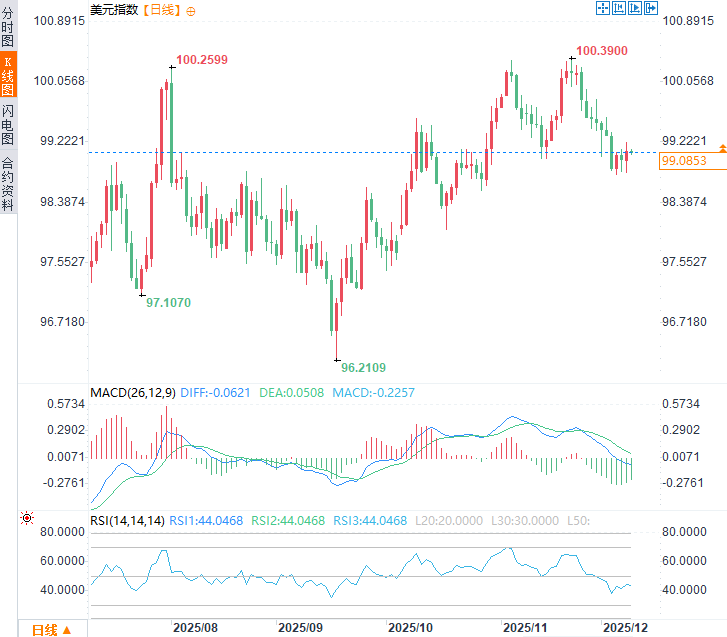
(US Dollar Index Daily Chart, Source: FX678)
At 9:19 Beijing time, the US dollar index is currently at 99.10.
Federal Reserve watchers increasingly believe that interest rates, at their most restrictive level in over 20 years, are no longer suitable for an economy that is losing momentum on multiple fronts. Positioning in the stock, bond, and currency markets reflects this belief that data now more strongly suggests the need for policy readjustment.
The US labor market is cooling down.
The labor market—a long-standing argument for the Federal Reserve to maintain high interest rates—is showing more pronounced signs of cooling. While overall nonfarm payrolls remain positive, underlying indicators suggest that demand for workers is weakening .
Job vacancies have fallen sharply from their pandemic-era highs, hiring activity has eased, and wage growth across industries is slowing. Businesses have shifted from aggressive hiring to cautious adjustments, consistent with a labor market that is easing rather than overheating.
Given the long lag effect of monetary policy, forward-looking indicators are more important than retrospective aggregate statistics, which reinforces the view that a restrictive policy stance carries risks and may unnecessarily become a procyclical factor .
As the most resilient pillar of the U.S. economic recovery, household consumption is also showing signs of strain. The process of reducing excess savings accumulated during the pandemic has largely ended, and with borrowing costs remaining high, consumers are becoming more reliant on credit.
US consumer spending engine no longer accelerates
Rising delinquency rates and more discerning non-essential spending indicate that while the consumption engine continues to drive overall economic activity, it is no longer accelerating. This shift represents a turning point: the balance of risks has shifted from overheated inflation to policy tightening, which could exert a greater restraining effect on demand than policymakers anticipated .
Inflation dynamics have also changed significantly. Goods prices remain subdued, while services inflation is trending downward in line with softening wage pressures, and supply chains have returned to normal after years of disruption. Although inflation remains above the Federal Reserve's target, the likelihood of new upside shocks has diminished.
Policy interest rates were initially set for overheated economies, an environment that has since disappeared, and the cost of maintaining an overly restrictive policy stance is increasingly high. With inflation risks receding, stabilizing growth has become a more prominent issue .
Financial markets prepare for policy adjustments
Financial markets appear to have braced for policy adjustments. Stock indices have rebounded as expectations of easing have risen, with participation expanding from defensive sectors to cyclical and growth stocks. Investors interpret this shift in expectations as a more orderly approach, aligned with the current economic climate, rather than an emergency measure. Confirmation of an interest rate cut could reinforce market sentiment that the tightening cycle has ended.
The bond market has begun to price in expectations of a transition to a more accommodative environment. Lower Treasury yields are prompting investors to extend duration and reassess returns on fixed-income products after a prolonged period of contraction. Lower yields will contribute to an overall easing of financial conditions, supporting credit markets and refinancing activities.
What does this mean for the US dollar?
A more accommodative policy stance will also impact the US dollar. Weaker yield support will encourage a gradual diversification of global capital flows, particularly towards economies where central banks have more room to maintain or widen real interest rate differentials.
Many emerging economies struggling due to a stronger dollar and global liquidity constraints are expected to benefit from the shift in US policy. The dollar index fluctuated around 99.10 on Tuesday (December 9).
The upcoming rate cut is expected to have an impact that extends beyond US borders, giving other central banks greater policy flexibility and helping to revive global investment flows. Amidst strengthening pre-meeting expectations, markets are signaling that the economic case for easing has clearly strengthened and the next phase of the global monetary cycle is approaching .
(US Dollar Index Daily Chart, Source: FX678)
At 9:19 Beijing time, the US dollar index is currently at 99.10.
- Risk Warning and Disclaimer
- The market involves risk, and trading may not be suitable for all investors. This article is for reference only and does not constitute personal investment advice, nor does it take into account certain users’ specific investment objectives, financial situation, or other needs. Any investment decisions made based on this information are at your own risk.