Gold prices showed resilience amid stalemate in US-Iran negotiations and bombing of Russian-Ukrainian facilities.
2026-02-18 14:31:29
Spot gold rebounded during the Asian and European sessions on Wednesday (February 18). The US held talks with both Ukraine and Iran last night, but the talks did not yield any significant results. Short sellers who had previously bet on a de-escalation of geopolitical tensions exited the market.
The international gold market is currently in a sensitive period with multiple key variables intertwined, with geopolitical tensions and expectations of Federal Reserve policy becoming the core twin engines driving gold prices.
ActivTrades analyst Ricardo Evangelista stated bluntly: "Traders are currently in a wait-and-see mode... waiting for the market to reach a clearer outcome in the US-Iran negotiations, and the release of the latest Federal Open Market Committee meeting minutes may affect market expectations for the Fed's interest rate path."
The tense standoff between the US and Iran is the core catalyst for gold's safe-haven appeal in the short term. The parallel diplomatic negotiations and military actions have exacerbated market concerns about the regional situation.
During the second round of indirect talks between the US and Iran in Geneva, US special envoys Steve Vitkov and Jared Kushner will hold consultations with Iranian Foreign Minister Abbas Araqchi under the mediation of Oman.
U.S. Vice President Vance stated that the U.S.-Iran talks held in Geneva, Switzerland that day progressed well on some issues, and both sides agreed to continue contact. This marks the second direct dialogue between the U.S. and Iran recently, following the talks in Oman.
Vance revealed that the US clearly drew some "red lines" for Iran during the negotiations, but Iran "has not yet truly acknowledged or is willing to resolve the issue through negotiation."
Vance reiterated that the United States' "core objective" is "not to have Iran possess nuclear weapons and not to have nuclear proliferation," and that with the increasing frequency of diplomatic contacts, the US-Iran nuclear negotiations have entered a critical stage of strategic maneuvering.
It is worth noting that Araghchi had met with the Director General of the International Atomic Energy Agency before the meeting to lay the technical foundation for the negotiations, but there are still no signs of compromise on the core differences between the two sides on the nuclear issue and the lifting of sanctions.
While the diplomatic process is progressing, is the atmosphere of military confrontation continuing to escalate? According to open-source flight radar data, another batch of 18 F-35 fighter jets and several refueling aircraft arrived in the Middle East yesterday, forming a military deterrent against Iran.
At the same time, Iran launched military exercises in the Strait of Hormuz in response to the US military deployment. More importantly, two US officials revealed that the US military is preparing for a multi-week military operation against Iran, and if the conflict were to occur, its severity would far exceed previous US-Iran frictions.
Furthermore, other reports indicate that Trump pledged in December of last year to support Israel's strikes against Iran's ballistic missile program should US-Iran negotiations break down. The US military and intelligence community are already discussing specific plans to assist Israel in airstrikes (including aerial refueling and overflight permits). The potential risk of military conflict continues to support safe-haven buying of gold.
Besides the US-Iran situation, another geopolitical focus is also affecting market sentiment: Ukraine and Russia are holding US-mediated peace talks in Geneva from Tuesday to Wednesday.
Although this is the third trilateral meeting in recent weeks, significant differences remain between Kyiv and Moscow on issues of territorial sovereignty and security guarantees, and the risk of a breakdown in negotiations has not been eliminated.
Despite recent military pressure from Russia, Zelenskyy stated that the Ukrainian people will not allow him to cede territory to Russia.
The Russian Ministry of Defense announced on the 17th that in the past day, the Russian military used high-precision weapons and drones to carry out large-scale strikes against Ukrainian military industrial facilities, energy infrastructure that supplies the needs of the Ukrainian army, and drone sites.
Russian air defense forces shot down eight Ukrainian-made guided-missile bombs and 334 drones.
Multiple locations in Russia's southwestern Krasnodar Krai were attacked by drones, and a localized fire broke out at an oil refinery after the attack. Ukrainian President Volodymyr Zelenskyy stated that Russia launched a large-scale joint strike against Ukrainian energy facilities, affecting 12 regions.
The General Staff of the Armed Forces of Ukraine reported on the 17th that Ukrainian forces shot down a Russian Ka-27 multi-purpose helicopter in Crimea in the early hours of the day and carried out an attack on a petrochemical company in Russia. The offensive and defensive operations between the two sides on energy facilities and targets deep in the country continue to escalate.
U.S. Special Envoy for the Middle East, Witkov: The United States hosted the third round of trilateral talks with Ukraine and Russia, and both sides agreed to brief their respective leaders and continue to work toward an agreement.
If geopolitics is the short-term driver of gold prices, then the direction of the Federal Reserve's monetary policy will determine the core direction of gold's medium-term trend. The meeting minutes to be released early Thursday morning are expected to provide a clear signal to the market.
The market is betting on the first interest rate cut in June. For gold, a non-interest-bearing asset, a rate cut by the Federal Reserve means a decrease in holding costs, which has always been the core logic driving gold prices higher.
According to the CME Group’s FedWatch Tool, the market currently widely expects the Fed to cut interest rates for the first time this year in June. This expectation has already been reflected in the gold price trend. After the Fed kept interest rates unchanged and raised its economic growth forecast at the end of January, spot gold still surged by more than 4.5% in a single day, reaching a historical high of $5,400 per ounce, which confirms the strong boost to gold prices from the expectation of policy easing.
The minutes of the January meeting will release important signals, and investors are closely watching the minutes of the Federal Reserve's January meeting, scheduled to be released early Thursday morning, to look for two key pieces of information: the Fed's assessment of the pace of the decline in inflation, and the disagreements among officials regarding the timing and magnitude of interest rate cuts.
If the minutes release a dovish signal (such as emphasizing the downward trend in inflation or mentioning the possibility of an early rate cut), it is expected to further strengthen market expectations for rate cuts and push gold prices above the $5,000/ounce mark. If it shows a hawkish tendency (such as concerns about sticky inflation or maintaining high interest rate guidance), it may trigger a short-term pullback in gold prices, but the medium- to long-term easing logic remains unchanged, and the pullback may become a buying opportunity.
Considering the two core variables of geopolitics and monetary policy, the current gold market is in a state of "short-term wait-and-see, medium- to long-term bullish" pattern.
In the short term, the market is in a cautious wait-and-see state due to the uncertainty of the US-Iran negotiations. Gold prices are fluctuating around the $5,000/ounce mark, waiting for the direction to be chosen after the key events (negotiation results, meeting minutes) are released.
However, the core logic supporting gold prices in the medium to long term remains unchanged: on the one hand, the root causes of geopolitical conflicts such as those between the US and Iran, and Russia and Ukraine, have not been resolved, and risk premiums will persist for a long time; on the other hand, the Fed's rate-cutting cycle has entered its final countdown, and the low-interest-rate environment coupled with expectations of a weaker dollar will continue to enhance the relative attractiveness of gold.
ActivTrades analyst Ricardo Evangelista added, "Amid geopolitical and economic uncertainty, this is expected to support safe-haven demand in the medium to long term. Coupled with dovish market expectations for the dollar, I believe gold prices will consolidate above $5,000 and rise further to $6,000 this year." For investors, it is crucial to closely monitor the progress of US-Iran negotiations, developments in the Middle East, and signals from the Federal Reserve meeting minutes to seize opportunities for phased allocation to safe-haven assets.
From a technical perspective, spot gold rebounded after adjusting to the lower channel line. Currently, it is being suppressed by the key level of 4944. If the gold price cannot break through and hold above 4944, it may face continued adjustment or even a bear market.
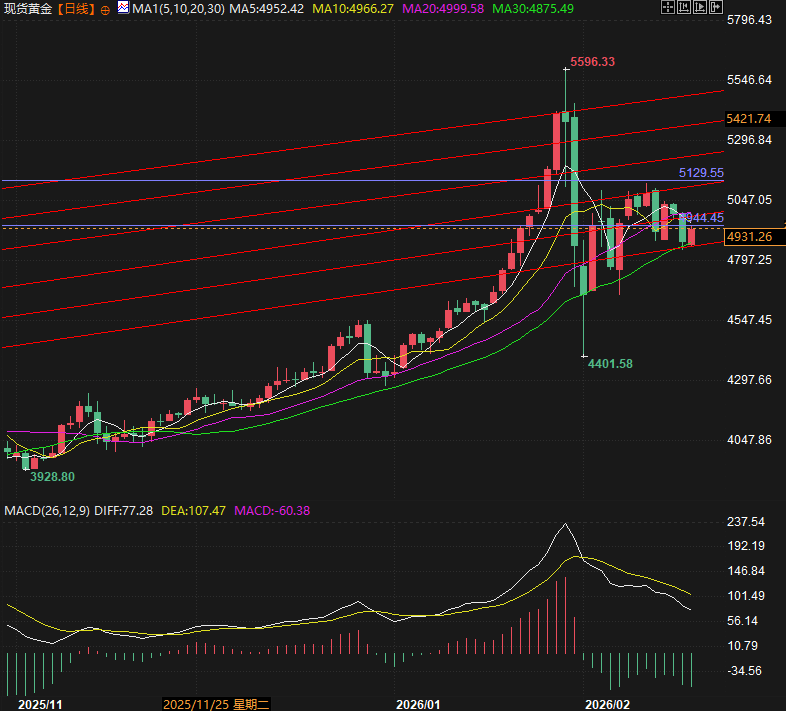
(Spot gold daily chart, source: FX678)
At 14:29 Beijing time, spot gold was trading at $4,930 per ounce.
The international gold market is currently in a sensitive period with multiple key variables intertwined, with geopolitical tensions and expectations of Federal Reserve policy becoming the core twin engines driving gold prices.
ActivTrades analyst Ricardo Evangelista stated bluntly: "Traders are currently in a wait-and-see mode... waiting for the market to reach a clearer outcome in the US-Iran negotiations, and the release of the latest Federal Open Market Committee meeting minutes may affect market expectations for the Fed's interest rate path."
Geopolitics: Uncertain outcome of US-Iran standoff provides strong support for safe-haven buying.
The tense standoff between the US and Iran is the core catalyst for gold's safe-haven appeal in the short term. The parallel diplomatic negotiations and military actions have exacerbated market concerns about the regional situation.
During the second round of indirect talks between the US and Iran in Geneva, US special envoys Steve Vitkov and Jared Kushner will hold consultations with Iranian Foreign Minister Abbas Araqchi under the mediation of Oman.
U.S. Vice President Vance stated that the U.S.-Iran talks held in Geneva, Switzerland that day progressed well on some issues, and both sides agreed to continue contact. This marks the second direct dialogue between the U.S. and Iran recently, following the talks in Oman.
Vance revealed that the US clearly drew some "red lines" for Iran during the negotiations, but Iran "has not yet truly acknowledged or is willing to resolve the issue through negotiation."
Vance reiterated that the United States' "core objective" is "not to have Iran possess nuclear weapons and not to have nuclear proliferation," and that with the increasing frequency of diplomatic contacts, the US-Iran nuclear negotiations have entered a critical stage of strategic maneuvering.
It is worth noting that Araghchi had met with the Director General of the International Atomic Energy Agency before the meeting to lay the technical foundation for the negotiations, but there are still no signs of compromise on the core differences between the two sides on the nuclear issue and the lifting of sanctions.
While the diplomatic process is progressing, is the atmosphere of military confrontation continuing to escalate? According to open-source flight radar data, another batch of 18 F-35 fighter jets and several refueling aircraft arrived in the Middle East yesterday, forming a military deterrent against Iran.
At the same time, Iran launched military exercises in the Strait of Hormuz in response to the US military deployment. More importantly, two US officials revealed that the US military is preparing for a multi-week military operation against Iran, and if the conflict were to occur, its severity would far exceed previous US-Iran frictions.
Furthermore, other reports indicate that Trump pledged in December of last year to support Israel's strikes against Iran's ballistic missile program should US-Iran negotiations break down. The US military and intelligence community are already discussing specific plans to assist Israel in airstrikes (including aerial refueling and overflight permits). The potential risk of military conflict continues to support safe-haven buying of gold.
Russia-Ukraine negotiations resume, but the future remains uncertain, increasing geopolitical risks and investment value.
Besides the US-Iran situation, another geopolitical focus is also affecting market sentiment: Ukraine and Russia are holding US-mediated peace talks in Geneva from Tuesday to Wednesday.
Although this is the third trilateral meeting in recent weeks, significant differences remain between Kyiv and Moscow on issues of territorial sovereignty and security guarantees, and the risk of a breakdown in negotiations has not been eliminated.
Despite recent military pressure from Russia, Zelenskyy stated that the Ukrainian people will not allow him to cede territory to Russia.
The Russian Ministry of Defense announced on the 17th that in the past day, the Russian military used high-precision weapons and drones to carry out large-scale strikes against Ukrainian military industrial facilities, energy infrastructure that supplies the needs of the Ukrainian army, and drone sites.
Russian air defense forces shot down eight Ukrainian-made guided-missile bombs and 334 drones.
Multiple locations in Russia's southwestern Krasnodar Krai were attacked by drones, and a localized fire broke out at an oil refinery after the attack. Ukrainian President Volodymyr Zelenskyy stated that Russia launched a large-scale joint strike against Ukrainian energy facilities, affecting 12 regions.
The General Staff of the Armed Forces of Ukraine reported on the 17th that Ukrainian forces shot down a Russian Ka-27 multi-purpose helicopter in Crimea in the early hours of the day and carried out an attack on a petrochemical company in Russia. The offensive and defensive operations between the two sides on energy facilities and targets deep in the country continue to escalate.
U.S. Special Envoy for the Middle East, Witkov: The United States hosted the third round of trilateral talks with Ukraine and Russia, and both sides agreed to brief their respective leaders and continue to work toward an agreement.
Federal Reserve Policy: Rate Cut Expectations Anchored in the Medium Term, Meeting Minutes Become Key Catalyst
If geopolitics is the short-term driver of gold prices, then the direction of the Federal Reserve's monetary policy will determine the core direction of gold's medium-term trend. The meeting minutes to be released early Thursday morning are expected to provide a clear signal to the market.
The market is betting on the first interest rate cut in June. For gold, a non-interest-bearing asset, a rate cut by the Federal Reserve means a decrease in holding costs, which has always been the core logic driving gold prices higher.
According to the CME Group’s FedWatch Tool, the market currently widely expects the Fed to cut interest rates for the first time this year in June. This expectation has already been reflected in the gold price trend. After the Fed kept interest rates unchanged and raised its economic growth forecast at the end of January, spot gold still surged by more than 4.5% in a single day, reaching a historical high of $5,400 per ounce, which confirms the strong boost to gold prices from the expectation of policy easing.
The minutes of the January meeting will release important signals, and investors are closely watching the minutes of the Federal Reserve's January meeting, scheduled to be released early Thursday morning, to look for two key pieces of information: the Fed's assessment of the pace of the decline in inflation, and the disagreements among officials regarding the timing and magnitude of interest rate cuts.
If the minutes release a dovish signal (such as emphasizing the downward trend in inflation or mentioning the possibility of an early rate cut), it is expected to further strengthen market expectations for rate cuts and push gold prices above the $5,000/ounce mark. If it shows a hawkish tendency (such as concerns about sticky inflation or maintaining high interest rate guidance), it may trigger a short-term pullback in gold prices, but the medium- to long-term easing logic remains unchanged, and the pullback may become a buying opportunity.
Summary and Technical Analysis:
Considering the two core variables of geopolitics and monetary policy, the current gold market is in a state of "short-term wait-and-see, medium- to long-term bullish" pattern.
In the short term, the market is in a cautious wait-and-see state due to the uncertainty of the US-Iran negotiations. Gold prices are fluctuating around the $5,000/ounce mark, waiting for the direction to be chosen after the key events (negotiation results, meeting minutes) are released.
However, the core logic supporting gold prices in the medium to long term remains unchanged: on the one hand, the root causes of geopolitical conflicts such as those between the US and Iran, and Russia and Ukraine, have not been resolved, and risk premiums will persist for a long time; on the other hand, the Fed's rate-cutting cycle has entered its final countdown, and the low-interest-rate environment coupled with expectations of a weaker dollar will continue to enhance the relative attractiveness of gold.
ActivTrades analyst Ricardo Evangelista added, "Amid geopolitical and economic uncertainty, this is expected to support safe-haven demand in the medium to long term. Coupled with dovish market expectations for the dollar, I believe gold prices will consolidate above $5,000 and rise further to $6,000 this year." For investors, it is crucial to closely monitor the progress of US-Iran negotiations, developments in the Middle East, and signals from the Federal Reserve meeting minutes to seize opportunities for phased allocation to safe-haven assets.
From a technical perspective, spot gold rebounded after adjusting to the lower channel line. Currently, it is being suppressed by the key level of 4944. If the gold price cannot break through and hold above 4944, it may face continued adjustment or even a bear market.
(Spot gold daily chart, source: FX678)
At 14:29 Beijing time, spot gold was trading at $4,930 per ounce.
- Risk Warning and Disclaimer
- The market involves risk, and trading may not be suitable for all investors. This article is for reference only and does not constitute personal investment advice, nor does it take into account certain users’ specific investment objectives, financial situation, or other needs. Any investment decisions made based on this information are at your own risk.