Federal Reserve Governor Milan: All the answers to questions about interest rate cuts, the AI impact, the dollar, and gold.
2026-02-20 10:07:13
In an interview on Wednesday (February 18), Federal Reserve Governor Stephen Milan offered insightful perspectives on hot topics such as the path of interest rates, inflation measurement, the impact of artificial intelligence on monetary policy, the development of the US dollar, and the management of the Federal Reserve's balance sheet. As one of the more active voices within the Federal Reserve, Milan's views reflect the complex considerations of current policymakers in balancing economic growth, price stability, and the evolution of the financial system.
Milan expressed high praise for President Trump's nominee for Federal Reserve Chairman, Kevin Warsh. He noted that Warsh has a strong reputation in areas such as monetary policy, balance sheet management, and interactions with the banking system, and is widely recognized in financial markets and policy circles.
Milan cited Rogoff's famous 1985 research, emphasizing that a Federal Reserve chairman with a "hawkish" reputation often gains more trust from the market, thus enjoying greater flexibility in implementing appropriate policies and achieving a better balance in monetary policy. He believes Warsh's appointment will inject significant value into the Federal Reserve and is "very excited" about it.
Milan sharply questions the reliability of current inflation measurements. He emphasizes that the overall price level is essentially an abstract concept, constructed by statisticians through thousands of methodological choices, and many decisions do not have a clearly "correct" answer. For example, the EU simply excludes the landlord's equivalent rent indicator from its housing inflation statistics because member states cannot reach a consensus.
Milan specifically pointed out two significant current deviations:
Portfolio management services : Their price calculation method simply tracks stock market performance, misrepresenting increases in asset value as price increases rather than quantity increases. This contributed 36 basis points to core inflation in the past year, far exceeding the historical average of 6 basis points, effectively lowering the inflation target implicitly.
Housing inflation : Measurements are severely lagging, with current data still reflecting the rental market 3-4 years ago, while current market rent growth has slowed to around 1%. More importantly, renewal rents from about a year ago have caught up with new rental rents, limiting landlords' room for further significant price increases. Future housing inflation measurements are expected to slow significantly.
Milan believes that if these biases are corrected, the current inflation performance is "actually not bad" .
Milan is sometimes perceived as "slow to react" to economic data. He denies this, citing as an example: In his economic forecasts for September to December 2025, he lowered the federal funds rate "dot plot" by 50 basis points by the end of 2026, mainly due to better-than-expected inflation and a weaker-than-expected labor market. However, with the recent slight recovery in the labor market and stabilization of commodity inflation, if he were to re-adjust the dot plot now, it could potentially rise back to the September level.
Milan emphasized that monetary policy has a 12-18 month lag effect, therefore decisions should be based on forecasts rather than simply relying on hindsight data. When forecasts are clear (such as the guiding role of market rents in future housing inflation), more emphasis should be placed on forward-looking analysis; data remains important because it can revise forecasts. He describes himself as "forecast-dependent" rather than "data-dependent," but he never ignores data.
Milan disagrees with Federal Reserve Vice Chairman Barr's view that the AI boom represents a structural shift and does not support interest rate cuts. He analyzes the impact of AI from the perspective of the three pillars of monetary policy:
Inflation : AI exhibits clear deflationary characteristics, suppressing prices by lowering production costs and increasing supply. The Federal Reserve has acknowledged that supply bottlenecks will drive up inflation in 2021-2022, while conversely, supply expansion (including technological advancements and deregulation) should have a symmetrical price-lowering effect.
Output gap : This is complex. The IT revolution of the 1990s approached a "gap neutrality" (actual and potential output grew in tandem due to the need for substantial investment and labor). AI may be somewhat similar (data centers, GPU investment), but if investment is less labor-intensive or flows overseas in large quantities, it could widen the positive output gap, supporting more lenient policies. A deregulation-driven productivity shock would almost certainly widen the gap (existing capital can increase production without large-scale new investment).
Neutral interest rate (r*): Long-term productivity gains will raise r, but Milan argues that factors such as slowing population growth and fluctuations in national savings due to fiscal deficits have a more quantifiable and dominant impact on r. Currently, no one can reliably predict the specific impact of AI on long-term productivity.
Furthermore, while AI may eliminate some jobs, historically, technological progress has always been "creative destruction"—destroying old jobs while creating new ones (such as the "social media advertising strategist" that emerged in the social media era). Milan believes the Federal Reserve should provide accommodative support during this period of structural transformation . He generally leans towards believing that AI factors support a more accommodative monetary policy, but emphasizes the difficulty of quantifying this.
In response to Europe's push for a euro-pegged stablecoin and a digital euro to enhance the euro's international role, Milan believes the dollar's structural dominance will not face substantial challenges. Simply adding "packaging" to fragmented markets is insufficient to build a deep infrastructure comparable to the dollar. Deeper reforms, such as eurobonds, involve issues of sovereignty and democracy and should be decided by Europe itself.
As for the impact of the US dollar offering yields that compete with bank deposits, the effect on monetary policy transmission would be limited, but the potential impact on financial stability is still under study and no conclusion has been reached.
Milan believes there is no need to rush back to a "scarce reserve" system. Through gradual regulatory reforms (such as relaxing liquidity coverage ratio requirements), the threshold between "ample reserves" and "scarce reserves" can be lowered, thereby achieving balance sheet reduction while maintaining sufficient reserves, alleviating the regulatory burden on banks, and improving credit transmission efficiency. He disagrees with the view that balance sheet reduction itself inevitably brings financial stability risks, emphasizing that the key lies in adjusting regulatory boundaries.
He also observed that administrative interest rates (such as the IORB) have dominated the secured funding market, while the importance of the federal funds market has significantly declined. If there is a substantial reduction in the balance sheet and the implementation of "super-relaxed" regulations in the future, it may be necessary to rethink the operational framework accordingly.
Milan acknowledged the mechanical and close linkage between Treasury bond issuance, reserve levels, and money market conditions (the Federal Reserve needs to passively respond to fluctuations in the fiscal account). However, he emphasized that the two institutions should each perform their respective duties, requiring only mutual information rather than routine coordination. In extreme circumstances (such as a sharp shift by the Federal Reserve towards short-term Treasury bills leading to a supply shortage), communication might be necessary, but this is not currently a realistic risk.
Milan remains unfazed by the surge in gold prices, believing that the gold market has limited liquidity and its prices are easily driven by small amounts of capital. It is influenced by factors such as US interest rates and geopolitics, but it is difficult to extract clear signals of the Federal Reserve's policies from these factors.
Overall, Milan's statements indicate a relatively optimistic outlook on inflation, an openness to positive supply-side factors such as AI, and continued confidence in the US dollar. His slight adjustment to the 2026 interest rate path (slightly more conservative than his December forecast) is data-driven.
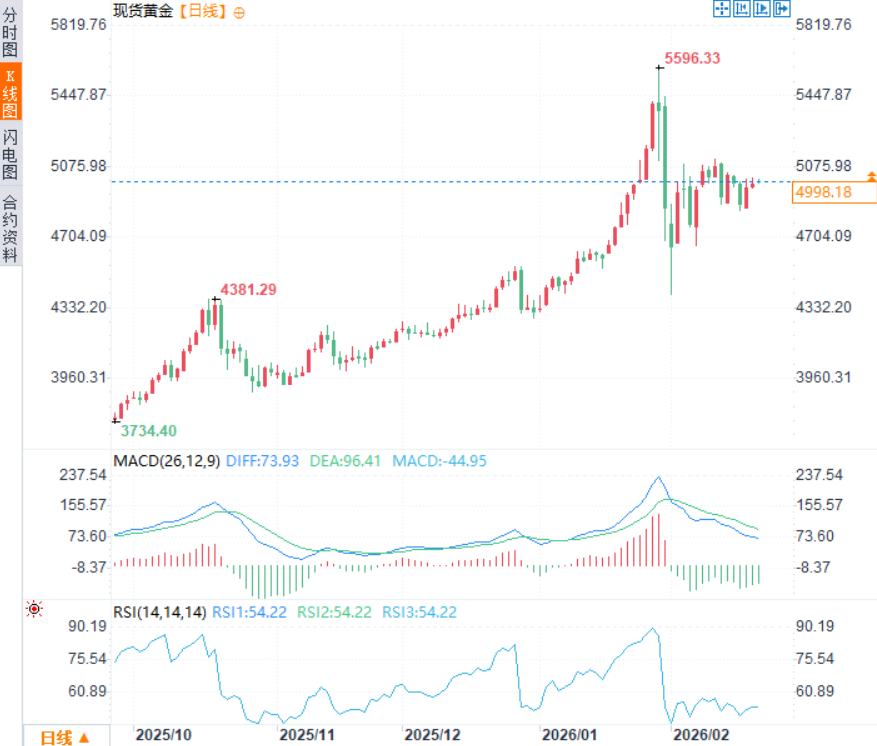
(Spot gold daily chart, source: FX678)
At 10:06 Beijing time, spot gold was trading at $5006.53 per ounce.
Expectations for Kevin Warsh, the future chairman of the Federal Reserve
Milan expressed high praise for President Trump's nominee for Federal Reserve Chairman, Kevin Warsh. He noted that Warsh has a strong reputation in areas such as monetary policy, balance sheet management, and interactions with the banking system, and is widely recognized in financial markets and policy circles.
Milan cited Rogoff's famous 1985 research, emphasizing that a Federal Reserve chairman with a "hawkish" reputation often gains more trust from the market, thus enjoying greater flexibility in implementing appropriate policies and achieving a better balance in monetary policy. He believes Warsh's appointment will inject significant value into the Federal Reserve and is "very excited" about it.
Distortions in Inflation Data vs. the Real Trend
Milan sharply questions the reliability of current inflation measurements. He emphasizes that the overall price level is essentially an abstract concept, constructed by statisticians through thousands of methodological choices, and many decisions do not have a clearly "correct" answer. For example, the EU simply excludes the landlord's equivalent rent indicator from its housing inflation statistics because member states cannot reach a consensus.
Milan specifically pointed out two significant current deviations:
Portfolio management services : Their price calculation method simply tracks stock market performance, misrepresenting increases in asset value as price increases rather than quantity increases. This contributed 36 basis points to core inflation in the past year, far exceeding the historical average of 6 basis points, effectively lowering the inflation target implicitly.
Housing inflation : Measurements are severely lagging, with current data still reflecting the rental market 3-4 years ago, while current market rent growth has slowed to around 1%. More importantly, renewal rents from about a year ago have caught up with new rental rents, limiting landlords' room for further significant price increases. Future housing inflation measurements are expected to slow significantly.
Milan believes that if these biases are corrected, the current inflation performance is "actually not bad" .
Clarification of Market Misinterpretations of its Policy Framework
Milan is sometimes perceived as "slow to react" to economic data. He denies this, citing as an example: In his economic forecasts for September to December 2025, he lowered the federal funds rate "dot plot" by 50 basis points by the end of 2026, mainly due to better-than-expected inflation and a weaker-than-expected labor market. However, with the recent slight recovery in the labor market and stabilization of commodity inflation, if he were to re-adjust the dot plot now, it could potentially rise back to the September level.
Milan emphasized that monetary policy has a 12-18 month lag effect, therefore decisions should be based on forecasts rather than simply relying on hindsight data. When forecasts are clear (such as the guiding role of market rents in future housing inflation), more emphasis should be placed on forward-looking analysis; data remains important because it can revise forecasts. He describes himself as "forecast-dependent" rather than "data-dependent," but he never ignores data.
AI productivity impact and monetary policy orientation
Milan disagrees with Federal Reserve Vice Chairman Barr's view that the AI boom represents a structural shift and does not support interest rate cuts. He analyzes the impact of AI from the perspective of the three pillars of monetary policy:
Inflation : AI exhibits clear deflationary characteristics, suppressing prices by lowering production costs and increasing supply. The Federal Reserve has acknowledged that supply bottlenecks will drive up inflation in 2021-2022, while conversely, supply expansion (including technological advancements and deregulation) should have a symmetrical price-lowering effect.
Output gap : This is complex. The IT revolution of the 1990s approached a "gap neutrality" (actual and potential output grew in tandem due to the need for substantial investment and labor). AI may be somewhat similar (data centers, GPU investment), but if investment is less labor-intensive or flows overseas in large quantities, it could widen the positive output gap, supporting more lenient policies. A deregulation-driven productivity shock would almost certainly widen the gap (existing capital can increase production without large-scale new investment).
Neutral interest rate (r*): Long-term productivity gains will raise r, but Milan argues that factors such as slowing population growth and fluctuations in national savings due to fiscal deficits have a more quantifiable and dominant impact on r. Currently, no one can reliably predict the specific impact of AI on long-term productivity.
Furthermore, while AI may eliminate some jobs, historically, technological progress has always been "creative destruction"—destroying old jobs while creating new ones (such as the "social media advertising strategist" that emerged in the social media era). Milan believes the Federal Reserve should provide accommodative support during this period of structural transformation . He generally leans towards believing that AI factors support a more accommodative monetary policy, but emphasizes the difficulty of quantifying this.
The dollar's status is hard to shake.
In response to Europe's push for a euro-pegged stablecoin and a digital euro to enhance the euro's international role, Milan believes the dollar's structural dominance will not face substantial challenges. Simply adding "packaging" to fragmented markets is insufficient to build a deep infrastructure comparable to the dollar. Deeper reforms, such as eurobonds, involve issues of sovereignty and democracy and should be decided by Europe itself.
As for the impact of the US dollar offering yields that compete with bank deposits, the effect on monetary policy transmission would be limited, but the potential impact on financial stability is still under study and no conclusion has been reached.
Balance sheet contraction and regulatory leadership
Milan believes there is no need to rush back to a "scarce reserve" system. Through gradual regulatory reforms (such as relaxing liquidity coverage ratio requirements), the threshold between "ample reserves" and "scarce reserves" can be lowered, thereby achieving balance sheet reduction while maintaining sufficient reserves, alleviating the regulatory burden on banks, and improving credit transmission efficiency. He disagrees with the view that balance sheet reduction itself inevitably brings financial stability risks, emphasizing that the key lies in adjusting regulatory boundaries.
He also observed that administrative interest rates (such as the IORB) have dominated the secured funding market, while the importance of the federal funds market has significantly declined. If there is a substantial reduction in the balance sheet and the implementation of "super-relaxed" regulations in the future, it may be necessary to rethink the operational framework accordingly.
The linkage between government bond issuance, reserves, and the money market
Milan acknowledged the mechanical and close linkage between Treasury bond issuance, reserve levels, and money market conditions (the Federal Reserve needs to passively respond to fluctuations in the fiscal account). However, he emphasized that the two institutions should each perform their respective duties, requiring only mutual information rather than routine coordination. In extreme circumstances (such as a sharp shift by the Federal Reserve towards short-term Treasury bills leading to a supply shortage), communication might be necessary, but this is not currently a realistic risk.
Gold prices have no policy implications
Milan remains unfazed by the surge in gold prices, believing that the gold market has limited liquidity and its prices are easily driven by small amounts of capital. It is influenced by factors such as US interest rates and geopolitics, but it is difficult to extract clear signals of the Federal Reserve's policies from these factors.
Overall, Milan's statements indicate a relatively optimistic outlook on inflation, an openness to positive supply-side factors such as AI, and continued confidence in the US dollar. His slight adjustment to the 2026 interest rate path (slightly more conservative than his December forecast) is data-driven.
(Spot gold daily chart, source: FX678)
At 10:06 Beijing time, spot gold was trading at $5006.53 per ounce.
- Risk Warning and Disclaimer
- The market involves risk, and trading may not be suitable for all investors. This article is for reference only and does not constitute personal investment advice, nor does it take into account certain users’ specific investment objectives, financial situation, or other needs. Any investment decisions made based on this information are at your own risk.