The US dollar is trending stronger, and multiple factors combined suggest further upside potential.
2026-02-20 20:45:57
On Friday (February 20), during the European session, the US dollar index fluctuated between 97.75 and 98.05 during the Asian session, with a clear battle between bulls and bears. After entering the European session, the price stabilized above 97.88, and the short-term bullish trend strengthened. Currently, the US dollar is showing a clear trend of strengthening amid fluctuations, and under the influence of multiple factors such as geopolitics, policy, and data, there is still ample room for further rebound.
The core fundamental support lies in the resonance between geopolitical factors, monetary attributes, and Federal Reserve policies.
Geopolitical factors have become the core variable dominating the current dollar trend, with escalating tensions between the US and Iran overshadowing most other market factors. Since early February, international oil prices have been highly correlated with Polymarket's prediction of the probability of a US strike against Iran before March 31st. This probability has now risen to 60%, on par with the level at the end of January, corresponding to the Brent crude oil price fluctuation of $71-72 per barrel at the end of January. Extrapolating from this correlation, if the probability of a strike rises to 100%, oil prices are expected to climb to the $75-76 per barrel range.
Whether crude oil prices can continue to rise sharply hinges on whether Iran will block the Strait of Hormuz. Polymarket forecasts indicate that the probability is 18% by the end of March and will rise to 35% by the end of the year. Currently, only a portion of this is priced in, leaving room for further price increases, which will continue to support the US dollar. Meanwhile, the US military deployment in the Middle East is the largest since 2003, which cannot be simply viewed as a deterrent to negotiations. The UN has warned that this move could close diplomatic channels. Coupled with the contradiction between Trump's hints of a "10-15 day nuclear agreement timeframe" and "rumors of limited preemptive strikes," this further exacerbates market uncertainty and drives safe-haven funds into the US dollar.
The US dollar's safe-haven appeal has further strengthened its upward momentum, a characteristic particularly prominent against the backdrop of an impending oil crisis. As a traditional safe-haven currency, the dollar's appeal typically weakens after the liberation, but fully recovers when geopolitical tensions trigger an oil crisis. The core reason is that alternative safe-haven currencies such as the euro and yen heavily rely on energy imports. Soaring oil prices will exacerbate inflation and downward pressure on their economies, reducing their safe-haven appeal and indirectly enhancing the dollar's relative advantage, forming a transmission chain of "rising oil prices—weakening alternative currencies—strengthening dollar."
The Federal Reserve's hawkish stance is another core pillar of the dollar's strength. The latest meeting minutes show that the Fed has no immediate intention to cut interest rates; most FOMC officials favored maintaining current rates, with only a few considering a cut, highlighting its cautious approach. Current US inflation remains above the Fed's 2% long-term target, which is key to its reluctance to rush into rate cuts—only when inflation truly declines can there be a basis for rate cuts. This stable policy orientation provides a favorable macroeconomic environment for the dollar's strength.
Core economic data: key variables for short-term trends
Today, the US will release two key data points that will directly influence the short-term trend of the US dollar: the December core PCE inflation rate, which is closely watched by the Federal Reserve, and the fourth-quarter GDP data. Both are market focuses, with little divergence but some volatility risk.
The market generally expects the core PCE inflation rate to be 0.3% month-on-month in December, with the possibility of an upward trend. Fourth-quarter GDP growth is projected at 2.7% year-on-year, close to the market expectation of 2.8%, indicating an overall trend towards stability. Core PCE, the Federal Reserve's core inflation indicator, is compiled by the Bureau of Economic Analysis of the U.S. Department of Commerce. Adopted as a primary measure of inflation in 2002, it has a broader weighting and reflects actual consumer behavior. Its performance directly impacts the Fed's policy expectations; a sustained level above 2% would further solidify a hawkish stance and support the dollar.
Specifically, TD Securities provides a detailed forecast: Core PCE rose 0.25% month-over-month in December, while overall PCE rose 0.27% (the increase was slightly higher due to food prices). Year-over-year growth for core and overall PCE were 2.9% and 2.8% respectively, consistent with market consensus. Super core PCE remained flat at 0.26% month-over-month, indicating that core inflationary pressures are manageable but have not eased significantly. Regarding consumption and income, personal spending rose 0.4% month-over-month in December (0.1% in reality), reflecting a moderate slowdown in consumption at the end of the fourth quarter, echoing the decline in controlled retail and food service retail sales. Personal income slowed to 0.2% month-over-month (lower than the expected 0.3%), with core growth due to weak total wage income, highlighting a localized slowdown in labor market momentum.
Regarding GDP, TD Securities expects the annualized quarter-on-quarter growth rate to slow to 2.3% in the fourth quarter, lower than the market consensus of 3.0%, mainly due to slowing consumption, contraction in federal government spending, and unfavorable net exports. However, investment in artificial intelligence will support non-residential fixed investment, alleviating the pressure of declining growth. At the same time, we need to be wary of the downside risk of a greater-than-expected decline in government consumption due to the government shutdown.
Potential impact of data on the US dollar: If there are no new developments in the Iranian situation, unexpected data performance will dominate the trend - better-than-expected core data (especially the rise in core PCE) will help the US dollar break through the 98.08 resistance level; if the data falls short of expectations, the US dollar may pull back in the short term, but the downside is limited due to support from fundamentals and policies; even if oil prices rise, weak macroeconomic data may also trigger a short-term weakening of the US dollar.
Institutional views: Generally optimistic about the rebound potential, but short-term upside risks still exist.
Currently, market institutions and experts are largely in agreement on the dollar's trajectory, focusing on "short-term upside risks and ample long-term rebound," while also clarifying the core premise for a dollar decline, providing an important reference for trend judgment.
Today's core PCE and GDP data will dominate the short-term trend of the US dollar. We are focusing on the downside risks of GDP and PCE, believing that weak data may put short-term pressure on the US dollar, but the medium- to long-term impact will be limited.
TD Securities' global strategy team believes that the Federal Reserve's hawkish stance will continue to support the US dollar, while rising oil prices due to escalating geopolitical tensions will further enhance the dollar's safe-haven appeal. They also caution that government shutdowns and geopolitical easing are the main downside risks to the dollar's future trajectory, and if such signals emerge, a period of adjustment in the dollar's price is warranted.
Three major consensuses have emerged in the market: First, the current valuation of the US dollar is still undervalued relative to short-term fundamentals, and with the dual benefits of geopolitical support and the Fed's hawkish stance, there is ample room for a subsequent rebound. Second, the US dollar still faces upside risks in the short term, and it is too early to talk about a decline. Two prerequisites must be met for a substantial decline to occur—progress in US-Iran diplomacy and a reduction in US military threat rhetoric, neither of which has yet materialized. Third, core economic data and geopolitical situation are two key short-term variables, and their subsequent changes need to be closely monitored, as their interaction will determine the recent trend of the US dollar.
Technical Analysis: The bullish trend is clear; breaking through the resistance level is key.
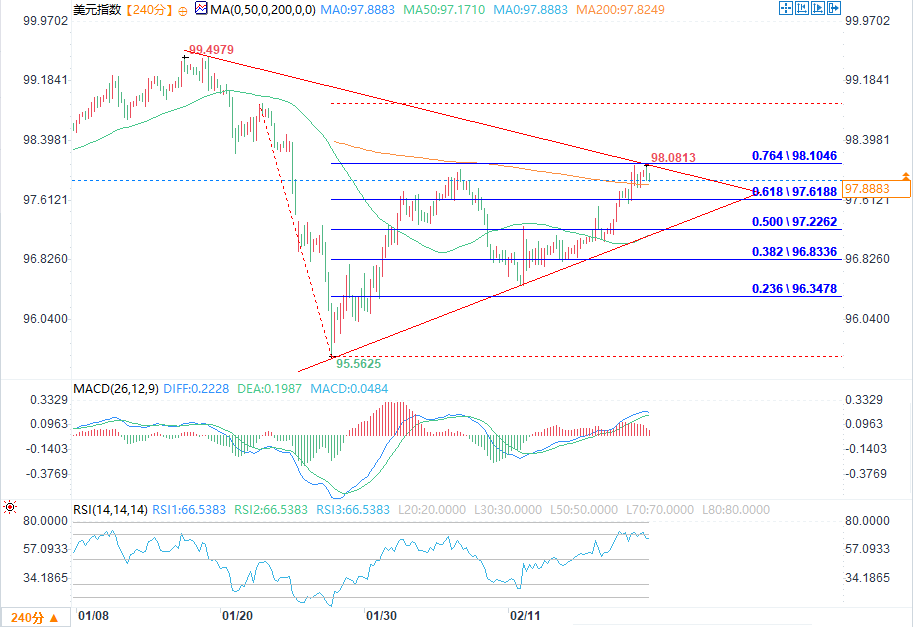
From a technical perspective, the current trend of the US Dollar Index (DXY) is clear, with a definite upward trend. The breakthrough and stabilization of key levels will determine the strength and subsequent upside potential of the short-term rebound.
The 4-hour chart shows that the US dollar index is currently consolidating in the 97.90-98.00 range, and is generally within a rebound channel. Since the rebound from the low of 95.54, upward momentum has been gradually accumulating, market bullish sentiment is slowly warming up, and the technical picture shows a healthy rebound trend.
From a key perspective, the US dollar index has successfully recovered the 0.618 Fibonacci support level of 97.61. The stabilization at this level lays the foundation for a subsequent rebound and validates the effectiveness of the current upward momentum. The core resistance level above is 98.08, a crucial hurdle in the recent rebound. A successful break and hold above this level would open up further upside potential, potentially leading to higher levels. Support levels to watch are 97.61 (Fibonacci level) and the psychological level of 97.00. A pullback below 97.61 could trigger further short-term corrections, but given the fundamental support, the pullback is expected to be limited.
From a trend perspective, the US dollar index is currently in a generally upward trend with fluctuations. The moving average system shows a preliminary bullish alignment. Although the upward momentum has not seen explosive growth, it is steadily releasing, consistent with current fundamentals and institutional expectations. In the short term, the key focus is on whether the 98.08 resistance level can be broken. A successful breakout would confirm a strong technical pattern, propelling the dollar's rebound. If it fails to break through, it may maintain a range-bound consolidation between 97.61 and 98.08, awaiting clear direction from key data and geopolitical developments.
Summarize
Based on a comprehensive analysis of fundamentals and data, expert opinions, and technical factors, the current upward trend of the US dollar is highly sustainable, with ample room for further rebound. On the fundamental front, geopolitical tensions between the US and Iran, rising oil prices, and the Federal Reserve's hawkish stance provide support. Key data will determine the short-term trend, with better-than-expected performance potentially propelling a breakout above resistance. Institutions generally favor the rebound, although short-term upside risks remain. Technically, the bullish trend is clear, with a key level to break through at 98.08. Going forward, close attention should be paid to developments in the US-Iran situation, the release of key data, and the breakout of key technical levels. In the long term, if geopolitical risks persist and high inflation leads to a delay in Fed rate cuts, the US dollar is likely to embark on a new round of upward movement.
The core fundamental support lies in the resonance between geopolitical factors, monetary attributes, and Federal Reserve policies.
Geopolitical factors have become the core variable dominating the current dollar trend, with escalating tensions between the US and Iran overshadowing most other market factors. Since early February, international oil prices have been highly correlated with Polymarket's prediction of the probability of a US strike against Iran before March 31st. This probability has now risen to 60%, on par with the level at the end of January, corresponding to the Brent crude oil price fluctuation of $71-72 per barrel at the end of January. Extrapolating from this correlation, if the probability of a strike rises to 100%, oil prices are expected to climb to the $75-76 per barrel range.
Whether crude oil prices can continue to rise sharply hinges on whether Iran will block the Strait of Hormuz. Polymarket forecasts indicate that the probability is 18% by the end of March and will rise to 35% by the end of the year. Currently, only a portion of this is priced in, leaving room for further price increases, which will continue to support the US dollar. Meanwhile, the US military deployment in the Middle East is the largest since 2003, which cannot be simply viewed as a deterrent to negotiations. The UN has warned that this move could close diplomatic channels. Coupled with the contradiction between Trump's hints of a "10-15 day nuclear agreement timeframe" and "rumors of limited preemptive strikes," this further exacerbates market uncertainty and drives safe-haven funds into the US dollar.
The US dollar's safe-haven appeal has further strengthened its upward momentum, a characteristic particularly prominent against the backdrop of an impending oil crisis. As a traditional safe-haven currency, the dollar's appeal typically weakens after the liberation, but fully recovers when geopolitical tensions trigger an oil crisis. The core reason is that alternative safe-haven currencies such as the euro and yen heavily rely on energy imports. Soaring oil prices will exacerbate inflation and downward pressure on their economies, reducing their safe-haven appeal and indirectly enhancing the dollar's relative advantage, forming a transmission chain of "rising oil prices—weakening alternative currencies—strengthening dollar."
The Federal Reserve's hawkish stance is another core pillar of the dollar's strength. The latest meeting minutes show that the Fed has no immediate intention to cut interest rates; most FOMC officials favored maintaining current rates, with only a few considering a cut, highlighting its cautious approach. Current US inflation remains above the Fed's 2% long-term target, which is key to its reluctance to rush into rate cuts—only when inflation truly declines can there be a basis for rate cuts. This stable policy orientation provides a favorable macroeconomic environment for the dollar's strength.
Core economic data: key variables for short-term trends
Today, the US will release two key data points that will directly influence the short-term trend of the US dollar: the December core PCE inflation rate, which is closely watched by the Federal Reserve, and the fourth-quarter GDP data. Both are market focuses, with little divergence but some volatility risk.
The market generally expects the core PCE inflation rate to be 0.3% month-on-month in December, with the possibility of an upward trend. Fourth-quarter GDP growth is projected at 2.7% year-on-year, close to the market expectation of 2.8%, indicating an overall trend towards stability. Core PCE, the Federal Reserve's core inflation indicator, is compiled by the Bureau of Economic Analysis of the U.S. Department of Commerce. Adopted as a primary measure of inflation in 2002, it has a broader weighting and reflects actual consumer behavior. Its performance directly impacts the Fed's policy expectations; a sustained level above 2% would further solidify a hawkish stance and support the dollar.
Specifically, TD Securities provides a detailed forecast: Core PCE rose 0.25% month-over-month in December, while overall PCE rose 0.27% (the increase was slightly higher due to food prices). Year-over-year growth for core and overall PCE were 2.9% and 2.8% respectively, consistent with market consensus. Super core PCE remained flat at 0.26% month-over-month, indicating that core inflationary pressures are manageable but have not eased significantly. Regarding consumption and income, personal spending rose 0.4% month-over-month in December (0.1% in reality), reflecting a moderate slowdown in consumption at the end of the fourth quarter, echoing the decline in controlled retail and food service retail sales. Personal income slowed to 0.2% month-over-month (lower than the expected 0.3%), with core growth due to weak total wage income, highlighting a localized slowdown in labor market momentum.
Regarding GDP, TD Securities expects the annualized quarter-on-quarter growth rate to slow to 2.3% in the fourth quarter, lower than the market consensus of 3.0%, mainly due to slowing consumption, contraction in federal government spending, and unfavorable net exports. However, investment in artificial intelligence will support non-residential fixed investment, alleviating the pressure of declining growth. At the same time, we need to be wary of the downside risk of a greater-than-expected decline in government consumption due to the government shutdown.
Potential impact of data on the US dollar: If there are no new developments in the Iranian situation, unexpected data performance will dominate the trend - better-than-expected core data (especially the rise in core PCE) will help the US dollar break through the 98.08 resistance level; if the data falls short of expectations, the US dollar may pull back in the short term, but the downside is limited due to support from fundamentals and policies; even if oil prices rise, weak macroeconomic data may also trigger a short-term weakening of the US dollar.
Institutional views: Generally optimistic about the rebound potential, but short-term upside risks still exist.
Currently, market institutions and experts are largely in agreement on the dollar's trajectory, focusing on "short-term upside risks and ample long-term rebound," while also clarifying the core premise for a dollar decline, providing an important reference for trend judgment.
Today's core PCE and GDP data will dominate the short-term trend of the US dollar. We are focusing on the downside risks of GDP and PCE, believing that weak data may put short-term pressure on the US dollar, but the medium- to long-term impact will be limited.
TD Securities' global strategy team believes that the Federal Reserve's hawkish stance will continue to support the US dollar, while rising oil prices due to escalating geopolitical tensions will further enhance the dollar's safe-haven appeal. They also caution that government shutdowns and geopolitical easing are the main downside risks to the dollar's future trajectory, and if such signals emerge, a period of adjustment in the dollar's price is warranted.
Three major consensuses have emerged in the market: First, the current valuation of the US dollar is still undervalued relative to short-term fundamentals, and with the dual benefits of geopolitical support and the Fed's hawkish stance, there is ample room for a subsequent rebound. Second, the US dollar still faces upside risks in the short term, and it is too early to talk about a decline. Two prerequisites must be met for a substantial decline to occur—progress in US-Iran diplomacy and a reduction in US military threat rhetoric, neither of which has yet materialized. Third, core economic data and geopolitical situation are two key short-term variables, and their subsequent changes need to be closely monitored, as their interaction will determine the recent trend of the US dollar.
Technical Analysis: The bullish trend is clear; breaking through the resistance level is key.
From a technical perspective, the current trend of the US Dollar Index (DXY) is clear, with a definite upward trend. The breakthrough and stabilization of key levels will determine the strength and subsequent upside potential of the short-term rebound.
The 4-hour chart shows that the US dollar index is currently consolidating in the 97.90-98.00 range, and is generally within a rebound channel. Since the rebound from the low of 95.54, upward momentum has been gradually accumulating, market bullish sentiment is slowly warming up, and the technical picture shows a healthy rebound trend.
From a key perspective, the US dollar index has successfully recovered the 0.618 Fibonacci support level of 97.61. The stabilization at this level lays the foundation for a subsequent rebound and validates the effectiveness of the current upward momentum. The core resistance level above is 98.08, a crucial hurdle in the recent rebound. A successful break and hold above this level would open up further upside potential, potentially leading to higher levels. Support levels to watch are 97.61 (Fibonacci level) and the psychological level of 97.00. A pullback below 97.61 could trigger further short-term corrections, but given the fundamental support, the pullback is expected to be limited.
From a trend perspective, the US dollar index is currently in a generally upward trend with fluctuations. The moving average system shows a preliminary bullish alignment. Although the upward momentum has not seen explosive growth, it is steadily releasing, consistent with current fundamentals and institutional expectations. In the short term, the key focus is on whether the 98.08 resistance level can be broken. A successful breakout would confirm a strong technical pattern, propelling the dollar's rebound. If it fails to break through, it may maintain a range-bound consolidation between 97.61 and 98.08, awaiting clear direction from key data and geopolitical developments.
Summarize
Based on a comprehensive analysis of fundamentals and data, expert opinions, and technical factors, the current upward trend of the US dollar is highly sustainable, with ample room for further rebound. On the fundamental front, geopolitical tensions between the US and Iran, rising oil prices, and the Federal Reserve's hawkish stance provide support. Key data will determine the short-term trend, with better-than-expected performance potentially propelling a breakout above resistance. Institutions generally favor the rebound, although short-term upside risks remain. Technically, the bullish trend is clear, with a key level to break through at 98.08. Going forward, close attention should be paid to developments in the US-Iran situation, the release of key data, and the breakout of key technical levels. In the long term, if geopolitical risks persist and high inflation leads to a delay in Fed rate cuts, the US dollar is likely to embark on a new round of upward movement.
- Risk Warning and Disclaimer
- The market involves risk, and trading may not be suitable for all investors. This article is for reference only and does not constitute personal investment advice, nor does it take into account certain users’ specific investment objectives, financial situation, or other needs. Any investment decisions made based on this information are at your own risk.