Euro's sharp decline pierces key defense, opening window for a potential yen attack.
2026-02-20 20:58:49
The euro/yen (EUR/JPY) pair is expected to maintain a moderately bullish trend in the short term. The core logic stems from the divergence in fundamentals between the strengthening economic recovery momentum in the Eurozone and the easing of price pressures in Japan, coupled with the expected differences in the policy paths of the two major central banks, the European Central Bank and the Bank of Japan, which lays a clear direction for the cross-currency pair's movement.
However, considering the technical factors and the overall overvaluation of the euro, the probability of the yen appreciating is gradually increasing.

The preliminary HCOB Eurozone Composite Purchasing Managers' Index (PMI) for February came in at 51.9, higher than the market expectation of 51.5 and the previous reading of 51.3. Driven by a simultaneous recovery in both the manufacturing and service sectors, overall business activity in the region accelerated. Specifically, the manufacturing PMI rebounded from 49.5 to 50.8, officially returning to expansion territory; while the services PMI rose to 51.8 (slightly below the expected 52), it continued its positive trend, further confirming the resilience of the Eurozone's recovery at the start of the first quarter and providing fundamental support for the euro.
Meanwhile, Germany's February PMI came in at 50.7, exceeding expectations and turning positive above the expansion/contraction threshold. At the same time, stock indices in France, Germany, and other European countries also rose across the board.
In terms of institutional developments, according to The Wall Street Journal, European Central Bank (ECB) President Christine Lagarde has stated that she expects to remain in office until October 2027. She did not directly address market speculation about an early departure, only mentioning that the World Economic Forum might be one of her potential destinations after leaving office.
This statement effectively reduced the political uncertainty surrounding the European Central Bank; however, investors remain focused on the future direction of its monetary policy, with inflation dynamics remaining the core variable driving policy adjustments.
Derek Halpenney, head of research at MUFG, pointed out that although the euro/dollar exchange rate has completely given back its gains from late January, falling by about 2.5% to around the opening price in 2026, the euro/yen exchange rate is more driven by the fundamental differences between the euro and the yen.
Softer inflation data in the Eurozone boosted market pricing in a rate cut by the European Central Bank, while speculation about Lagarde's term and the hawkish leanings of potential successors exacerbated short-term volatility in the euro.
However, the institution emphasized that "the degree of deviation of inflation from the target level will still determine the direction of monetary policy more than the change of the governor"; and "although the inflation data has strengthened the euro's pullback against the dollar, the eurozone's economic recovery trend remains unchanged, and its relative advantage over the yen still exists."
Under current benchmark expectations, the probability of the European Central Bank maintaining its existing policy stance is relatively high. Although the risk of another interest rate cut this year cannot be ignored, it has not yet posed a substantial threat to the euro.
Japan's fundamentals continue to constrain the yen, with the core issues being the cooling of inflation and the slowdown in the normalization of monetary policy.
The latest data shows that the national consumer price index (CPI) rose 1.5% year-on-year in January, a significant drop from 2.1% in December, marking the lowest growth rate since March 2022; the core CPI, excluding fresh food, rose 2% year-on-year (a slowdown from the previous value of 2.4% and in line with expectations).
The core CPI, excluding fresh food and energy, also fell from 2.9% to 2.6%, significantly easing price pressures.
The Danske Bank research team analyzed that the core inflation falling to a two-year low may directly affect the pace of the Bank of Japan's (BoJ) monetary policy normalization.
Despite recent Japanese PMI data indicating robust domestic demand and a trend toward looser fiscal policy, the moderate performance of core inflation poses a significant challenge to the Bank of Japan's decision to raise interest rates in the short term, making it difficult to provide substantial support for the yen.
Japanese Prime Minister Sanae Takaichi stated that Japan will steadily reduce the debt-to-GDP ratio and restore fiscal sustainability. This clear stance has alleviated market concerns about fiscal risks to some extent and may begin to gradually change the overall pattern of the yen's weakness.
In summary, the uncertainty surrounding the pace of cooling inflation and monetary policy tightening continues to suppress the yen's elasticity, but the market cannot rule out the possibility of government intervention such as window guidance, thus laying the groundwork for yen appreciation. Meanwhile, the relative advantages brought by the Eurozone's economic recovery complement each other, coupled with the potential for policy divergence between the ECB and the BOJ, ultimately pushing the euro against the yen to a relatively favorable position at a high level in the short term.
However, from a technical perspective, the euro/yen exchange rate is in a two-year high range, and the exchange rate has inadvertently broken through the high-level consolidation range. Therefore, the possibility of yen appreciation can be expected here.
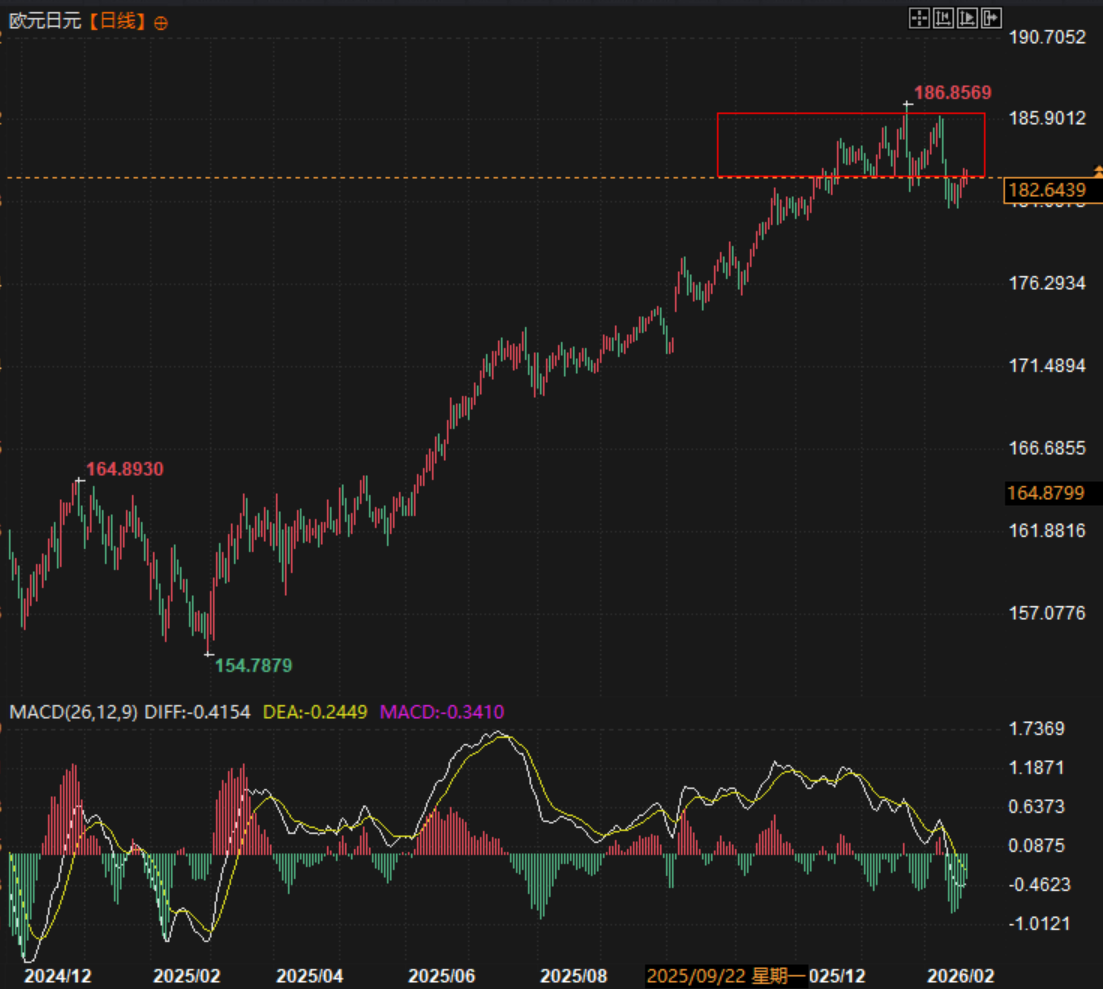
(EUR/JPY daily chart, source: FX678)
The euro is currently trading at 182.64/65 against the yen at Beijing time.
However, considering the technical factors and the overall overvaluation of the euro, the probability of the yen appreciating is gradually increasing.
Eurozone: Accelerated economic recovery and easing policy uncertainty provide fundamental support for the euro.
The preliminary HCOB Eurozone Composite Purchasing Managers' Index (PMI) for February came in at 51.9, higher than the market expectation of 51.5 and the previous reading of 51.3. Driven by a simultaneous recovery in both the manufacturing and service sectors, overall business activity in the region accelerated. Specifically, the manufacturing PMI rebounded from 49.5 to 50.8, officially returning to expansion territory; while the services PMI rose to 51.8 (slightly below the expected 52), it continued its positive trend, further confirming the resilience of the Eurozone's recovery at the start of the first quarter and providing fundamental support for the euro.
Meanwhile, Germany's February PMI came in at 50.7, exceeding expectations and turning positive above the expansion/contraction threshold. At the same time, stock indices in France, Germany, and other European countries also rose across the board.
In terms of institutional developments, according to The Wall Street Journal, European Central Bank (ECB) President Christine Lagarde has stated that she expects to remain in office until October 2027. She did not directly address market speculation about an early departure, only mentioning that the World Economic Forum might be one of her potential destinations after leaving office.
This statement effectively reduced the political uncertainty surrounding the European Central Bank; however, investors remain focused on the future direction of its monetary policy, with inflation dynamics remaining the core variable driving policy adjustments.
Short-term disturbances in the euro: Inflation and policy speculation cause volatility, but its relative advantage remains unchanged.
Derek Halpenney, head of research at MUFG, pointed out that although the euro/dollar exchange rate has completely given back its gains from late January, falling by about 2.5% to around the opening price in 2026, the euro/yen exchange rate is more driven by the fundamental differences between the euro and the yen.
Softer inflation data in the Eurozone boosted market pricing in a rate cut by the European Central Bank, while speculation about Lagarde's term and the hawkish leanings of potential successors exacerbated short-term volatility in the euro.
However, the institution emphasized that "the degree of deviation of inflation from the target level will still determine the direction of monetary policy more than the change of the governor"; and "although the inflation data has strengthened the euro's pullback against the dollar, the eurozone's economic recovery trend remains unchanged, and its relative advantage over the yen still exists."
Under current benchmark expectations, the probability of the European Central Bank maintaining its existing policy stance is relatively high. Although the risk of another interest rate cut this year cannot be ignored, it has not yet posed a substantial threat to the euro.
Japan: Cooling inflation and stalled interest rate hikes weaken the yen's support.
Japan's fundamentals continue to constrain the yen, with the core issues being the cooling of inflation and the slowdown in the normalization of monetary policy.
The latest data shows that the national consumer price index (CPI) rose 1.5% year-on-year in January, a significant drop from 2.1% in December, marking the lowest growth rate since March 2022; the core CPI, excluding fresh food, rose 2% year-on-year (a slowdown from the previous value of 2.4% and in line with expectations).
The core CPI, excluding fresh food and energy, also fell from 2.9% to 2.6%, significantly easing price pressures.
The Danske Bank research team analyzed that the core inflation falling to a two-year low may directly affect the pace of the Bank of Japan's (BoJ) monetary policy normalization.
Despite recent Japanese PMI data indicating robust domestic demand and a trend toward looser fiscal policy, the moderate performance of core inflation poses a significant challenge to the Bank of Japan's decision to raise interest rates in the short term, making it difficult to provide substantial support for the yen.
Fiscal statements failed to reverse the weakness, and the mildly bullish trend for EUR/JPY continued.
Japanese Prime Minister Sanae Takaichi stated that Japan will steadily reduce the debt-to-GDP ratio and restore fiscal sustainability. This clear stance has alleviated market concerns about fiscal risks to some extent and may begin to gradually change the overall pattern of the yen's weakness.
Summary and Technical Analysis:
In summary, the uncertainty surrounding the pace of cooling inflation and monetary policy tightening continues to suppress the yen's elasticity, but the market cannot rule out the possibility of government intervention such as window guidance, thus laying the groundwork for yen appreciation. Meanwhile, the relative advantages brought by the Eurozone's economic recovery complement each other, coupled with the potential for policy divergence between the ECB and the BOJ, ultimately pushing the euro against the yen to a relatively favorable position at a high level in the short term.
However, from a technical perspective, the euro/yen exchange rate is in a two-year high range, and the exchange rate has inadvertently broken through the high-level consolidation range. Therefore, the possibility of yen appreciation can be expected here.
(EUR/JPY daily chart, source: FX678)
The euro is currently trading at 182.64/65 against the yen at Beijing time.
- Risk Warning and Disclaimer
- The market involves risk, and trading may not be suitable for all investors. This article is for reference only and does not constitute personal investment advice, nor does it take into account certain users’ specific investment objectives, financial situation, or other needs. Any investment decisions made based on this information are at your own risk.