Gold prices were supported as investors weighed weak GDP figures against the Supreme Court's tariff ruling.
2026-02-21 01:31:26
On Friday (February 20), during the US trading session, international gold prices rose significantly, supported by weaker-than-expected US fourth-quarter GDP data and fueled by the US Supreme Court's ruling rejecting the Trump administration's comprehensive tariff plan, which triggered uncertainty about medium- and long-term trade policies in the market.

Spot gold rose 1.37% to $5,064.5 per ounce during the session, while COMEX gold was at $5,085 per ounce, up 1.76%.
The Supreme Court's rejection of tariff policies highlights trade policy uncertainty as a key factor.
The U.S. Supreme Court ruled that the Trump administration's comprehensive global tariffs under the International Emergency Economic Powers Act lacked legal authorization, overturning this highly controversial use of presidential power. This ruling directly impacts the global trade landscape and market capital flows. The overturned tariffs represent approximately 75% of the total tariffs the Trump administration planned to impose in 2025, with only the power to impose tariffs on specific goods such as automobiles and steel retained under the Trade Expansion Act.
Independent metals trader Tai Wong said, "On the surface, the Supreme Court ruling has eliminated most of the uncertainty surrounding Trump's tariffs (and his ability to impose tariffs arbitrarily), which is good for stocks and bad for gold." "However, it's hard to imagine the president stopping there; he will try to use other laws to re-impose tariffs, which will exacerbate market volatility. Therefore, while uncertainty may be reduced in the short term, it won't hinder gold bulls in the medium term."
In fact, Trump has publicly called the ruling "shameful" and clearly stated that he has prepared alternative plans. The White House had also previously indicated that it would immediately begin to reinstate tariffs after the ruling. The market generally expects him to reinstate targeted tariff measures through other legal grounds such as the Trade Expansion Act. The continued tug-of-war on trade policy has become an important support for the safe-haven demand for gold. After the Supreme Court's ruling, major Wall Street stock indexes rose sharply on Friday, and the game between risk assets and safe-haven assets further boosted the trading activity of gold.
Economic data reveals stagflation concerns, while the impact of Federal Reserve policy expectations weakens.
Data shows that, affected by both the government shutdown and weak consumer spending, the US economy is projected to grow sharply to an annualized rate of 1.4% in the fourth quarter of 2025, far below economists' forecasts of 3%, and a precipitous drop from the 4.4% growth rate in the third quarter. Furthermore, the Federal Reserve's preferred inflation gauge—the Personal Consumption Expenditures Index—rose 0.4% month-on-month in December, higher than the previously expected 0.3% increase, and its year-on-year increase reached 3.0%, continuing to exceed the Fed's 2% policy target. The sticky inflation and weak economic growth, coupled with concerns about stagflation, have heightened market anxieties about the fundamentals of the US economy.
Bob Habercohn, senior market strategist at RJO Futures, said, "Market inflation remains... but the slowing GDP growth suggests the economy is not yet near a turning point. There are still many unknowns and uncertainties surrounding the US economy, which is supporting gold." It's worth noting that despite strong inflation data, the reality of a weak economy has not changed market expectations for a Fed rate cut. Traders still expect the Fed to cut rates twice this year, each by 25 basis points, with the first cut expected in June. However, compared to the dual uncertainties of economic fundamentals and trade policy, the impact of Fed policy expectations on gold prices has significantly weakened in this round of price increases.
The safe-haven appeal of precious metals was activated, and the sector rose across the board.
Against the backdrop of uncertain economic growth prospects and significant uncertainties in trade policies, gold's safe-haven properties have been continuously activated. This is the core reason why it has been able to strengthen independently despite rising US stocks and short-term fluctuations in the US dollar, rather than being simply driven by expectations of Fed rate cuts. Moreover, in an environment where interest rates remain relatively high for a long period and economic uncertainty intensifies, gold's asset allocation value has become even more prominent.
In addition, the precious metals sector rose across the board, with safe-haven demand and capital rotation working in tandem. Spot silver rose 5.62% to $82.348 per ounce; spot platinum rose 3.2% to $2,135.95 per ounce; and palladium rose 2.5% to $1,726.25 per ounce.
Technical Outlook: $5002 is a key watershed, with targets above $5119 and $5143.
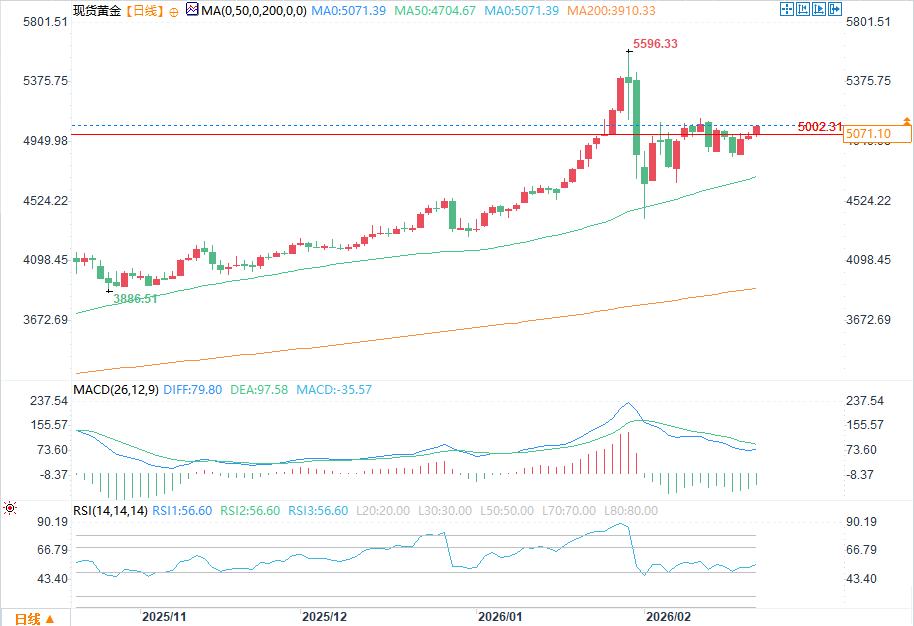
(Spot gold daily chart source: FX678)
From a technical perspective, spot gold has stabilized above the key short-term support level of $5002.31, indicating a bullish short-term trend. It is expected to challenge the recent high of $5119.35 and the Fibonacci resistance level of $5143.89. Once it breaks through $5143.89, the price of gold is expected to start an accelerated upward trend.
If the price of gold falls below the $5,002.31 support level, it will face downside risks. The key support levels below are $4,760.87 and $4,744.34. At the same time, the 50-day moving average at $4,705.42 is also an important support level, which usually attracts medium- to long-term buying.
Spot gold rose 1.37% to $5,064.5 per ounce during the session, while COMEX gold was at $5,085 per ounce, up 1.76%.
The Supreme Court's rejection of tariff policies highlights trade policy uncertainty as a key factor.
The U.S. Supreme Court ruled that the Trump administration's comprehensive global tariffs under the International Emergency Economic Powers Act lacked legal authorization, overturning this highly controversial use of presidential power. This ruling directly impacts the global trade landscape and market capital flows. The overturned tariffs represent approximately 75% of the total tariffs the Trump administration planned to impose in 2025, with only the power to impose tariffs on specific goods such as automobiles and steel retained under the Trade Expansion Act.
Independent metals trader Tai Wong said, "On the surface, the Supreme Court ruling has eliminated most of the uncertainty surrounding Trump's tariffs (and his ability to impose tariffs arbitrarily), which is good for stocks and bad for gold." "However, it's hard to imagine the president stopping there; he will try to use other laws to re-impose tariffs, which will exacerbate market volatility. Therefore, while uncertainty may be reduced in the short term, it won't hinder gold bulls in the medium term."
In fact, Trump has publicly called the ruling "shameful" and clearly stated that he has prepared alternative plans. The White House had also previously indicated that it would immediately begin to reinstate tariffs after the ruling. The market generally expects him to reinstate targeted tariff measures through other legal grounds such as the Trade Expansion Act. The continued tug-of-war on trade policy has become an important support for the safe-haven demand for gold. After the Supreme Court's ruling, major Wall Street stock indexes rose sharply on Friday, and the game between risk assets and safe-haven assets further boosted the trading activity of gold.
Economic data reveals stagflation concerns, while the impact of Federal Reserve policy expectations weakens.
Data shows that, affected by both the government shutdown and weak consumer spending, the US economy is projected to grow sharply to an annualized rate of 1.4% in the fourth quarter of 2025, far below economists' forecasts of 3%, and a precipitous drop from the 4.4% growth rate in the third quarter. Furthermore, the Federal Reserve's preferred inflation gauge—the Personal Consumption Expenditures Index—rose 0.4% month-on-month in December, higher than the previously expected 0.3% increase, and its year-on-year increase reached 3.0%, continuing to exceed the Fed's 2% policy target. The sticky inflation and weak economic growth, coupled with concerns about stagflation, have heightened market anxieties about the fundamentals of the US economy.
Bob Habercohn, senior market strategist at RJO Futures, said, "Market inflation remains... but the slowing GDP growth suggests the economy is not yet near a turning point. There are still many unknowns and uncertainties surrounding the US economy, which is supporting gold." It's worth noting that despite strong inflation data, the reality of a weak economy has not changed market expectations for a Fed rate cut. Traders still expect the Fed to cut rates twice this year, each by 25 basis points, with the first cut expected in June. However, compared to the dual uncertainties of economic fundamentals and trade policy, the impact of Fed policy expectations on gold prices has significantly weakened in this round of price increases.
The safe-haven appeal of precious metals was activated, and the sector rose across the board.
Against the backdrop of uncertain economic growth prospects and significant uncertainties in trade policies, gold's safe-haven properties have been continuously activated. This is the core reason why it has been able to strengthen independently despite rising US stocks and short-term fluctuations in the US dollar, rather than being simply driven by expectations of Fed rate cuts. Moreover, in an environment where interest rates remain relatively high for a long period and economic uncertainty intensifies, gold's asset allocation value has become even more prominent.
In addition, the precious metals sector rose across the board, with safe-haven demand and capital rotation working in tandem. Spot silver rose 5.62% to $82.348 per ounce; spot platinum rose 3.2% to $2,135.95 per ounce; and palladium rose 2.5% to $1,726.25 per ounce.
Technical Outlook: $5002 is a key watershed, with targets above $5119 and $5143.
(Spot gold daily chart source: FX678)
From a technical perspective, spot gold has stabilized above the key short-term support level of $5002.31, indicating a bullish short-term trend. It is expected to challenge the recent high of $5119.35 and the Fibonacci resistance level of $5143.89. Once it breaks through $5143.89, the price of gold is expected to start an accelerated upward trend.
If the price of gold falls below the $5,002.31 support level, it will face downside risks. The key support levels below are $4,760.87 and $4,744.34. At the same time, the 50-day moving average at $4,705.42 is also an important support level, which usually attracts medium- to long-term buying.
- Risk Warning and Disclaimer
- The market involves risk, and trading may not be suitable for all investors. This article is for reference only and does not constitute personal investment advice, nor does it take into account certain users’ specific investment objectives, financial situation, or other needs. Any investment decisions made based on this information are at your own risk.