Confused US tariff policies and weak economic data weighed on the dollar, and the DXY continued its correction.
2026-02-23 13:59:30
On Monday during Asian trading hours, the US Dollar Index (DXY), which measures the dollar's performance against six major currencies, continued its decline, fluctuating around 97.50.
The core reasons for the weakening dollar lie in policy inconsistencies and poor macroeconomic data. The US Supreme Court ruled that President Trump's authority to impose large-scale tariffs under emergency powers is limited.
This decision has raised questions about the sustainability of future trade policies. Although Trump subsequently proposed pushing for a 15% global tariff based on other trade laws, the uncertainty surrounding the policy path has not been eliminated; instead, it has increased investor caution.
On the economic front, the annualized GDP growth rate in the United States fell to 1.4% in the fourth quarter, significantly lower than previous levels, indicating that economic momentum is slowing down.
Meanwhile, core PCE rose to 3.0% year-on-year, indicating persistent inflationary pressures. This combination of slowing growth and high inflation has further complicated market expectations regarding the Federal Reserve's future interest rate policy.
Maintaining high interest rates could stifle the economy, while premature easing could stimulate a rebound in inflation, thus leaving the dollar without clear directional support. Furthermore, the market is still assessing the tensions between the US and Iran.
While geopolitical risks are theoretically beneficial to safe-haven assets, in the current context, investors are more concerned about the structural impact of the slowdown in the US economic fundamentals, and the US dollar remains weak overall.
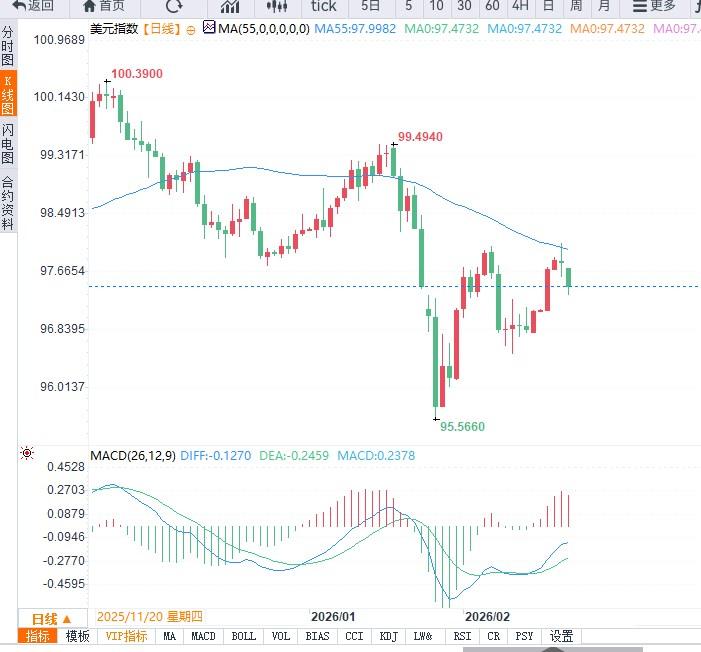
Observing the daily chart of the US dollar index, the price has continued to fall after being resisted in the 99.50 area, and has now broken below the 98.00 psychological level, with the short-term center of gravity clearly shifting downwards. The moving average system shows signs of a bearish alignment, with the 5-day and 10-day moving averages diverging downwards and suppressing any price rebound.
If prices continue to trade below short-term moving averages, it indicates that selling pressure remains dominant in the market. The MACD indicator has formed a death cross below the zero line, and the green bars are gradually expanding, indicating increasing bearish momentum.
The RSI has fallen back to around 45 and broken below the 50 midline, indicating a significant weakening of bullish momentum. Key support lies around 97.20, the previous low; a decisive break below this level could lead to further declines towards 96.80 or even 96.00.
The resistance levels are located in the 98.30 and 99.00 area. Only by regaining a foothold above 98.30 can the short-term structure be repaired.
Editor's Note:
The current decline in the US dollar is more likely a temporary correction following a loss of policy confidence, rather than a trend-driven downturn. The fluctuating tariff path has lowered market expectations for the stability of US policy, while slowing economic growth further weakens the dollar's fundamental advantages.
However, given the ongoing global risks, the US dollar still retains some safe-haven appeal. A technical rebound could occur if geopolitical risks escalate or the Federal Reserve releases hawkish signals. Until the daily chart structure shows significant improvement, the US dollar is expected to remain in a generally weak and volatile pattern.
The core reasons for the weakening dollar lie in policy inconsistencies and poor macroeconomic data. The US Supreme Court ruled that President Trump's authority to impose large-scale tariffs under emergency powers is limited.
This decision has raised questions about the sustainability of future trade policies. Although Trump subsequently proposed pushing for a 15% global tariff based on other trade laws, the uncertainty surrounding the policy path has not been eliminated; instead, it has increased investor caution.
On the economic front, the annualized GDP growth rate in the United States fell to 1.4% in the fourth quarter, significantly lower than previous levels, indicating that economic momentum is slowing down.
Meanwhile, core PCE rose to 3.0% year-on-year, indicating persistent inflationary pressures. This combination of slowing growth and high inflation has further complicated market expectations regarding the Federal Reserve's future interest rate policy.
Maintaining high interest rates could stifle the economy, while premature easing could stimulate a rebound in inflation, thus leaving the dollar without clear directional support. Furthermore, the market is still assessing the tensions between the US and Iran.
While geopolitical risks are theoretically beneficial to safe-haven assets, in the current context, investors are more concerned about the structural impact of the slowdown in the US economic fundamentals, and the US dollar remains weak overall.
Observing the daily chart of the US dollar index, the price has continued to fall after being resisted in the 99.50 area, and has now broken below the 98.00 psychological level, with the short-term center of gravity clearly shifting downwards. The moving average system shows signs of a bearish alignment, with the 5-day and 10-day moving averages diverging downwards and suppressing any price rebound.
If prices continue to trade below short-term moving averages, it indicates that selling pressure remains dominant in the market. The MACD indicator has formed a death cross below the zero line, and the green bars are gradually expanding, indicating increasing bearish momentum.
The RSI has fallen back to around 45 and broken below the 50 midline, indicating a significant weakening of bullish momentum. Key support lies around 97.20, the previous low; a decisive break below this level could lead to further declines towards 96.80 or even 96.00.
The resistance levels are located in the 98.30 and 99.00 area. Only by regaining a foothold above 98.30 can the short-term structure be repaired.
Editor's Note:
The current decline in the US dollar is more likely a temporary correction following a loss of policy confidence, rather than a trend-driven downturn. The fluctuating tariff path has lowered market expectations for the stability of US policy, while slowing economic growth further weakens the dollar's fundamental advantages.
However, given the ongoing global risks, the US dollar still retains some safe-haven appeal. A technical rebound could occur if geopolitical risks escalate or the Federal Reserve releases hawkish signals. Until the daily chart structure shows significant improvement, the US dollar is expected to remain in a generally weak and volatile pattern.
- Risk Warning and Disclaimer
- The market involves risk, and trading may not be suitable for all investors. This article is for reference only and does not constitute personal investment advice, nor does it take into account certain users’ specific investment objectives, financial situation, or other needs. Any investment decisions made based on this information are at your own risk.