Has the yen's counterattack fallen through? Cooling Tokyo data exposes the central bank's "Achilles' heel".
2026-02-27 20:53:16
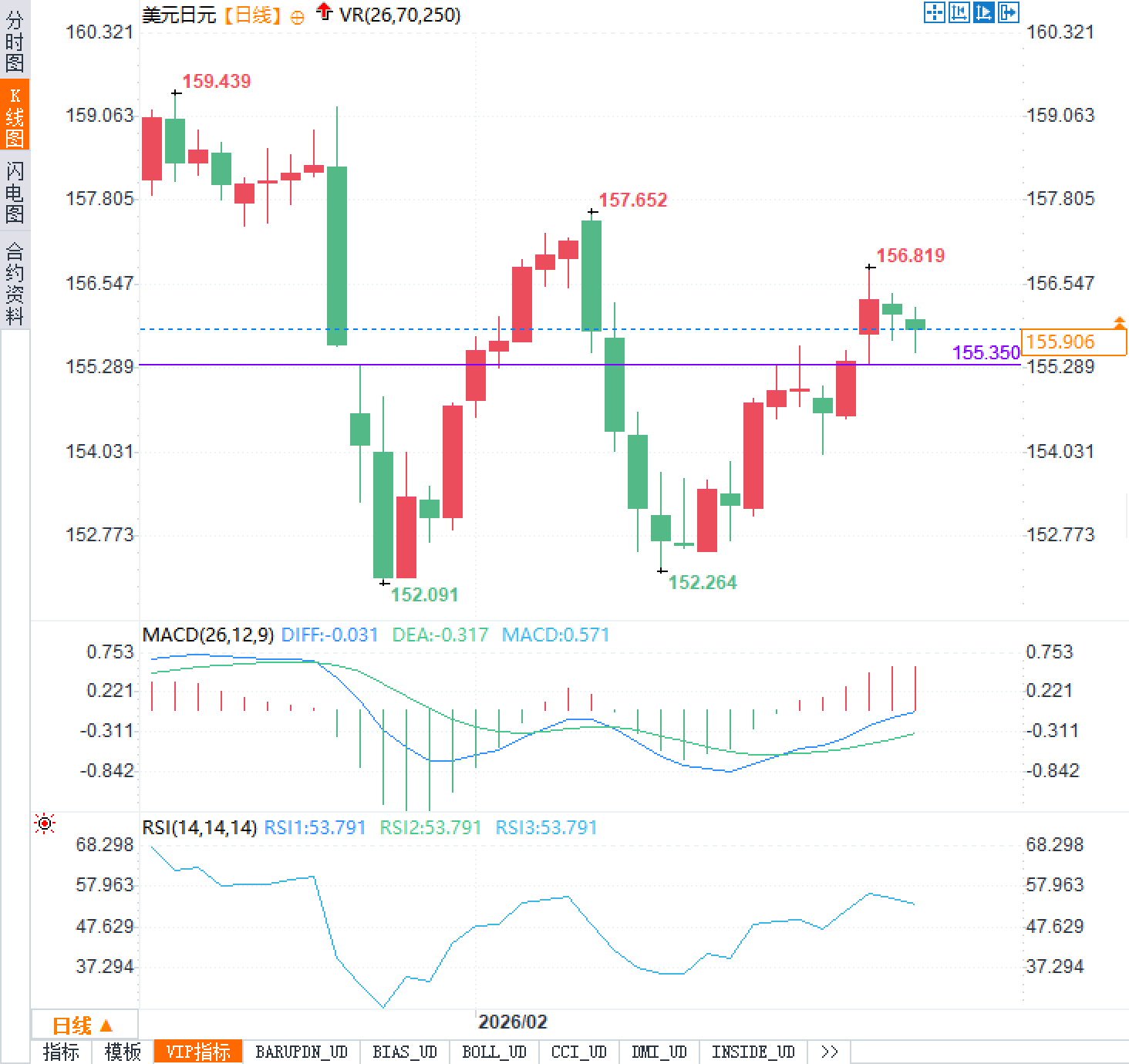
On Friday, February 27th, the USD/JPY pair was stuck at a delicate level of 155.90 in pre-market trading, seemingly held captive by an invisible hand within a trading range around 156. Looking back at recent daily chart movements, the exchange rate fell from its previous high of 159.439, finding temporary support around 152.091 before rebounding. However, it encountered strong resistance at 156.819 and had to retracede. This predicament reflects the current market's internal struggle.

The RSI reading is in the neutral-to-strong zone at 53.8, meaning that bulls want to attack while bears want to defend, with both sides restraining each other and neither daring to launch a full-scale attack easily. For short-term traders, 155.350 has become a crucial watershed: if it holds, the exchange rate may maintain a slow upward trend; once it breaks down effectively, market attention will quickly shift downwards, retesting 154 or even heading straight for the previous low support zone of 152.264 and 152.091.
The market spotlight is gradually shifting from short-term events to a deeper examination of the fundamentals of the Japanese economy, particularly the path of inflation and the Bank of Japan's ability to achieve its targets. The results of the spring wage negotiations in the coming weeks will be seen as a crucial window into the resilience of inflation, as wage growth directly impacts service prices and consumer expectations. However, analysts believe that the real constraint will not come from board personnel changes or external pressure, but rather from the objective laws governing inflation itself.
Data shows that Japan's nominal consumer price index (CPI) rose 1.5% year-on-year in January, with an estimated annual average of only 1.7%. While core inflation is currently at 2.4%, it is gradually declining towards the 2.0% target. If core inflation cannot be maintained stably above 2.0% over a longer period, the Bank of Japan's policy space will be significantly compressed. Based on this framework, it is predicted that the Bank of Japan may only raise interest rates by 25 basis points once more this year, bringing the policy rate to 1.00%. This contrasts sharply with the 46 basis points currently priced in by traders. If subsequent data confirms a clear de-inflation trend, the market's correction of overly optimistic expectations could trigger sharp fluctuations in the exchange rate.
Besides the domestic inflation narrative in Japan, the movement of the US dollar is also a key variable influencing the situation. Currently, the US dollar index is consolidating around 97.75, with funds holding their breath awaiting the release of the US January Producer Price Index (PPI) data. As an upstream indicator of inflation transmission, producer prices will directly affect investors' judgments on the Federal Reserve's policy path. If the data is strong, the market may raise its expectations for the duration of high interest rates, thereby boosting the dollar and pushing the USD/JPY pair to test the resistance zone of 156.819 or even 157.652. Conversely, if the data is weak, coupled with the backdrop of a moderate decline in Japanese inflation, the exchange rate will likely return to around 155, repeatedly fluctuating and testing the effectiveness of the support level at 155.350.
Furthermore, the interaction between Japanese politicians and the central bank is also affecting sentiment. Reports indicate that the statements made during the meeting between the Japanese Prime Minister and the central bank governor were interpreted as a sign of "no rush to tighten monetary policy." In addition, the year-on-year CPI in the Tokyo area, excluding fresh food, fell to 1.8%. This combination of "slightly stronger but declining" data is unlikely to unilaterally support a stronger yen. Instead, it is more likely to cause the exchange rate to repeatedly test the range, resulting in a back-and-forth struggle.
In summary, the short-term outlook for USD/JPY will be determined by the interplay of two sets of variables: first, the speed at which Japanese inflation falls from 2.4% to 2.0% and the extent to which it squeezes the central bank's room for interest rate hikes; and second, the extent to which the US Producer Price Index reprices the Fed's expectations. Before a decisive consensus is reached on both ends of the spectrum, the exchange rate is unlikely to move in a one-sided direction and is more likely to continue its range-bound trading and event-driven pattern.
The RSI reading is in the neutral-to-strong zone at 53.8, meaning that bulls want to attack while bears want to defend, with both sides restraining each other and neither daring to launch a full-scale attack easily. For short-term traders, 155.350 has become a crucial watershed: if it holds, the exchange rate may maintain a slow upward trend; once it breaks down effectively, market attention will quickly shift downwards, retesting 154 or even heading straight for the previous low support zone of 152.264 and 152.091.
The expectation of a receding inflation in Japan: Why is the path for central bank interest rate hikes becoming increasingly narrow?
The market spotlight is gradually shifting from short-term events to a deeper examination of the fundamentals of the Japanese economy, particularly the path of inflation and the Bank of Japan's ability to achieve its targets. The results of the spring wage negotiations in the coming weeks will be seen as a crucial window into the resilience of inflation, as wage growth directly impacts service prices and consumer expectations. However, analysts believe that the real constraint will not come from board personnel changes or external pressure, but rather from the objective laws governing inflation itself.
Data shows that Japan's nominal consumer price index (CPI) rose 1.5% year-on-year in January, with an estimated annual average of only 1.7%. While core inflation is currently at 2.4%, it is gradually declining towards the 2.0% target. If core inflation cannot be maintained stably above 2.0% over a longer period, the Bank of Japan's policy space will be significantly compressed. Based on this framework, it is predicted that the Bank of Japan may only raise interest rates by 25 basis points once more this year, bringing the policy rate to 1.00%. This contrasts sharply with the 46 basis points currently priced in by traders. If subsequent data confirms a clear de-inflation trend, the market's correction of overly optimistic expectations could trigger sharp fluctuations in the exchange rate.
A "duet" of US and Japanese data: Who can break the current stalemate?
Besides the domestic inflation narrative in Japan, the movement of the US dollar is also a key variable influencing the situation. Currently, the US dollar index is consolidating around 97.75, with funds holding their breath awaiting the release of the US January Producer Price Index (PPI) data. As an upstream indicator of inflation transmission, producer prices will directly affect investors' judgments on the Federal Reserve's policy path. If the data is strong, the market may raise its expectations for the duration of high interest rates, thereby boosting the dollar and pushing the USD/JPY pair to test the resistance zone of 156.819 or even 157.652. Conversely, if the data is weak, coupled with the backdrop of a moderate decline in Japanese inflation, the exchange rate will likely return to around 155, repeatedly fluctuating and testing the effectiveness of the support level at 155.350.
Furthermore, the interaction between Japanese politicians and the central bank is also affecting sentiment. Reports indicate that the statements made during the meeting between the Japanese Prime Minister and the central bank governor were interpreted as a sign of "no rush to tighten monetary policy." In addition, the year-on-year CPI in the Tokyo area, excluding fresh food, fell to 1.8%. This combination of "slightly stronger but declining" data is unlikely to unilaterally support a stronger yen. Instead, it is more likely to cause the exchange rate to repeatedly test the range, resulting in a back-and-forth struggle.
In summary, the short-term outlook for USD/JPY will be determined by the interplay of two sets of variables: first, the speed at which Japanese inflation falls from 2.4% to 2.0% and the extent to which it squeezes the central bank's room for interest rate hikes; and second, the extent to which the US Producer Price Index reprices the Fed's expectations. Before a decisive consensus is reached on both ends of the spectrum, the exchange rate is unlikely to move in a one-sided direction and is more likely to continue its range-bound trading and event-driven pattern.
- Risk Warning and Disclaimer
- The market involves risk, and trading may not be suitable for all investors. This article is for reference only and does not constitute personal investment advice, nor does it take into account certain users’ specific investment objectives, financial situation, or other needs. Any investment decisions made based on this information are at your own risk.