Crude oil trading alert: Escalating conflict in the Middle East and Iraqi production cuts drive oil prices higher, potentially targeting $100?
2026-03-05 09:18:20
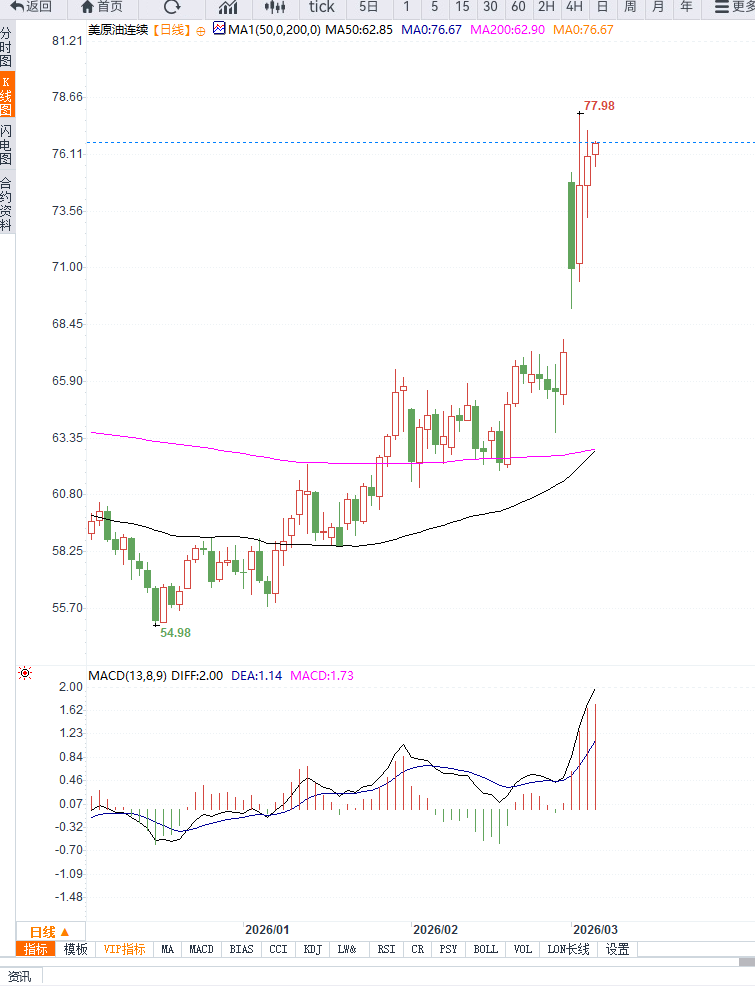
International oil prices continued their strong performance on Thursday, with WTI crude trading around $76.60 per barrel in Asian trading, marking its third consecutive day of gains. The core driver of this rally is not improved demand, but rather the rapidly escalating risk of supply disruptions. Recently, the conflict between the US, Israel, and Iran has escalated, with Iran launching retaliatory strikes against energy facilities.
The market's biggest concern is focused on the Strait of Hormuz . This strait handles approximately 20% of global crude oil and liquefied natural gas shipments; a sustained blockade would directly impact the global supply structure. Meanwhile, Iran, OPEC's second-largest oil producer, has already reduced its daily production by nearly 1.5 million barrels due to storage constraints and export disruptions.

If transportation recovers slowly, the production cuts could expand to 3 million barrels per day. Current global daily demand is approximately 100 million barrels; if 3 million barrels of supply are forced to withdraw, it would equate to a 3% reduction in global supply, a shock that cannot be ignored.
Shipping data shows that at least 200 ships are stranded in waters near Iraq, Saudi Arabia, and Qatar. The UK Maritime Trade Operations, the British naval authority, stated that eight ships have been attacked since last Saturday. In addition, a US submarine reportedly sank an Iranian warship in waters off Sri Lanka.
The US Defense Secretary called it "the first such operation against enemy ships since World War II." As the conflict entered its sixth day, markets began pricing in "protracted risks."
Analysts point out that if military action continues for four to five weeks and leads to a de facto closure of the Strait of Hormuz, the supply and demand structure of crude oil will be reassessed, and oil prices could approach $100. Meanwhile, US President Trump has proposed providing insurance and escort support for ships sailing in the Persian Gulf, and the US Treasury Secretary has also stated that measures will be taken to stabilize the market. However, the policy buffer will have limited effect until the supply risks are eliminated.
From a daily chart perspective , WTI has rebounded with three consecutive days of gains, and the price has regained its footing above the 20-day and 50-day moving averages, indicating a bullish short-term trend. Trend structure: The daily chart maintains an upward channel, with lower support around $72 and upper resistance around $78. Momentum indicators: The RSI is above 60 but has not entered overbought territory, suggesting further upside potential.
Key resistance : $78 is the previous high resistance level. A successful break above this level would target the psychological level of $80. Key support : $72 is the short-term support level. A break below this level could lead to a retest of the psychological level of $70. Looking at the 4-hour chart, the price is showing a stepped upward structure, with short-term moving averages clearly in a bullish alignment. Pullbacks are mostly technical corrections. Overall, technical and fundamental factors are converging, suggesting a short-term bias towards an upward trend with fluctuations.
Editor's Summary:
The current rise in oil prices is essentially a repricing of risk premiums. Unlike previous localized conflicts, this round of risks has three characteristics: the conflict is lasting longer, energy transport channels are directly affected, and actual production cuts have already been observed. If Iraq expands its production cuts and transport through the Strait of Hormuz continues to be blocked, the central oil price may rise from the current $70 range to above $85.
If the Taiwan Strait were to be effectively closed, a price of $100 would not be an extreme scenario. However, it is also necessary to be wary that if there are signs of diplomatic easing or OPEC releases spare capacity, the risk premium could be quickly reversed, and oil price volatility would increase significantly. At the current stage, the crude oil market has shifted from a "supply and demand balance game" to a "geopolitical risk-driven cycle." The short-term trend is bullish, but volatility risk is increasing simultaneously.
The market's biggest concern is focused on the Strait of Hormuz . This strait handles approximately 20% of global crude oil and liquefied natural gas shipments; a sustained blockade would directly impact the global supply structure. Meanwhile, Iran, OPEC's second-largest oil producer, has already reduced its daily production by nearly 1.5 million barrels due to storage constraints and export disruptions.
If transportation recovers slowly, the production cuts could expand to 3 million barrels per day. Current global daily demand is approximately 100 million barrels; if 3 million barrels of supply are forced to withdraw, it would equate to a 3% reduction in global supply, a shock that cannot be ignored.
Shipping data shows that at least 200 ships are stranded in waters near Iraq, Saudi Arabia, and Qatar. The UK Maritime Trade Operations, the British naval authority, stated that eight ships have been attacked since last Saturday. In addition, a US submarine reportedly sank an Iranian warship in waters off Sri Lanka.
The US Defense Secretary called it "the first such operation against enemy ships since World War II." As the conflict entered its sixth day, markets began pricing in "protracted risks."
Analysts point out that if military action continues for four to five weeks and leads to a de facto closure of the Strait of Hormuz, the supply and demand structure of crude oil will be reassessed, and oil prices could approach $100. Meanwhile, US President Trump has proposed providing insurance and escort support for ships sailing in the Persian Gulf, and the US Treasury Secretary has also stated that measures will be taken to stabilize the market. However, the policy buffer will have limited effect until the supply risks are eliminated.
From a daily chart perspective , WTI has rebounded with three consecutive days of gains, and the price has regained its footing above the 20-day and 50-day moving averages, indicating a bullish short-term trend. Trend structure: The daily chart maintains an upward channel, with lower support around $72 and upper resistance around $78. Momentum indicators: The RSI is above 60 but has not entered overbought territory, suggesting further upside potential.
Key resistance : $78 is the previous high resistance level. A successful break above this level would target the psychological level of $80. Key support : $72 is the short-term support level. A break below this level could lead to a retest of the psychological level of $70. Looking at the 4-hour chart, the price is showing a stepped upward structure, with short-term moving averages clearly in a bullish alignment. Pullbacks are mostly technical corrections. Overall, technical and fundamental factors are converging, suggesting a short-term bias towards an upward trend with fluctuations.
Editor's Summary:
The current rise in oil prices is essentially a repricing of risk premiums. Unlike previous localized conflicts, this round of risks has three characteristics: the conflict is lasting longer, energy transport channels are directly affected, and actual production cuts have already been observed. If Iraq expands its production cuts and transport through the Strait of Hormuz continues to be blocked, the central oil price may rise from the current $70 range to above $85.
If the Taiwan Strait were to be effectively closed, a price of $100 would not be an extreme scenario. However, it is also necessary to be wary that if there are signs of diplomatic easing or OPEC releases spare capacity, the risk premium could be quickly reversed, and oil price volatility would increase significantly. At the current stage, the crude oil market has shifted from a "supply and demand balance game" to a "geopolitical risk-driven cycle." The short-term trend is bullish, but volatility risk is increasing simultaneously.
- Risk Warning and Disclaimer
- The market involves risk, and trading may not be suitable for all investors. This article is for reference only and does not constitute personal investment advice, nor does it take into account certain users’ specific investment objectives, financial situation, or other needs. Any investment decisions made based on this information are at your own risk.