The Middle East conflict is driving futures higher, with natural gas poised to break through the 200-day moving average.
2026-03-09 21:59:38
On Monday (March 9), during the European trading session, US natural gas futures continued to rise slightly after a gap-up opening on Sunday evening, driven by a sharp rise in crude oil futures. Although the gains were less than those of crude oil, the conflict in the Middle East also poses a threat to natural gas supplies. The Strait of Hormuz remains closed to oil tankers, raising concerns about natural gas shortages in Europe and Asia.
At 21:54 Beijing time, April natural gas futures were trading at $3.290, up $0.104, or 3.26%.
Europe is in trouble
While the US has ample natural gas supplies, Europe is in dire straits. European natural gas prices surged again on Monday, nearly doubling from February 27th (the day before the Iranian attacks). Reports indicate that the benchmark European natural gas price has risen from €32 per megawatt-hour before the attacks to over €60 per megawatt-hour.
European gas prices are driving up US gas prices as Europe may be forced to turn to the US to meet its liquefied natural gas (LNG) supply needs. The longer the Strait of Hormuz remains blocked, the greater the impact on global supply.
Off-season restocking faces risks
Europe is transitioning from winter to spring, but those who follow the natural gas market closely know that companies typically view the spring and autumn transition season as a crucial period for replenishing gas reserves for the following winter. Asia, on the other hand, needs to complete its gas reserve replenishment before the summer heat arrives.
The fighting shows no signs of ending.
The conflict has entered its second week, with no end in sight, and in my view, the situation is deteriorating. Problems are spreading, and consumers and businesses may begin to feel the financial strain, with power plants, airlines, and even inflation expectations all affected.
Market Focus on the Strait of Hormuz
As of now, market trading is generally under control, but the situation could change rapidly once risk premiums begin to rise. This week, market focus will be on the Strait of Hormuz and whether the United States can fulfill its commitments to ensure the smooth flow of oil and gas transportation.
Unfortunately, reopening the strait is only one part of a complex situation. Qatari Energy Minister Saad al-Qaeda stated that even if the fighting ends quickly, the country's resumption of gas deliveries could take "weeks to months."
Technical Analysis
The Middle East conflict and the blockade of the Strait of Hormuz are fundamentally driving natural gas prices upward, while technical indicators are also signaling a bullish trend: prices have risen above the Kijun line (3.256), the Tenkan line (3.135) has crossed above the Kijun line to form a short-term golden cross, the MACD (DIFF 0.106, DEA -0.165) has also formed a golden cross, and the RSI (53.112) has risen above 50, confirming the exhaustion of bearish momentum and the beginning of bullish dominance. This resonates with the article's logic of "increased supply risks and rising US export demand," clearly indicating a bullish short-term trend.
Key resistance levels determine the price range.
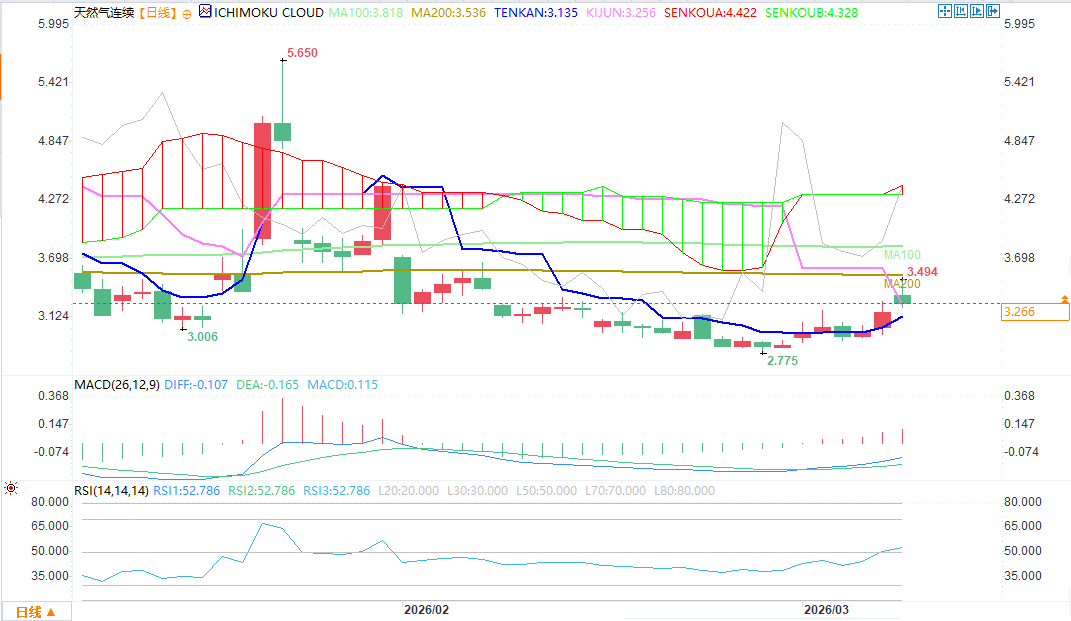
(COMEX natural gas daily chart source: EasyForex)
The current price (approximately 3.279) remains below the MA100 (3.819) and the cloud layer, indicating that the medium-term trend has not yet fully reversed. The key battleground is concentrated at the MA200 (3.536), a crucial resistance level.
If the price can break through 3.536 effectively, it will trigger a large-scale short covering, with speculative targets at 4.085–4.118, and further challenge the lower edge of the cloud at 4.328.
If the price encounters resistance at 3.536 and falls back, and the MACD shows a bearish divergence, then we need to be wary of a rapid pullback after the risk premium subsides. The first support level to watch is the Kijun line at 3.256, with strong support at the recent low of 2.775.
Trading Strategies and Risk Balance
Taking into account both geographical and technological factors, the following approach can be adopted:
Bullish strategy: Enter a small position when the price retraces to the Kijun line (3.256) and holds, with a stop loss below 2.775. The initial target is the MA200 (3.536), and if it breaks through, the next target is 4.085–4.118.
Short selling strategy: If the price encounters resistance at 3.536 and the MACD shows a bearish divergence, consider shorting with a stop loss above 3.60 and a target around 3.000.
Key risk: The situation in the Strait of Hormuz is the biggest variable. If the blockade continues, supply concerns will continue to push up prices. If the situation eases, the risk premium may quickly subside. We need to closely monitor the statements from Washington and Qatar.
At 21:54 Beijing time, April natural gas futures were trading at $3.290, up $0.104, or 3.26%.
Europe is in trouble
While the US has ample natural gas supplies, Europe is in dire straits. European natural gas prices surged again on Monday, nearly doubling from February 27th (the day before the Iranian attacks). Reports indicate that the benchmark European natural gas price has risen from €32 per megawatt-hour before the attacks to over €60 per megawatt-hour.
European gas prices are driving up US gas prices as Europe may be forced to turn to the US to meet its liquefied natural gas (LNG) supply needs. The longer the Strait of Hormuz remains blocked, the greater the impact on global supply.
Off-season restocking faces risks
Europe is transitioning from winter to spring, but those who follow the natural gas market closely know that companies typically view the spring and autumn transition season as a crucial period for replenishing gas reserves for the following winter. Asia, on the other hand, needs to complete its gas reserve replenishment before the summer heat arrives.
The fighting shows no signs of ending.
The conflict has entered its second week, with no end in sight, and in my view, the situation is deteriorating. Problems are spreading, and consumers and businesses may begin to feel the financial strain, with power plants, airlines, and even inflation expectations all affected.
Market Focus on the Strait of Hormuz
As of now, market trading is generally under control, but the situation could change rapidly once risk premiums begin to rise. This week, market focus will be on the Strait of Hormuz and whether the United States can fulfill its commitments to ensure the smooth flow of oil and gas transportation.
Unfortunately, reopening the strait is only one part of a complex situation. Qatari Energy Minister Saad al-Qaeda stated that even if the fighting ends quickly, the country's resumption of gas deliveries could take "weeks to months."
Technical Analysis
The Middle East conflict and the blockade of the Strait of Hormuz are fundamentally driving natural gas prices upward, while technical indicators are also signaling a bullish trend: prices have risen above the Kijun line (3.256), the Tenkan line (3.135) has crossed above the Kijun line to form a short-term golden cross, the MACD (DIFF 0.106, DEA -0.165) has also formed a golden cross, and the RSI (53.112) has risen above 50, confirming the exhaustion of bearish momentum and the beginning of bullish dominance. This resonates with the article's logic of "increased supply risks and rising US export demand," clearly indicating a bullish short-term trend.
Key resistance levels determine the price range.
(COMEX natural gas daily chart source: EasyForex)
The current price (approximately 3.279) remains below the MA100 (3.819) and the cloud layer, indicating that the medium-term trend has not yet fully reversed. The key battleground is concentrated at the MA200 (3.536), a crucial resistance level.
If the price can break through 3.536 effectively, it will trigger a large-scale short covering, with speculative targets at 4.085–4.118, and further challenge the lower edge of the cloud at 4.328.
If the price encounters resistance at 3.536 and falls back, and the MACD shows a bearish divergence, then we need to be wary of a rapid pullback after the risk premium subsides. The first support level to watch is the Kijun line at 3.256, with strong support at the recent low of 2.775.
Trading Strategies and Risk Balance
Taking into account both geographical and technological factors, the following approach can be adopted:
Bullish strategy: Enter a small position when the price retraces to the Kijun line (3.256) and holds, with a stop loss below 2.775. The initial target is the MA200 (3.536), and if it breaks through, the next target is 4.085–4.118.
Short selling strategy: If the price encounters resistance at 3.536 and the MACD shows a bearish divergence, consider shorting with a stop loss above 3.60 and a target around 3.000.
Key risk: The situation in the Strait of Hormuz is the biggest variable. If the blockade continues, supply concerns will continue to push up prices. If the situation eases, the risk premium may quickly subside. We need to closely monitor the statements from Washington and Qatar.
- Risk Warning and Disclaimer
- The market involves risk, and trading may not be suitable for all investors. This article is for reference only and does not constitute personal investment advice, nor does it take into account certain users’ specific investment objectives, financial situation, or other needs. Any investment decisions made based on this information are at your own risk.