The Federal Reserve meeting cast a shadow over oil prices amid Middle East conflicts, with divergent dot plots becoming the market focus.
2026-03-18 14:25:14
According to APP, John Teiner, head of fixed income at Aptus Capital Advisors , said the Federal Reserve meeting will undoubtedly be overshadowed to some extent by the Middle East conflict and rising oil prices, but this meeting could determine the market's next move. While rate cuts are no longer on the table, the market will be watching the dot plot, the divergence among Fed officials relative to the median forecast, and any hints in Powell's press conference regarding whether he intends to ignore the price increases caused by commodity supply shocks. Following the surge in oil prices, the market has already canceled the two rate cut expectations priced in earlier this year, but if the conflict ends quickly, these expectations will be rapidly repriced.
The latest CME FedWatch data shows that the probability of maintaining interest rates in the 3.50%-3.75% range at the March 18 meeting is as high as 97.9%. Expectations for rate cuts in 2026 have been significantly reduced from two to 0-1, with the first rate cut potentially shifting to the second half of the year or even later. This adjustment directly reflects the inflationary uncertainty caused by the conflict.
To clearly compare the expectations of interest rate cuts with their multi-dimensional impacts, the following table presents key indicators (including pricing changes, dot plot divergences, the impact of policy wording, economic transmission, and expert assessments):
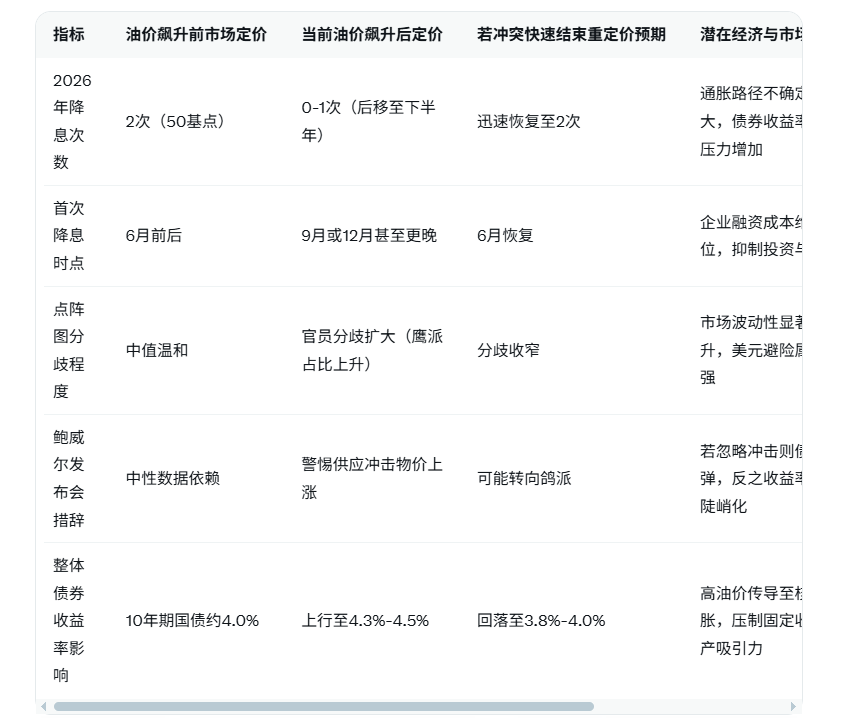
From an in-depth analysis perspective, the Middle East conflict directly amplifies the risk of imported inflation through oil prices. John Tainer emphasizes that this meeting will be a key turning point: if the dot plot shows a more hawkish shift, it will solidify the "higher and longer" framework; conversely, if Powell hints at a willingness to ignore short-term supply shocks, the market will immediately price in easing. It is reasonable to speculate that the two previously cancelled rate cut expectations (approximately 50 basis points) could be quickly reinstated within days if the conflict eases in mid-to-late April, pushing the 10-year Treasury yield down by 20-30 basis points, while also benefiting the stock market and high-yield bonds. However, if retaliatory actions continue, the more complex inflation path will force the Fed to maintain the current 3.50%-3.75% range for longer, significantly increasing bond market volatility. Investors need to be wary of the risk of a steepening yield curve.
On the other hand, repricing occurs extremely quickly after a conflict ends, and historical experience shows that the expected rebound after similar geopolitical events often completes within 1-2 weeks. This dynamic reminds the market that the Fed's policy is not isolated but highly linked to global energy supply, and John Tainer 's warning highlights the decisive role of this meeting.
Editor's Summary : While the Middle East conflict and oil price pressures have temporarily frozen the room for interest rate cuts, the Fed's dot plot, disagreements, and Powell's remarks will act as catalysts for repricing. The future path depends on the pace of conflict easing and the actual transmission of inflation; the bond and foreign exchange markets need to remain highly vigilant.
Frequently Asked Questions
Q1: Why did the Middle East conflict and rising oil prices directly cancel the expectation of two Fed rate cuts this year?
A: Soaring oil prices are driving imported inflation, complicating the Federal Reserve's assessment of the price path. John Tainer points out that the market has completely priced in the two previously anticipated rate cuts, shifting its focus to the hawkish divergence in the dot plot. If the conflict persists, supply shocks could make core inflation stickier, forcing policy to remain at 3.50%-3.75% for longer to avoid premature easing exacerbating price pressures.
Q2: What are the three most important focuses of this Federal Reserve meeting?
A: First, the changing divergence among officials relative to the median in the dot plot; second, whether Powell's press conference hinted at intentionally ignoring price increases caused by commodity supply shocks; and third, whether the overall policy signal remains "data-dependent." John Tainer emphasizes that these factors will directly determine the market's next move, and any hawkish tilt could push up bond yields.
Q3: If the conflict ends quickly, how will the expectation of interest rate cuts be quickly repriced?
A: History shows that after geopolitical tensions ease, the market can quickly recover previously canceled expectations within days. John Tainer explicitly stated that if the conflict ends quickly, the pricing of the previous two rate cuts will be rapidly restored, pushing the timing of the first rate cut forward to June. The 10-year Treasury yield is expected to fall by 20-30 basis points, which is beneficial to fixed-income assets.
Q4: What specific impact will the widening divergence in the dot plot have on the bond market?
A: Widening divergence will increase policy uncertainty, causing the yield curve to steepen, with short-term bond yields remaining relatively stable while long-term bond yields come under pressure. John Tainer cautions that investors should pay attention to officials' deviations from the median; if hawkish sentiment increases, the overall attractiveness of the bond market will decline.
The latest CME FedWatch data shows that the probability of maintaining interest rates in the 3.50%-3.75% range at the March 18 meeting is as high as 97.9%. Expectations for rate cuts in 2026 have been significantly reduced from two to 0-1, with the first rate cut potentially shifting to the second half of the year or even later. This adjustment directly reflects the inflationary uncertainty caused by the conflict.
To clearly compare the expectations of interest rate cuts with their multi-dimensional impacts, the following table presents key indicators (including pricing changes, dot plot divergences, the impact of policy wording, economic transmission, and expert assessments):
From an in-depth analysis perspective, the Middle East conflict directly amplifies the risk of imported inflation through oil prices. John Tainer emphasizes that this meeting will be a key turning point: if the dot plot shows a more hawkish shift, it will solidify the "higher and longer" framework; conversely, if Powell hints at a willingness to ignore short-term supply shocks, the market will immediately price in easing. It is reasonable to speculate that the two previously cancelled rate cut expectations (approximately 50 basis points) could be quickly reinstated within days if the conflict eases in mid-to-late April, pushing the 10-year Treasury yield down by 20-30 basis points, while also benefiting the stock market and high-yield bonds. However, if retaliatory actions continue, the more complex inflation path will force the Fed to maintain the current 3.50%-3.75% range for longer, significantly increasing bond market volatility. Investors need to be wary of the risk of a steepening yield curve.
On the other hand, repricing occurs extremely quickly after a conflict ends, and historical experience shows that the expected rebound after similar geopolitical events often completes within 1-2 weeks. This dynamic reminds the market that the Fed's policy is not isolated but highly linked to global energy supply, and John Tainer 's warning highlights the decisive role of this meeting.
Editor's Summary : While the Middle East conflict and oil price pressures have temporarily frozen the room for interest rate cuts, the Fed's dot plot, disagreements, and Powell's remarks will act as catalysts for repricing. The future path depends on the pace of conflict easing and the actual transmission of inflation; the bond and foreign exchange markets need to remain highly vigilant.
Frequently Asked Questions
Q1: Why did the Middle East conflict and rising oil prices directly cancel the expectation of two Fed rate cuts this year?
A: Soaring oil prices are driving imported inflation, complicating the Federal Reserve's assessment of the price path. John Tainer points out that the market has completely priced in the two previously anticipated rate cuts, shifting its focus to the hawkish divergence in the dot plot. If the conflict persists, supply shocks could make core inflation stickier, forcing policy to remain at 3.50%-3.75% for longer to avoid premature easing exacerbating price pressures.
Q2: What are the three most important focuses of this Federal Reserve meeting?
A: First, the changing divergence among officials relative to the median in the dot plot; second, whether Powell's press conference hinted at intentionally ignoring price increases caused by commodity supply shocks; and third, whether the overall policy signal remains "data-dependent." John Tainer emphasizes that these factors will directly determine the market's next move, and any hawkish tilt could push up bond yields.
Q3: If the conflict ends quickly, how will the expectation of interest rate cuts be quickly repriced?
A: History shows that after geopolitical tensions ease, the market can quickly recover previously canceled expectations within days. John Tainer explicitly stated that if the conflict ends quickly, the pricing of the previous two rate cuts will be rapidly restored, pushing the timing of the first rate cut forward to June. The 10-year Treasury yield is expected to fall by 20-30 basis points, which is beneficial to fixed-income assets.
Q4: What specific impact will the widening divergence in the dot plot have on the bond market?
A: Widening divergence will increase policy uncertainty, causing the yield curve to steepen, with short-term bond yields remaining relatively stable while long-term bond yields come under pressure. John Tainer cautions that investors should pay attention to officials' deviations from the median; if hawkish sentiment increases, the overall attractiveness of the bond market will decline.
- Risk Warning and Disclaimer
- The market involves risk, and trading may not be suitable for all investors. This article is for reference only and does not constitute personal investment advice, nor does it take into account certain users’ specific investment objectives, financial situation, or other needs. Any investment decisions made based on this information are at your own risk.