The closure of the strait caused oil prices to surge to multi-year highs, with corporate executives saying the worst-case scenario could continue until the end of the year.
2026-03-23 11:06:43
The de facto closure of the Strait of Hormuz has pushed global oil prices to extreme levels unseen in many years, disrupted supply chains across industries, and puts the last vestiges of confidence among corporate executives that "the worst is yet to come" to an unprecedented and severe test.
This energy crisis, triggered by the US-Iran war, has not only plunged markets into turmoil but has also forced global business decision-makers to begin preparing for the worst-case scenario of prolonged high oil prices and economic recession.
Last Friday (March 20), United Airlines CEO Scott Kirby publicly stated that the company is planning for a full range of oil prices based on a price of $175 per barrel, assuming that oil prices will remain above $100 until 2027. He added that this prediction may not necessarily come true, but as the CEO of an airline, he has every reason to at least begin to treat this scenario as a potential reality and prepare for a potentially long-term energy shock.
In recent years, corporate executives have gradually adapted to a world where new uncertainties emerge one after another. However, the potential cascading consequences of the US-Iran war have put immense pressure on everyone.
President Trump's continued provision of a vague timeline for ending the war has further heightened tensions in markets and among many executives.
Last Friday, the Nasdaq officially entered correction territory, marking the fourth consecutive week of declines in the stock market. More worryingly, not only did risk assets fall sharply, but traditional safe-haven assets such as gold and bonds also declined, indicating a serious shaken investor confidence.
The U.S. government and military are acting swiftly. Last Thursday, the Chairman of the Joint Chiefs of Staff stated explicitly that the U.S. military is "hunting down and destroying" various vessels used by Iran to blockade the Strait of Hormuz.
President Trump escalated his threats regarding the Strait of Hormuz, publicly declaring on Saturday that Iran must reopen the strait within 48 hours or the United States would directly destroy power plants within Iran. Meanwhile, more U.S. allies have expressed their willingness to support actions to ensure the safe passage of ships, although no concrete implementation plan has yet been unveiled. Trump also emphasized on Friday: "The Strait of Hormuz must be guarded and patrolled by other countries that use it, as needed. The United States will not assume this responsibility!"
In response to the above statement, Iran issued a strong statement on Sunday (March 22) saying that if its power infrastructure is attacked, the Strait will be "completely closed," indicating that the two sides' positions have entered a highly confrontational stage.
Corporate executives have reached a consensus: the Trump administration and its allies have only about two weeks left to successfully reopen the Strait of Hormuz, or they must assume the conflict will continue until at least the middle of the year and bear all the negative consequences for the global economy .
This assessment stemmed from an internal conference call earlier last week among members of the CNBC CFO Council. The call featured John Kilduff, an energy and commodities market expert at Again Capital, who shared his latest views on the oil price outlook from a trader's and investor's perspective.
Of all industries, the energy sector is undoubtedly at the forefront of the battle.
During a conference call last Tuesday morning, an energy company's CFO (who was allowed to remain anonymous to allow for free discussion of the company's true perspectives) revealed that his team was planning for three distinct scenarios: the Strait of Hormuz reopening by the end of March, reopening near mid-year, or, in the worst-case scenario, remaining closed until the end of the year. The CFO admitted that it was currently difficult to accurately determine which scenario was more likely, forcing the management team to prepare for "the worst-case scenario" and remain highly vigilant.
This pressing concern about time quickly resonated with CFOs in non-energy sectors.
A tech CFO stated that not directly facing rising oil prices doesn't mean the company can rest easy; the indirect impact on global enterprises is equally significant, especially in the Middle East and other rapidly growing economies like Saudi Arabia, Dubai, and the UAE. Despite his business primarily focusing on enterprise sales, the CFO pointed out, "Consumer demand will ultimately translate into enterprise demand, directly impacting our performance." He further pressed, "How long can this situation last?"
John Kilduff stated that the scenario planning of energy company boards is highly consistent with the actual operations of market traders.
He told the energy CFO, "The reopening scenario you mentioned at the end of March only has about two weeks left, which is exactly the window I've been emphasizing." He added, "We're currently in a huge window of uncertainty, partly because the military has clearly shifted its focus to the Strait." John Kilduff stated, "The future remains unclear, but if the situation isn't resolved by April 1st and the conflict drags into the middle of the year, then we'll see another major repricing, with WTI crude easily breaking the $100 mark, and shortages in Asia will be the first to surface. "
The release of strategic petroleum reserves from Japan to the United States, along with the U.S. capacity to release more than a million barrels per day, could have alleviated the supply panic that had emerged following the Russia-Ukraine conflict.
However, John Kilduff points out that "the numbers are simply too large," and these measures cannot be effective in the long run. He emphasizes, "This is a massive shortfall of 10 to 12 million barrels per day... truly insurmountable. There are no policy measures that can address this, and no leverage that can offset this shock."
Therefore, he believes the real focus should be on what happens after April 1st. “If there are still no solutions, no concrete plans, and not even a glimmer of hope for reopening the strait by then, no matter how much the military assembles its forces,” John Kilduff said, “it will truly evolve into an energy crisis. By mid-year, India, Japan, South Korea, and other places will experience significant shortages. These countries will have to limit industrial production and truly begin conserving energy to maintain basic power supply.” He warned, “If the military and government still haven’t come up with effective solutions by April 1st, austerity measures will be fully implemented.”
John Kilduff stated that the relatively positive news at present is that the United States is facing less direct pressure.
Despite the dramatic fluctuations in the diesel market, with prices rising far more sharply than crude oil and gasoline, short-term supply remains relatively ample. However, he added, "By the end of the year, even in the continental United States, we will face a major energy crisis... I think the shortage will definitely extend to California."
John Kilduff points out that the oil market's own adjustments are insufficient to resolve the crisis. The Strait of Hormuz normally handles about 20 million barrels per day, which cannot be completely diverted through facilities such as the Saudi East-West Pipeline. Even if the pipeline transports a maximum of 2 million barrels per day, only 1 to 1.5 million barrels can actually be loaded onto ships. "All the policy measures we've discussed cannot truly solve the current predicament."
In his view, the reason why WTI crude oil is currently capped around $100 and Brent crude oil is relatively stable in the $105-$110 range is that: "The market still believes that the situation may be resolved quickly... We are standing on the edge of a cliff, waiting to see if it will rise further."
John Kilduff added, " If this continues for more than two weeks, oil prices will be significantly repriced ."
Even if the Taiwan Strait issue is temporarily resolved, the market generally expects oil prices to retain a significant risk premium for an extended period, as many Middle Eastern countries have shut down production, damaged facilities, and face lengthy recovery periods. Regarding potential further attacks on Iranian oil export facilities by the US or Israel, John Kilduff stated, "I expect Iran to use its remaining resources to asymmetrically attack oil facilities in neighboring countries, with the UAE bearing the brunt due to its proximity and vulnerability."
He further analyzed: "This is a key unknown. How will Iran respond? Will it attack neighboring countries? Will there be what I call 'drowning syndrome,' where you go to save someone but get dragged into the abyss along with them? Iran currently seems to be adopting this strategy; they want everyone to suffer together, and they're doing it quite successfully."
John Kilduff added, "Once news breaks that Iran has successfully attacked key facilities in Saudi Arabia, Kuwait, or Iraq, oil prices will jump by $20 instantly, and traders will go into 'buy now, ask later' mode."
John Kilduff concluded by emphasizing that even if the situation eventually eases, "the return will be an extremely cautious and slow process, and getting back to the $70 or even $60 range will be exceptionally difficult because the fundamentals and risk environment will remain highly tense."
However, the immediate priority remains the next two weeks. John Kilduff said, "We are at the critical point where $100 could become a new bottom. If there is no substantial progress in securing the Straits, market tolerance will completely disappear, and supply losses will begin to tighten and really bite."
He concluded, "With President Trump and the military focusing all their attention on the Strait recently, the market is now facing its final test. Can we get out of this predicament within two weeks? We are all holding our breath. It's like a scene from a disaster movie, watching a giant wave crashing in. Will everything end in the worst possible way?"
This energy storm, triggered by the blockade of the Strait of Hormuz, is testing the limits of global businesses and governments at an alarming pace. Regardless of whether the situation improves in the next two weeks, business executives are already preparing for the worst: high oil prices, supply chain disruptions, and the long shadow of persistent inflation may loom over the global economy until the second half of 2026. The trajectory of the conflict remains uncertain, but its profound impact on the world economy is already clear—those who adapt first will gain breathing room in this crisis.
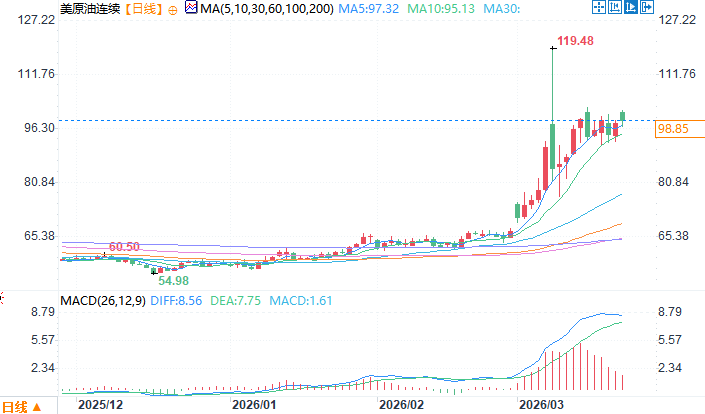
US crude oil daily chart source: EasyTrade
At 11:06 AM Beijing time on March 23, US crude oil futures were trading at $98.90 per barrel.
This energy crisis, triggered by the US-Iran war, has not only plunged markets into turmoil but has also forced global business decision-makers to begin preparing for the worst-case scenario of prolonged high oil prices and economic recession.
United Airlines CEO is the first to speak out: Plans are in place based on a $175 fuel price.
Last Friday (March 20), United Airlines CEO Scott Kirby publicly stated that the company is planning for a full range of oil prices based on a price of $175 per barrel, assuming that oil prices will remain above $100 until 2027. He added that this prediction may not necessarily come true, but as the CEO of an airline, he has every reason to at least begin to treat this scenario as a potential reality and prepare for a potentially long-term energy shock.
Senior management is generally anxious: uncertainty coupled with the risk of war has led to a continuous sharp decline in the market.
In recent years, corporate executives have gradually adapted to a world where new uncertainties emerge one after another. However, the potential cascading consequences of the US-Iran war have put immense pressure on everyone.
President Trump's continued provision of a vague timeline for ending the war has further heightened tensions in markets and among many executives.
Last Friday, the Nasdaq officially entered correction territory, marking the fourth consecutive week of declines in the stock market. More worryingly, not only did risk assets fall sharply, but traditional safe-haven assets such as gold and bonds also declined, indicating a serious shaken investor confidence.
The Trump administration and military responded strongly, and Iran issued a tit-for-tat warning.
The U.S. government and military are acting swiftly. Last Thursday, the Chairman of the Joint Chiefs of Staff stated explicitly that the U.S. military is "hunting down and destroying" various vessels used by Iran to blockade the Strait of Hormuz.
President Trump escalated his threats regarding the Strait of Hormuz, publicly declaring on Saturday that Iran must reopen the strait within 48 hours or the United States would directly destroy power plants within Iran. Meanwhile, more U.S. allies have expressed their willingness to support actions to ensure the safe passage of ships, although no concrete implementation plan has yet been unveiled. Trump also emphasized on Friday: "The Strait of Hormuz must be guarded and patrolled by other countries that use it, as needed. The United States will not assume this responsibility!"
In response to the above statement, Iran issued a strong statement on Sunday (March 22) saying that if its power infrastructure is attacked, the Strait will be "completely closed," indicating that the two sides' positions have entered a highly confrontational stage.
Emergency meeting of the CFO Council: Two-week countdown becomes a critical juncture
Corporate executives have reached a consensus: the Trump administration and its allies have only about two weeks left to successfully reopen the Strait of Hormuz, or they must assume the conflict will continue until at least the middle of the year and bear all the negative consequences for the global economy .
This assessment stemmed from an internal conference call earlier last week among members of the CNBC CFO Council. The call featured John Kilduff, an energy and commodities market expert at Again Capital, who shared his latest views on the oil price outlook from a trader's and investor's perspective.
In-depth scenario simulation for energy companies: All three possible outcomes are not optimistic.
Of all industries, the energy sector is undoubtedly at the forefront of the battle.
During a conference call last Tuesday morning, an energy company's CFO (who was allowed to remain anonymous to allow for free discussion of the company's true perspectives) revealed that his team was planning for three distinct scenarios: the Strait of Hormuz reopening by the end of March, reopening near mid-year, or, in the worst-case scenario, remaining closed until the end of the year. The CFO admitted that it was currently difficult to accurately determine which scenario was more likely, forcing the management team to prepare for "the worst-case scenario" and remain highly vigilant.
Non-energy sectors such as technology are also indirectly impacted: consumer demand may shrink across the board.
This pressing concern about time quickly resonated with CFOs in non-energy sectors.
A tech CFO stated that not directly facing rising oil prices doesn't mean the company can rest easy; the indirect impact on global enterprises is equally significant, especially in the Middle East and other rapidly growing economies like Saudi Arabia, Dubai, and the UAE. Despite his business primarily focusing on enterprise sales, the CFO pointed out, "Consumer demand will ultimately translate into enterprise demand, directly impacting our performance." He further pressed, "How long can this situation last?"
John Kilduff's in-depth analysis: A full-blown crisis may begin after April 1st.
John Kilduff stated that the scenario planning of energy company boards is highly consistent with the actual operations of market traders.
He told the energy CFO, "The reopening scenario you mentioned at the end of March only has about two weeks left, which is exactly the window I've been emphasizing." He added, "We're currently in a huge window of uncertainty, partly because the military has clearly shifted its focus to the Strait." John Kilduff stated, "The future remains unclear, but if the situation isn't resolved by April 1st and the conflict drags into the middle of the year, then we'll see another major repricing, with WTI crude easily breaking the $100 mark, and shortages in Asia will be the first to surface. "
The release of strategic oil reserves cannot solve the fundamental gap: the shortage of tens of millions of barrels per day cannot be filled.
The release of strategic petroleum reserves from Japan to the United States, along with the U.S. capacity to release more than a million barrels per day, could have alleviated the supply panic that had emerged following the Russia-Ukraine conflict.
However, John Kilduff points out that "the numbers are simply too large," and these measures cannot be effective in the long run. He emphasizes, "This is a massive shortfall of 10 to 12 million barrels per day... truly insurmountable. There are no policy measures that can address this, and no leverage that can offset this shock."
Therefore, he believes the real focus should be on what happens after April 1st. “If there are still no solutions, no concrete plans, and not even a glimmer of hope for reopening the strait by then, no matter how much the military assembles its forces,” John Kilduff said, “it will truly evolve into an energy crisis. By mid-year, India, Japan, South Korea, and other places will experience significant shortages. These countries will have to limit industrial production and truly begin conserving energy to maintain basic power supply.” He warned, “If the military and government still haven’t come up with effective solutions by April 1st, austerity measures will be fully implemented.”
The US is relatively resilient in the short term, but will still fall into a serious crisis by the end of the year.
John Kilduff stated that the relatively positive news at present is that the United States is facing less direct pressure.
Despite the dramatic fluctuations in the diesel market, with prices rising far more sharply than crude oil and gasoline, short-term supply remains relatively ample. However, he added, "By the end of the year, even in the continental United States, we will face a major energy crisis... I think the shortage will definitely extend to California."
The oil market's self-regulation is also powerless: risk premiums have become a long-term reality.
John Kilduff points out that the oil market's own adjustments are insufficient to resolve the crisis. The Strait of Hormuz normally handles about 20 million barrels per day, which cannot be completely diverted through facilities such as the Saudi East-West Pipeline. Even if the pipeline transports a maximum of 2 million barrels per day, only 1 to 1.5 million barrels can actually be loaded onto ships. "All the policy measures we've discussed cannot truly solve the current predicament."
In his view, the reason why WTI crude oil is currently capped around $100 and Brent crude oil is relatively stable in the $105-$110 range is that: "The market still believes that the situation may be resolved quickly... We are standing on the edge of a cliff, waiting to see if it will rise further."
John Kilduff added, " If this continues for more than two weeks, oil prices will be significantly repriced ."
The Middle East is experiencing a devastating chain reaction: Iran may drag everyone down with it.
Even if the Taiwan Strait issue is temporarily resolved, the market generally expects oil prices to retain a significant risk premium for an extended period, as many Middle Eastern countries have shut down production, damaged facilities, and face lengthy recovery periods. Regarding potential further attacks on Iranian oil export facilities by the US or Israel, John Kilduff stated, "I expect Iran to use its remaining resources to asymmetrically attack oil facilities in neighboring countries, with the UAE bearing the brunt due to its proximity and vulnerability."
He further analyzed: "This is a key unknown. How will Iran respond? Will it attack neighboring countries? Will there be what I call 'drowning syndrome,' where you go to save someone but get dragged into the abyss along with them? Iran currently seems to be adopting this strategy; they want everyone to suffer together, and they're doing it quite successfully."
John Kilduff added, "Once news breaks that Iran has successfully attacked key facilities in Saudi Arabia, Kuwait, or Iraq, oil prices will jump by $20 instantly, and traders will go into 'buy now, ask later' mode."
The next two weeks will determine everything: $100 may be the new bottom, and the market is holding its breath.
John Kilduff concluded by emphasizing that even if the situation eventually eases, "the return will be an extremely cautious and slow process, and getting back to the $70 or even $60 range will be exceptionally difficult because the fundamentals and risk environment will remain highly tense."
However, the immediate priority remains the next two weeks. John Kilduff said, "We are at the critical point where $100 could become a new bottom. If there is no substantial progress in securing the Straits, market tolerance will completely disappear, and supply losses will begin to tighten and really bite."
He concluded, "With President Trump and the military focusing all their attention on the Strait recently, the market is now facing its final test. Can we get out of this predicament within two weeks? We are all holding our breath. It's like a scene from a disaster movie, watching a giant wave crashing in. Will everything end in the worst possible way?"
This energy storm, triggered by the blockade of the Strait of Hormuz, is testing the limits of global businesses and governments at an alarming pace. Regardless of whether the situation improves in the next two weeks, business executives are already preparing for the worst: high oil prices, supply chain disruptions, and the long shadow of persistent inflation may loom over the global economy until the second half of 2026. The trajectory of the conflict remains uncertain, but its profound impact on the world economy is already clear—those who adapt first will gain breathing room in this crisis.
US crude oil daily chart source: EasyTrade
At 11:06 AM Beijing time on March 23, US crude oil futures were trading at $98.90 per barrel.
- Risk Warning and Disclaimer
- The market involves risk, and trading may not be suitable for all investors. This article is for reference only and does not constitute personal investment advice, nor does it take into account certain users’ specific investment objectives, financial situation, or other needs. Any investment decisions made based on this information are at your own risk.