More terrifying than the oil crisis! Morgan Stanley sounds the alarm: $120 oil prices will severely impact Asia.
2026-03-23 13:44:10
A recent research report from Morgan Stanley warns that if international oil prices continue to rise to $120 per barrel, it will pose a significant risk to Asian economic growth. The report emphasizes that with the Strait of Hormuz essentially blocked, the escalating conflict between the US and Iran, and oil prices remaining high and volatile, Asia, as the world's largest energy importer, is facing unprecedented dual pressures from imported inflation and economic slowdown.
Analysts believe that high oil prices have shifted from a short-term shock to a medium- to long-term structural challenge, significantly compressing the policy space for Asian economies. On Monday (March 23) during Asian trading hours, US crude oil prices initially surged before retreating, currently fluctuating around $98.20 per barrel. Earlier in the session, prices jumped 3% to $101.50 per barrel, a new high since March 16.

Morgan Stanley's quantitative analysis shows that every $10 increase in oil prices per barrel will directly drag down overall GDP growth in Asia by 20-30 basis points.
This impact is transmitted through multiple channels: first, it directly increases import costs, raising production costs for businesses and household spending; second, it amplifies inflation expectations, forcing central banks to tighten monetary policy; and third, it weakens export competitiveness, affecting the stability of the manufacturing sector and supply chains. Currently, Brent crude oil has stabilized above $110; if it further breaks through $120, Asian economic growth will face significant downside risks.
The report points out that if oil prices rise to $120, Asia's oil and gas import burden will account for 6.3% of GDP, far higher than the historical average.
This increased burden will squeeze fiscal and monetary policy space, weakening the government's ability to stimulate economic growth. Most Asian economies are highly dependent on Middle Eastern oil and Qatari LNG. Continued disruptions to shipping through the Strait of Hormuz and the long-term paralysis of Qatar's production capacity have made structurally high energy costs a reality, exposing Asia's "energy vulnerability."
Morgan Stanley emphasizes that if the US-Iran conflict drags on and commodity prices remain high, the policy buffers available to Asian economies will be significantly weakened. Most countries are already facing the dual challenges of high inflation and slowing growth, with widening fiscal deficits, increasing debt burdens, and limited room for monetary policy maneuvering.
If the energy crisis evolves into a protracted battle, Asian central banks will face a dilemma of "fighting inflation vs. stabilizing growth," resulting in a significant decrease in policy flexibility.
Analysts specifically pointed out that if the conflict continues, the central banks of the Philippines, Indonesia, India, and South Korea may have to start raising interest rates from the end of the third quarter or the fourth quarter.
These countries are highly dependent on imported energy, and high oil prices will directly push up the CPI, forcing central banks to prioritize anchoring inflation expectations. Interest rate hikes will further increase corporate financing costs, suppress consumption and investment, exacerbate downward pressure on economic growth, and create a vicious cycle.
A Morgan Stanley report views the $120 oil price scenario as a major turning point for Asian economic growth, with every $10 increase dragging down GDP by 20-30 basis points. Energy costs account for 6.3% of GDP, significantly reducing policy buffers. Central banks in highly dependent countries such as the Philippines, Indonesia, India, and South Korea may be forced to raise interest rates in the third or fourth quarter, facing a dilemma between combating inflation and stabilizing growth.
With the Strait of Hormuz essentially blocked, the US-Iran conflict escalating, and international oil prices fluctuating at high levels, Asian energy-importing countries are facing severe structural challenges. The report warns that if the conflict drags on, high commodity prices will become the "new normal" for the Asian economy, putting pressure on both growth prospects and inflation expectations, and severely testing the independence of regional monetary policy and fiscal sustainability.
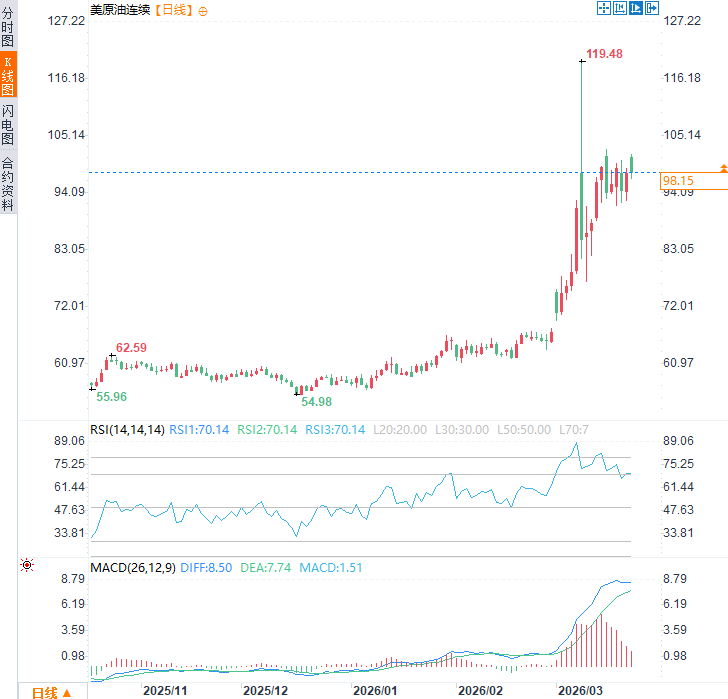
(US crude oil daily chart, source: FX678)
At 13:43 Beijing time, US crude oil futures were trading at $98.07 per barrel.
Analysts believe that high oil prices have shifted from a short-term shock to a medium- to long-term structural challenge, significantly compressing the policy space for Asian economies. On Monday (March 23) during Asian trading hours, US crude oil prices initially surged before retreating, currently fluctuating around $98.20 per barrel. Earlier in the session, prices jumped 3% to $101.50 per barrel, a new high since March 16.
Every $10 increase in oil prices drags down Asian GDP by 20-30 basis points.
Morgan Stanley's quantitative analysis shows that every $10 increase in oil prices per barrel will directly drag down overall GDP growth in Asia by 20-30 basis points.
This impact is transmitted through multiple channels: first, it directly increases import costs, raising production costs for businesses and household spending; second, it amplifies inflation expectations, forcing central banks to tighten monetary policy; and third, it weakens export competitiveness, affecting the stability of the manufacturing sector and supply chains. Currently, Brent crude oil has stabilized above $110; if it further breaks through $120, Asian economic growth will face significant downside risks.
With oil prices at $120, Asia's oil and gas burden accounts for 6.3% of GDP.
The report points out that if oil prices rise to $120, Asia's oil and gas import burden will account for 6.3% of GDP, far higher than the historical average.
This increased burden will squeeze fiscal and monetary policy space, weakening the government's ability to stimulate economic growth. Most Asian economies are highly dependent on Middle Eastern oil and Qatari LNG. Continued disruptions to shipping through the Strait of Hormuz and the long-term paralysis of Qatar's production capacity have made structurally high energy costs a reality, exposing Asia's "energy vulnerability."
The ongoing conflict will erode policy buffers in Asia.
Morgan Stanley emphasizes that if the US-Iran conflict drags on and commodity prices remain high, the policy buffers available to Asian economies will be significantly weakened. Most countries are already facing the dual challenges of high inflation and slowing growth, with widening fiscal deficits, increasing debt burdens, and limited room for monetary policy maneuvering.
If the energy crisis evolves into a protracted battle, Asian central banks will face a dilemma of "fighting inflation vs. stabilizing growth," resulting in a significant decrease in policy flexibility.
The central banks of the Philippines, Indonesia, India, and South Korea may be forced to raise interest rates in the third or fourth quarter.
Analysts specifically pointed out that if the conflict continues, the central banks of the Philippines, Indonesia, India, and South Korea may have to start raising interest rates from the end of the third quarter or the fourth quarter.
These countries are highly dependent on imported energy, and high oil prices will directly push up the CPI, forcing central banks to prioritize anchoring inflation expectations. Interest rate hikes will further increase corporate financing costs, suppress consumption and investment, exacerbate downward pressure on economic growth, and create a vicious cycle.
Editor's Summary
A Morgan Stanley report views the $120 oil price scenario as a major turning point for Asian economic growth, with every $10 increase dragging down GDP by 20-30 basis points. Energy costs account for 6.3% of GDP, significantly reducing policy buffers. Central banks in highly dependent countries such as the Philippines, Indonesia, India, and South Korea may be forced to raise interest rates in the third or fourth quarter, facing a dilemma between combating inflation and stabilizing growth.
With the Strait of Hormuz essentially blocked, the US-Iran conflict escalating, and international oil prices fluctuating at high levels, Asian energy-importing countries are facing severe structural challenges. The report warns that if the conflict drags on, high commodity prices will become the "new normal" for the Asian economy, putting pressure on both growth prospects and inflation expectations, and severely testing the independence of regional monetary policy and fiscal sustainability.
(US crude oil daily chart, source: FX678)
At 13:43 Beijing time, US crude oil futures were trading at $98.07 per barrel.
- Risk Warning and Disclaimer
- The market involves risk, and trading may not be suitable for all investors. This article is for reference only and does not constitute personal investment advice, nor does it take into account certain users’ specific investment objectives, financial situation, or other needs. Any investment decisions made based on this information are at your own risk.