Has the safe-haven demand failed? Gold prices have fallen for nine consecutive days, nearing their lowest point this year. When will central banks' hawkish stance end?
2026-03-23 13:32:51
Gold prices trended lower in Asian trading on Monday (March 23), marking their ninth consecutive day of decline. They are currently trading around $4,330 per ounce, down approximately 3.7% on the day, after hitting an eleven-week low of $4,319.66. While gold found some support around $4,300, any meaningful rebound seems unlikely. Gold has fallen more than 8% over the past four weeks, a significant pullback from recent highs above $5,300, reflecting the market's repricing of safe-haven demand and the dual pressures of a high-interest-rate environment.
The hawkish stance of major central banks has become the biggest negative factor for gold. The Bank of Japan maintained its normalization bias and warned that the Middle East conflict pushing up oil prices would exacerbate inflationary pressures; the Bank of England signaled a shift to a hawkish stance, hinting at a rate hike as early as April to combat inflation triggered by the war with Iran; the European Central Bank stated that it might act immediately on April 30 if geopolitical tensions exacerbate inflation; and the Federal Reserve raised its year-end PCE inflation forecast, expecting only one rate cut this year and one in 2027, with energy price risks being a key reason.
These signals collectively raise real interest rates and opportunity costs, significantly reducing the attractiveness of non-interest-bearing gold.
The Federal Reserve's hawkish outlook supported high US Treasury yields, while a stronger US dollar index became another major factor suppressing gold prices. A stronger dollar, as the currency for gold pricing, directly reduces its attractiveness, and the high-yield environment further increases the opportunity cost of holding gold. During Monday's Asian trading session, the US dollar index fluctuated and strengthened, currently trading around 99.70, with a daily increase of approximately 0.2%.
Although geopolitical risks provide some safe-haven support, gold is struggling to escape its downward trend due to expectations of central bank tightening.
Trump issued a 48-hour ultimatum demanding Iran unconditionally open the Strait of Hormuz, threatening to destroy Iran's power grid if it refused. The Iranian parliament speaker countered, stating that Iran would consider Gulf energy and water infrastructure legitimate targets and would "irreversibly destroy" them. This threat of mutual destruction of energy resources fueled risk aversion in the market, helping gold hold above the $4,300 mark.
However, the pressure from central bank hawks far outweighs geopolitical premiums. Traders are unwilling to overextend themselves in the face of Trump's "strategic gamble," fearing that if the ultimatum works and the Straits reopen, supply will recover rapidly, limiting the upside potential for gold.
The technical outlook for spot gold is bearish across the board. On the 4-hour chart, it broke below the 200-period exponential moving average (EMA, 4981.68) and fell below $4600; the MACD remains in negative territory, and the histogram is deeply in negative territory; the RSI is around 14, significantly deviating from the midline.
On the downside, the support level is at the psychological level of $4,300. If this level is broken, the channel to $4,250 will open up further downside potential.
On the upside, the first resistance level is at the psychological level of $4,500, with stronger resistance at the 200-period EMA. As long as the price cannot break above the dynamic resistance level of the 200-period EMA, any rebound should be considered a selling opportunity.
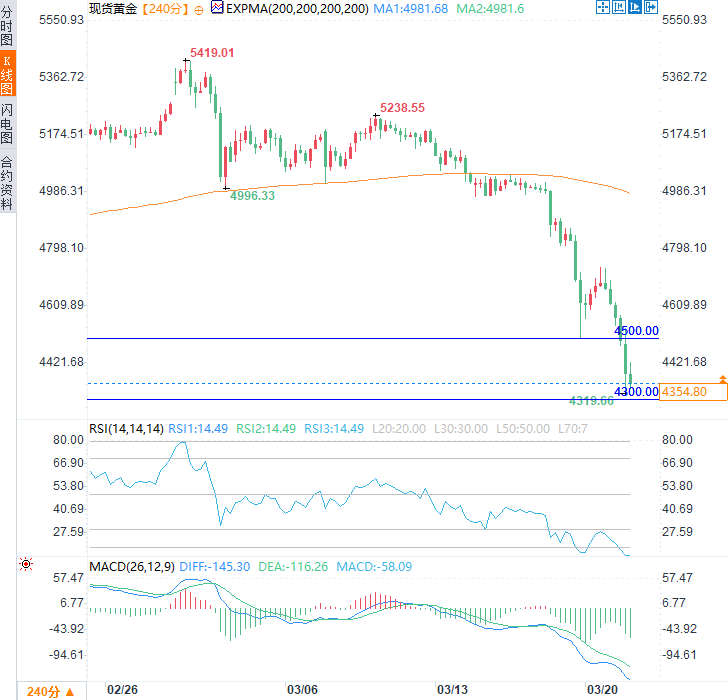
(Spot gold 4-hour chart, source: FX678)
Gold prices approached a yearly low of $4,300, falling for the ninth consecutive trading day as hawkish central bank policies dominated the market: the Federal Reserve raised its inflation forecast, Europe and the UK hinted at interest rate hikes in April, and Japan maintained its normalization policy, all of which together boosted real interest rates and strengthened the US dollar, severely suppressing non-interest-bearing gold.
While the threat of a mutual destruction of energy resources between the US and Iran provided limited safe-haven support, helping to hold the $4,300 level, traders' concerns about the potential success of Trump's ultimatum dampened bullish enthusiasm. Technically, bearish signals are strong.
Gold is currently caught in a game of "central bank tightening vs. geopolitical safe-haven demand," with central bank dominance prevailing. Short-term rebounds are weak, and long-term trends depend on whether the Strait of Hormuz is substantially opened and the intensity of the conflict.
At 13:31 Beijing time, spot gold was trading at $4318.38 per ounce.
Major central banks' hawkish shift suppresses non-interest-bearing gold.
The hawkish stance of major central banks has become the biggest negative factor for gold. The Bank of Japan maintained its normalization bias and warned that the Middle East conflict pushing up oil prices would exacerbate inflationary pressures; the Bank of England signaled a shift to a hawkish stance, hinting at a rate hike as early as April to combat inflation triggered by the war with Iran; the European Central Bank stated that it might act immediately on April 30 if geopolitical tensions exacerbate inflation; and the Federal Reserve raised its year-end PCE inflation forecast, expecting only one rate cut this year and one in 2027, with energy price risks being a key reason.
These signals collectively raise real interest rates and opportunity costs, significantly reducing the attractiveness of non-interest-bearing gold.
A strong dollar and rising US Treasury yields are the main negative factors.
The Federal Reserve's hawkish outlook supported high US Treasury yields, while a stronger US dollar index became another major factor suppressing gold prices. A stronger dollar, as the currency for gold pricing, directly reduces its attractiveness, and the high-yield environment further increases the opportunity cost of holding gold. During Monday's Asian trading session, the US dollar index fluctuated and strengthened, currently trading around 99.70, with a daily increase of approximately 0.2%.
Although geopolitical risks provide some safe-haven support, gold is struggling to escape its downward trend due to expectations of central bank tightening.
The threat of mutual attacks between the US and Iran provides limited safe-haven support.
Trump issued a 48-hour ultimatum demanding Iran unconditionally open the Strait of Hormuz, threatening to destroy Iran's power grid if it refused. The Iranian parliament speaker countered, stating that Iran would consider Gulf energy and water infrastructure legitimate targets and would "irreversibly destroy" them. This threat of mutual destruction of energy resources fueled risk aversion in the market, helping gold hold above the $4,300 mark.
However, the pressure from central bank hawks far outweighs geopolitical premiums. Traders are unwilling to overextend themselves in the face of Trump's "strategic gamble," fearing that if the ultimatum works and the Straits reopen, supply will recover rapidly, limiting the upside potential for gold.
Technical indicators strongly suggest a bearish outlook, with $4,300 becoming a key support level.
The technical outlook for spot gold is bearish across the board. On the 4-hour chart, it broke below the 200-period exponential moving average (EMA, 4981.68) and fell below $4600; the MACD remains in negative territory, and the histogram is deeply in negative territory; the RSI is around 14, significantly deviating from the midline.
On the downside, the support level is at the psychological level of $4,300. If this level is broken, the channel to $4,250 will open up further downside potential.
On the upside, the first resistance level is at the psychological level of $4,500, with stronger resistance at the 200-period EMA. As long as the price cannot break above the dynamic resistance level of the 200-period EMA, any rebound should be considered a selling opportunity.
(Spot gold 4-hour chart, source: FX678)
Editor's Summary
Gold prices approached a yearly low of $4,300, falling for the ninth consecutive trading day as hawkish central bank policies dominated the market: the Federal Reserve raised its inflation forecast, Europe and the UK hinted at interest rate hikes in April, and Japan maintained its normalization policy, all of which together boosted real interest rates and strengthened the US dollar, severely suppressing non-interest-bearing gold.
While the threat of a mutual destruction of energy resources between the US and Iran provided limited safe-haven support, helping to hold the $4,300 level, traders' concerns about the potential success of Trump's ultimatum dampened bullish enthusiasm. Technically, bearish signals are strong.
Gold is currently caught in a game of "central bank tightening vs. geopolitical safe-haven demand," with central bank dominance prevailing. Short-term rebounds are weak, and long-term trends depend on whether the Strait of Hormuz is substantially opened and the intensity of the conflict.
At 13:31 Beijing time, spot gold was trading at $4318.38 per ounce.
- Risk Warning and Disclaimer
- The market involves risk, and trading may not be suitable for all investors. This article is for reference only and does not constitute personal investment advice, nor does it take into account certain users’ specific investment objectives, financial situation, or other needs. Any investment decisions made based on this information are at your own risk.