Is the oil market experiencing a "false break" or a genuine drop? Expectations of US-Iran talks trigger a sell-off, with the US lending 8.48 million barrels of SPR crude oil in an emergency.
2026-04-11 09:03:03
Oil prices fell more than 2% on Friday as the market focused on the permanent ceasefire talks between Iran and the United States in Pakistan ahead of the weekend. Oil prices declined this week as the US-Iran temporary ceasefire and the permanent ceasefire negotiations progressed. Brent crude oil prices fell by 12.7%, marking the largest weekly drop since August 2022; US crude oil prices fell by as much as 13.4%, the worst weekly performance since the COVID-19 lockdowns in April 2020.
With the US-Iran negotiations, the market anticipated a possible easing of geopolitical tensions, thus prematurely priced in the prospect of supply recovery. However, the actual supply side still faces severe congestion, causing oil prices to fluctuate at high levels around $100, with spot market prices even hitting record highs, demonstrating a significant divergence between the futures and spot markets. Analysts at Commerzbank pointed out that the future trend of oil prices depends entirely on whether shipping through the Strait of Hormuz can resume; if Persian Gulf oil exports continue to be hampered, oil prices could surge again. This sharp drop also reflects the complex interplay between the market's perception of a short-term ceasefire and long-term fundamental contradictions.
Strait of Hormuz deadlock
The Strait of Hormuz, a vital chokepoint for global oil transport, is currently virtually at a standstill. Despite a two-week ceasefire agreement between the US and Iran, attacks continue, leading to a sharp decline in the number of oil tankers passing through the strait. Reports indicate that oil transport through the Strait of Hormuz is severely restricted, and market concerns about potential supply disruptions from Saudi Arabia persist. At the heart of this stalemate is the fact that the ceasefire agreement only represents temporary military restraint and does not address the substantial threat posed by Iran to control the strait. Prior to the negotiations, Iran publicly stated that if an agreement in its interests is not reached and fighting resumes, it will launch a "devastating blow" to Israeli and US interests in the Middle East. This makes any attempt to restore shipping extremely risky geopolitically. Analysts believe that the resumption of shipping traffic is a key variable for the oil market, and there are currently no signs that normalization will occur anytime soon. If negotiations break down, the strait could be completely blocked, disrupting the global transport of approximately 20 million barrels of oil per day and causing oil prices to skyrocket uncontrollably.
Supply disruptions and production cuts
Besides the disruption to shipping across the Strait, there has also been a large-scale disruption to actual production. According to official news agencies, the attacks have led to a reduction of 600,000 barrels per day in Saudi oil production. The U.S. Energy Information Administration further noted in its weekly report that, with storage capacity tightening, Middle Eastern oil-producing countries collectively reduced production by approximately 7.5 million barrels per day in March, and the reduction is expected to expand to 9.1 million barrels per day in April. This is a historically rare precipitous drop in supply in a single month, far exceeding any war-related expectations. Meanwhile, drilling activity in the United States is also contracting: Baker Hughes data shows that U.S. energy companies cut 38 oil and gas drilling rigs this week, a total decrease of about 7% compared to the same period last year.
The double whammy on the supply side—active/passive production cuts in the Middle East and declining investment in US shale oil—has formed the basis for this round of oil price surges. Although futures prices have temporarily retreated due to ceasefire expectations, the physical market still faces a supply gap of nearly 10 million barrels per day, and any further deterioration in transportation routes will immediately translate into another price spike.
US Strategic Reserves Lending
In response to the runaway oil prices caused by the war, the Trump administration resorted to the unconventional measure of massively utilizing the Strategic Petroleum Reserve (SPR). The U.S. Department of Energy announced on Friday that it had lent 8.48 million barrels of crude oil to four companies, including Gunvor USA and Phillips 66, in the second round of lending. In the first round, companies only drew down 45.2 million barrels (approximately 52% of the amount provided at that time). According to the final plan, the U.S. will lend a total of 172 million barrels of crude oil from the SPR throughout 2026 and into 2027. This is part of a 32-nation joint effort coordinated by the International Energy Agency to release 400 million barrels of crude oil.
It's worth noting that this time, a "loan + premium return" mechanism is being used: the company will need to return crude oil in the future, plus an additional quantity, theoretically without increasing taxpayer costs. SPR currently holds approximately 413.3 million barrels, equivalent to more than four days of global oil consumption, the lowest level since the mid-1980s. Although the US has become the world's largest oil producer, SPR's rapid depletion has raised long-term energy security concerns. The Department of Energy has also launched a third round of bidding for 30 million barrels of loans, with bidding closing next Monday. This series of operations aims to use reserve inventories to smooth out spot premiums, but whether it can truly curb end-user fuel prices remains to be seen.
Iran Negotiations and Threats
The pivotal event determining the fate of the oil market is the direct US-Iran talks scheduled for Saturday in Islamabad, Pakistan. The Iranian delegation, led by Parliament Speaker Mohammad-Baqar Ghalibaf, includes Foreign Minister Abbas Araqchi, Supreme National Security Council Secretary Ali Akbar Ahmadian, and the Central Bank Governor. The US delegation, led by Vice President Vance, includes Presidential Envoy Witkov and Trump's son-in-law Jared Kushner. The negotiations aim to reach a permanent ceasefire agreement, but the two sides hold deeply divergent positions.
Iranian state media IRIB warned that if an agreement acceptable to both Iran and its resistance forces is not reached and hostilities resume, Iran will launch a "devastating strike" against Israeli and American interests in the Middle East. This threat is not empty rhetoric—Iran possesses a large number of ballistic missiles and regional proxy forces, enabling it to blockade the Strait of Hormuz or attack US military bases.
The market widely expects a low probability of substantial progress in the negotiations, with a more likely outcome being an extension of the temporary ceasefire or a stalemate. If negotiations break down, oil prices will quickly reverse this week's losses and reach new highs; if a permanent agreement is unexpectedly reached, further selling could occur.
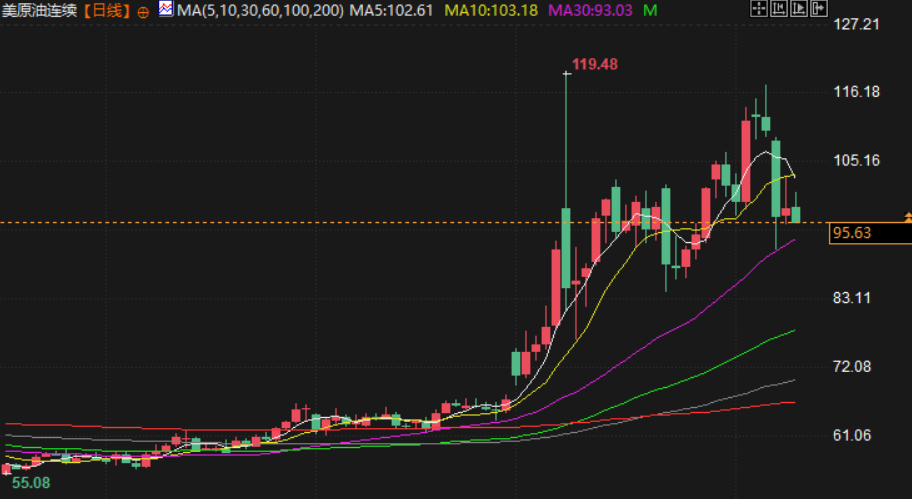
With the US-Iran negotiations, the market anticipated a possible easing of geopolitical tensions, thus prematurely priced in the prospect of supply recovery. However, the actual supply side still faces severe congestion, causing oil prices to fluctuate at high levels around $100, with spot market prices even hitting record highs, demonstrating a significant divergence between the futures and spot markets. Analysts at Commerzbank pointed out that the future trend of oil prices depends entirely on whether shipping through the Strait of Hormuz can resume; if Persian Gulf oil exports continue to be hampered, oil prices could surge again. This sharp drop also reflects the complex interplay between the market's perception of a short-term ceasefire and long-term fundamental contradictions.
Strait of Hormuz deadlock
The Strait of Hormuz, a vital chokepoint for global oil transport, is currently virtually at a standstill. Despite a two-week ceasefire agreement between the US and Iran, attacks continue, leading to a sharp decline in the number of oil tankers passing through the strait. Reports indicate that oil transport through the Strait of Hormuz is severely restricted, and market concerns about potential supply disruptions from Saudi Arabia persist. At the heart of this stalemate is the fact that the ceasefire agreement only represents temporary military restraint and does not address the substantial threat posed by Iran to control the strait. Prior to the negotiations, Iran publicly stated that if an agreement in its interests is not reached and fighting resumes, it will launch a "devastating blow" to Israeli and US interests in the Middle East. This makes any attempt to restore shipping extremely risky geopolitically. Analysts believe that the resumption of shipping traffic is a key variable for the oil market, and there are currently no signs that normalization will occur anytime soon. If negotiations break down, the strait could be completely blocked, disrupting the global transport of approximately 20 million barrels of oil per day and causing oil prices to skyrocket uncontrollably.
Supply disruptions and production cuts
Besides the disruption to shipping across the Strait, there has also been a large-scale disruption to actual production. According to official news agencies, the attacks have led to a reduction of 600,000 barrels per day in Saudi oil production. The U.S. Energy Information Administration further noted in its weekly report that, with storage capacity tightening, Middle Eastern oil-producing countries collectively reduced production by approximately 7.5 million barrels per day in March, and the reduction is expected to expand to 9.1 million barrels per day in April. This is a historically rare precipitous drop in supply in a single month, far exceeding any war-related expectations. Meanwhile, drilling activity in the United States is also contracting: Baker Hughes data shows that U.S. energy companies cut 38 oil and gas drilling rigs this week, a total decrease of about 7% compared to the same period last year.
The double whammy on the supply side—active/passive production cuts in the Middle East and declining investment in US shale oil—has formed the basis for this round of oil price surges. Although futures prices have temporarily retreated due to ceasefire expectations, the physical market still faces a supply gap of nearly 10 million barrels per day, and any further deterioration in transportation routes will immediately translate into another price spike.
US Strategic Reserves Lending
In response to the runaway oil prices caused by the war, the Trump administration resorted to the unconventional measure of massively utilizing the Strategic Petroleum Reserve (SPR). The U.S. Department of Energy announced on Friday that it had lent 8.48 million barrels of crude oil to four companies, including Gunvor USA and Phillips 66, in the second round of lending. In the first round, companies only drew down 45.2 million barrels (approximately 52% of the amount provided at that time). According to the final plan, the U.S. will lend a total of 172 million barrels of crude oil from the SPR throughout 2026 and into 2027. This is part of a 32-nation joint effort coordinated by the International Energy Agency to release 400 million barrels of crude oil.
It's worth noting that this time, a "loan + premium return" mechanism is being used: the company will need to return crude oil in the future, plus an additional quantity, theoretically without increasing taxpayer costs. SPR currently holds approximately 413.3 million barrels, equivalent to more than four days of global oil consumption, the lowest level since the mid-1980s. Although the US has become the world's largest oil producer, SPR's rapid depletion has raised long-term energy security concerns. The Department of Energy has also launched a third round of bidding for 30 million barrels of loans, with bidding closing next Monday. This series of operations aims to use reserve inventories to smooth out spot premiums, but whether it can truly curb end-user fuel prices remains to be seen.
Iran Negotiations and Threats
The pivotal event determining the fate of the oil market is the direct US-Iran talks scheduled for Saturday in Islamabad, Pakistan. The Iranian delegation, led by Parliament Speaker Mohammad-Baqar Ghalibaf, includes Foreign Minister Abbas Araqchi, Supreme National Security Council Secretary Ali Akbar Ahmadian, and the Central Bank Governor. The US delegation, led by Vice President Vance, includes Presidential Envoy Witkov and Trump's son-in-law Jared Kushner. The negotiations aim to reach a permanent ceasefire agreement, but the two sides hold deeply divergent positions.
Iranian state media IRIB warned that if an agreement acceptable to both Iran and its resistance forces is not reached and hostilities resume, Iran will launch a "devastating strike" against Israeli and American interests in the Middle East. This threat is not empty rhetoric—Iran possesses a large number of ballistic missiles and regional proxy forces, enabling it to blockade the Strait of Hormuz or attack US military bases.
The market widely expects a low probability of substantial progress in the negotiations, with a more likely outcome being an extension of the temporary ceasefire or a stalemate. If negotiations break down, oil prices will quickly reverse this week's losses and reach new highs; if a permanent agreement is unexpectedly reached, further selling could occur.
- Risk Warning and Disclaimer
- The market involves risk, and trading may not be suitable for all investors. This article is for reference only and does not constitute personal investment advice, nor does it take into account certain users’ specific investment objectives, financial situation, or other needs. Any investment decisions made based on this information are at your own risk.