Market estimates suggest Japanese authorities will intervene with 5 to 6 trillion yen to stabilize the currency, while institutions are mildly bearish on the USD/JPY exchange rate.
2026-05-04 16:39:35
Michael Wan, senior currency analyst at MUFG, pointed out that Japanese authorities likely intervened aggressively in the foreign exchange market. This move caused the USD/JPY exchange rate to fall rapidly from a high of nearly 160 to below 157, with market estimates placing the intervention at around 5-6 trillion yen. This action is highly similar in scale and timing to previous interventions in 2022 and 2024. MUFG's base case scenario is that the Bank of Japan will implement two interest rate hikes this year, gradually pushing the USD/JPY exchange rate back towards the 152 level.

Wan stated that the USD/JPY exchange rate has fallen sharply, rapidly retreating from a high of nearly 160 to a level slightly below 157. It is highly likely that Japanese authorities intervened in the foreign exchange market on Thursday evening Beijing time, directly pushing the USD/JPY lower.
Market participants, based on data on demand deposits and changes in money market positions released by the Bank of Japan, estimate that the intervention could amount to approximately 5-6 trillion yen, equivalent to about US$32-38 billion. If these preliminary estimates are accurate, the scale of this intervention would be roughly equivalent to the interventions in April 2024 and October 2022.
Wan further analyzed that whether these intervention efforts can lead to a sustainable decline in the USD/JPY exchange rate ultimately depends on changes in market fundamentals. He particularly emphasized two key factors: first, whether the Federal Reserve shifts to a more dovish policy stance; and second, whether the Bank of Japan can proceed with its expected interest rate hikes.
He added, " Our base case remains unchanged: the Bank of Japan will raise interest rates twice this year, in June and December . This assumption, along with a de-escalation of tensions in the Strait of Hormuz, will be a key premise for predicting a gradual decline in the USD/JPY exchange rate to the 152 level."
Historically, Japanese authorities have repeatedly intervened in the foreign exchange market to stabilize the yen when faced with excessive weakness. However, such interventions often only provide short-term support, while long-term trends still rely on monetary policy adjustments and improvements in economic fundamentals. This intervention once again demonstrates Japan's firm commitment to maintaining exchange rate stability, while also highlighting the profound impact of policy divergences among major global central banks on cross-border capital flows and exchange rate trends.
In the current environment, the Federal Reserve's policy path, the Bank of Japan's interest rate hike pace, and geopolitical factors together constitute the key variables affecting the USD/JPY exchange rate. MUFG believes that as the Bank of Japan gradually tightens its policy, coupled with the potential weakening of the US dollar, the USD/JPY exchange rate is likely to show a moderate downward trend in the near future.
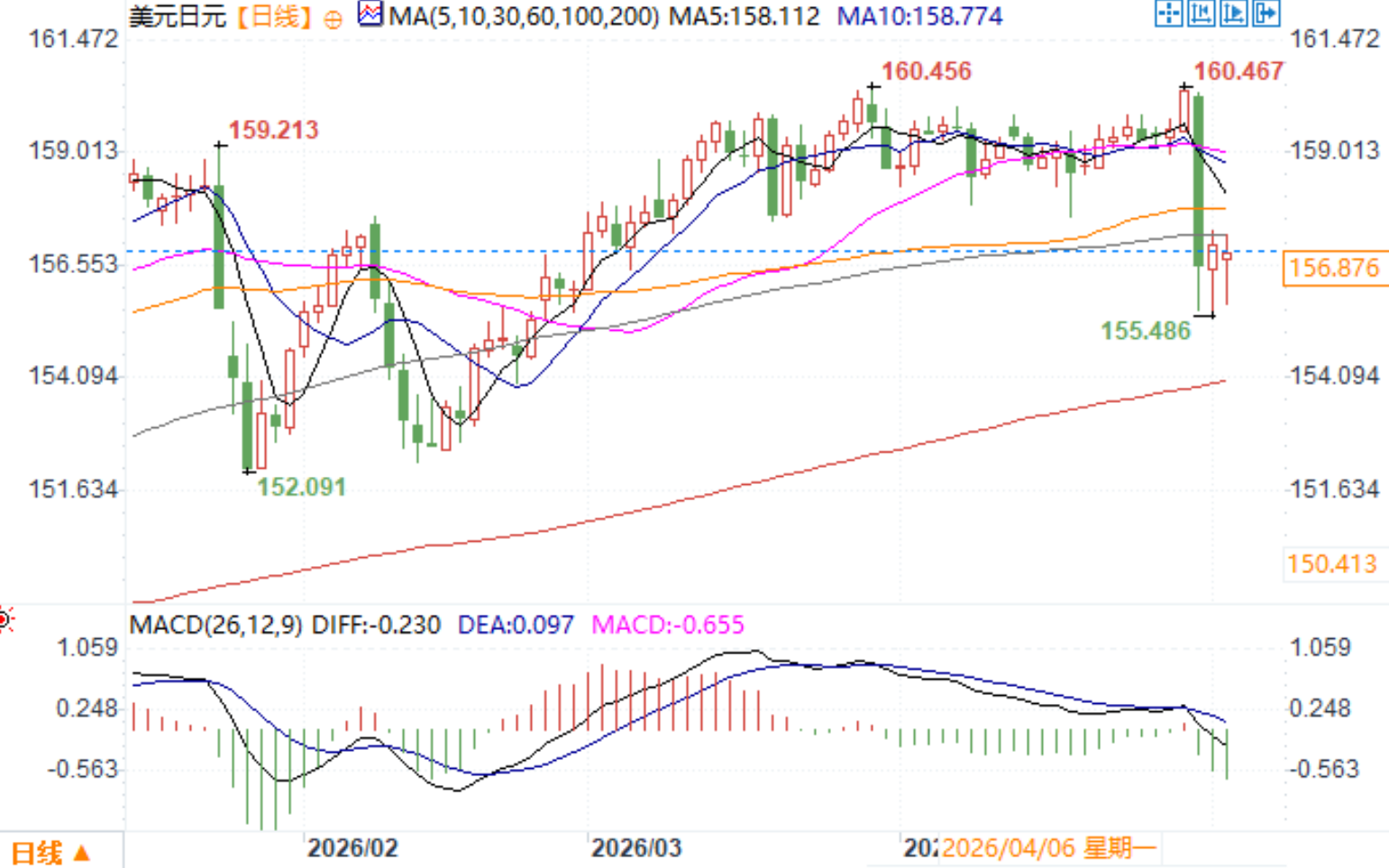
USD/JPY Daily Chart Source: EasyForex
At 15:40 Beijing time on May 4, the USD/JPY exchange rate was 156.876/897.
Authorities adopted a two-pronged approach: intervening to raise interest rates to stabilize the yen.
Wan stated that the USD/JPY exchange rate has fallen sharply, rapidly retreating from a high of nearly 160 to a level slightly below 157. It is highly likely that Japanese authorities intervened in the foreign exchange market on Thursday evening Beijing time, directly pushing the USD/JPY lower.
Market participants, based on data on demand deposits and changes in money market positions released by the Bank of Japan, estimate that the intervention could amount to approximately 5-6 trillion yen, equivalent to about US$32-38 billion. If these preliminary estimates are accurate, the scale of this intervention would be roughly equivalent to the interventions in April 2024 and October 2022.
The effectiveness of intervention depends on the coordination of fundamentals and policies.
Wan further analyzed that whether these intervention efforts can lead to a sustainable decline in the USD/JPY exchange rate ultimately depends on changes in market fundamentals. He particularly emphasized two key factors: first, whether the Federal Reserve shifts to a more dovish policy stance; and second, whether the Bank of Japan can proceed with its expected interest rate hikes.
He added, " Our base case remains unchanged: the Bank of Japan will raise interest rates twice this year, in June and December . This assumption, along with a de-escalation of tensions in the Strait of Hormuz, will be a key premise for predicting a gradual decline in the USD/JPY exchange rate to the 152 level."
Historical Experience and Future Prospects
Historically, Japanese authorities have repeatedly intervened in the foreign exchange market to stabilize the yen when faced with excessive weakness. However, such interventions often only provide short-term support, while long-term trends still rely on monetary policy adjustments and improvements in economic fundamentals. This intervention once again demonstrates Japan's firm commitment to maintaining exchange rate stability, while also highlighting the profound impact of policy divergences among major global central banks on cross-border capital flows and exchange rate trends.
In the current environment, the Federal Reserve's policy path, the Bank of Japan's interest rate hike pace, and geopolitical factors together constitute the key variables affecting the USD/JPY exchange rate. MUFG believes that as the Bank of Japan gradually tightens its policy, coupled with the potential weakening of the US dollar, the USD/JPY exchange rate is likely to show a moderate downward trend in the near future.
USD/JPY Daily Chart Source: EasyForex
At 15:40 Beijing time on May 4, the USD/JPY exchange rate was 156.876/897.
- Risk Warning and Disclaimer
- The market involves risk, and trading may not be suitable for all investors. This article is for reference only and does not constitute personal investment advice, nor does it take into account certain users’ specific investment objectives, financial situation, or other needs. Any investment decisions made based on this information are at your own risk.