Goldman Sachs significantly postpones its expectation of a Federal Reserve rate cut to the end of 2026, citing high energy prices as a factor that could lock in inflationary pressures.
2026-05-11 14:55:41
According to APP, Goldman Sachs has significantly postponed its forecast for the timing of Federal Reserve rate cuts, from September and December 2026 to December 2026 and March 2027. The firm emphasizes that high energy prices are likely to pass on costs, keeping core PCE inflation near 3% for an extended period, well above the Fed's long-term target of 2%.

This adjustment reflects the generally cautious attitude of global financial institutions towards the path of monetary policy. With the conflict in the Middle East having lasted for about 10 weeks, energy supplies are facing disruptions, oil prices have risen significantly, and overall inflation expectations have increased. Several brokerages have subsequently lowered their outlook for US easing policies in 2026, and market opinions are now clearly divided: some institutions still expect a slight easing, while others believe that there may be no rate cuts at all in 2026, or even that action will not be possible until 2027.
Goldman Sachs economists point out that persistently high energy costs will have a lasting transmission effect on core inflation. Even with some softening in the labor market, the Federal Reserve will find it difficult to initiate a rate-cutting cycle if the oil price shock does not subside significantly. The bank maintains its terminal interest rate target in the **3%-3.25%** range, but the significant postponement of the timeline highlights the constraints that geopolitical risks place on macroeconomic policy.
New York Federal Reserve President John Williams recently stated that the Middle East conflict has driven up inflation and shown initial signs of supply chain disruptions. He projects inflation could reach 2.75%-3% in 2026, but long-term inflation expectations remain stable, and pressures are expected to gradually ease in 2027 if the conflict subsides. Williams emphasized that policymakers need to pay attention to both declining inflation and signs of further weakening in the labor market.
Currently, the Federal Reserve's target range for the federal funds rate remains at 3.50%-3.75%, and recent meetings have all opted to hold rates steady. The CME FedWatch tool indicates a low probability of significant easing in the first half of 2026, with market pricing suggesting stability or very limited adjustments throughout the year.
The table below shows the latest outlook from some institutions on the Federal Reserve's interest rate cut path in 2026-2027 (based on publicly available reports):
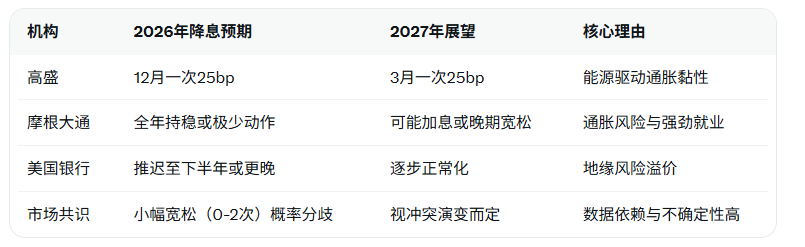
This comparison shows that mainstream opinion on Wall Street is becoming more conservative, and the restrictive policy stance of "higher and longer" is being maintained in the current environment.
Editor's Summary:
The delay in the Federal Reserve's interest rate cut stems from the combined effects of high energy prices and geopolitical uncertainties, rather than solely from fluctuations in economic data. Future policy path will heavily depend on the evolution of the Middle East situation, oil price trends, and the actual decline in core inflation. Investors need to closely monitor monthly inflation reports and employment data to dynamically adjust their asset allocation strategies.
This adjustment reflects the generally cautious attitude of global financial institutions towards the path of monetary policy. With the conflict in the Middle East having lasted for about 10 weeks, energy supplies are facing disruptions, oil prices have risen significantly, and overall inflation expectations have increased. Several brokerages have subsequently lowered their outlook for US easing policies in 2026, and market opinions are now clearly divided: some institutions still expect a slight easing, while others believe that there may be no rate cuts at all in 2026, or even that action will not be possible until 2027.
Goldman Sachs economists point out that persistently high energy costs will have a lasting transmission effect on core inflation. Even with some softening in the labor market, the Federal Reserve will find it difficult to initiate a rate-cutting cycle if the oil price shock does not subside significantly. The bank maintains its terminal interest rate target in the **3%-3.25%** range, but the significant postponement of the timeline highlights the constraints that geopolitical risks place on macroeconomic policy.
New York Federal Reserve President John Williams recently stated that the Middle East conflict has driven up inflation and shown initial signs of supply chain disruptions. He projects inflation could reach 2.75%-3% in 2026, but long-term inflation expectations remain stable, and pressures are expected to gradually ease in 2027 if the conflict subsides. Williams emphasized that policymakers need to pay attention to both declining inflation and signs of further weakening in the labor market.
Currently, the Federal Reserve's target range for the federal funds rate remains at 3.50%-3.75%, and recent meetings have all opted to hold rates steady. The CME FedWatch tool indicates a low probability of significant easing in the first half of 2026, with market pricing suggesting stability or very limited adjustments throughout the year.
The table below shows the latest outlook from some institutions on the Federal Reserve's interest rate cut path in 2026-2027 (based on publicly available reports):
This comparison shows that mainstream opinion on Wall Street is becoming more conservative, and the restrictive policy stance of "higher and longer" is being maintained in the current environment.
Editor's Summary:
The delay in the Federal Reserve's interest rate cut stems from the combined effects of high energy prices and geopolitical uncertainties, rather than solely from fluctuations in economic data. Future policy path will heavily depend on the evolution of the Middle East situation, oil price trends, and the actual decline in core inflation. Investors need to closely monitor monthly inflation reports and employment data to dynamically adjust their asset allocation strategies.
- Risk Warning and Disclaimer
- The market involves risk, and trading may not be suitable for all investors. This article is for reference only and does not constitute personal investment advice, nor does it take into account certain users’ specific investment objectives, financial situation, or other needs. Any investment decisions made based on this information are at your own risk.