The spot crude oil premium has plummeted, and the inventory buffer is about to be exhausted; a new round of price surges is on the way.
2026-05-13 14:50:36
International spot crude oil prices have recently fallen sharply, and the spot premium has narrowed rapidly. From being more than $30 per barrel higher than Brent crude in early April, the price was nearly par with Brent crude in May, and even slightly discounted. This is not due to an easing of the global crude oil supply shortage, but rather to multiple short-term buffering factors, including refineries delaying high-price purchases, strategic reserve releases, a sharp decline in imports by major Asian countries, and a surge in US exports.
Industry insiders warn that the current low prices are only a temporary window of opportunity. Market buffer inventories continue to be depleted, the opening of the Strait of Hormuz remains uncertain, and with refineries approaching their peak summer operating rates, spot oil prices are likely to experience another sharp rebound soon.
The recent weakening of spot crude oil prices is primarily due to global refineries proactively adjusting their purchasing schedules. They are unwilling to accept cargoes priced close to $150 per barrel, generally betting on a potential easing of tensions between the US and Iran and the swift reopening of the Strait of Hormuz, thus deliberately delaying concentrated purchases. Simultaneously, the global market is employing multiple measures to offset supply shortages. Countries are continuously releasing commercial inventories and proactively reducing refinery operating rates, coupled with the International Energy Agency's coordinated release of a record 400 million barrels from global strategic reserves, effectively stabilizing spot prices in the short term.
Refineries started their spring equipment maintenance ahead of schedule, with some carrying out planned upkeep in preparation for the summer peak season, further weakening immediate demand for crude oil. Meanwhile, U.S. crude oil exports hit a record high, with large quantities of West Texas Intermediate (WTI) crude flowing into European and Asian markets, diverting regional supply pressure and collectively dragging down spot oil prices in the May procurement window.
As the world's largest crude oil importer, the Asian giant saw its crude oil imports plummet by 20% year-on-year in April, with daily imports decreasing by 2.4 million barrels to a low of 9.25 million barrels, the lowest level since the COVID-19 pandemic began in July 2022. Affected by tightening supply in the Middle East and soaring oil prices, major oil companies reduced refinery processing capacity and even unusually resold crude oil shipments for May delivery.
Vitoxa's chief economist, David Wech, stated that the sharp drop in imports from major Asian countries and the counter-trend accumulation of onshore inventories have become important pillars for market self-balancing in this round of crude oil supply crisis. The combination of declining demand and proactive supply controls has temporarily eased pressure on spot price increases, but industry insiders believe that this state of extremely low imports is unsustainable in the long term.
The global buffer created by inventory releases, refinery reductions, and demand concessions is rapidly shrinking. Morgan Stanley analysts believe that the two major buffer reserves—those of major Asian powers and the United States—that have suppressed the surge in crude oil futures are likely to be exhausted before the Strait of Hormuz reopens, and the crude oil market has entered a countdown to passive restocking.
Neil Crosby, senior crude oil analyst at Sparta Commodities, a market intelligence firm, said that current spot oil prices do not truly reflect the extremely tight supply and demand fundamentals. Asian buyers are only maintaining minimal purchases to meet their immediate needs, deliberately refraining from high-price stockpiling, further depressing spot premiums. The spot price spread has now fallen below its two-year average, a significant departure from the actual geopolitical supply risks.
In the early stages, market speculation focused on a breakthrough in US-Iran peace talks, leading buyers to generally hold cash and wait, unwilling to lock in positions at high prices and bear the risk of price corrections. Now, with optimistic expectations for peace negotiations fading, the spot price linked to Brent crude oil is clearly undervalued from an arbitrage perspective. As the summer peak operating period for refineries approaches, refineries and traders will eventually replenish their stocks. Once the market confirms that the Strait of Hormuz is unlikely to reopen to navigation in the short term, the Brent crude oil spot price spread will quickly recover and rebound.
Helima Croft, Global Head of Commodities and Middle East & North Africa Research at RBC Capital Markets, believes that while frequent optimistic news of easing tensions has suppressed prices in the short term, it has delayed necessary demand contraction and adjustment, failing to absorb the huge supply gap before the summer peak. This optimism masks the real supply crisis.
Overall, the recent sharp drop in spot crude oil prices is a result of a confluence of short-term buffering factors, not a resolution to the Middle East supply stalemate. The contraction of imports by major Asian countries, the release of strategic reserves, and refineries postponing purchases are merely temporary market-supporting measures, and various inventory buffers are being rapidly depleted. With the summer peak season for oil consumption approaching and the prospects for US-Iran peace talks fading, the window of opportunity for low spot crude oil prices is about to close. Supply and demand fundamentals will ultimately dominate market trends, and a new round of oil price surges is gradually approaching.
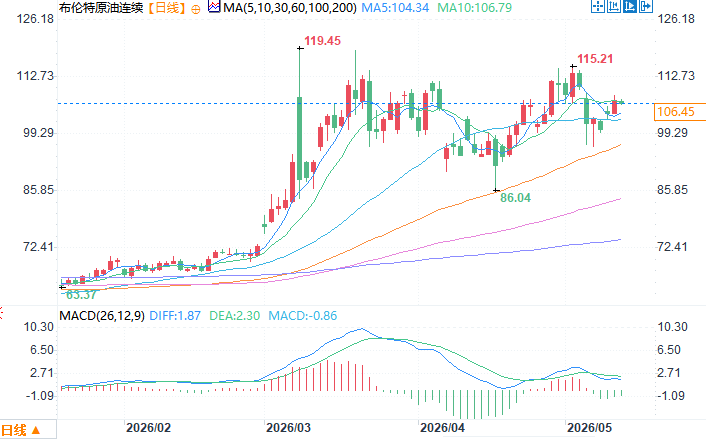
Brent crude oil daily chart source: EasyForex
At 14:49 Beijing time on May 13, Brent crude oil futures were trading at $106.52 per barrel.
Industry insiders warn that the current low prices are only a temporary window of opportunity. Market buffer inventories continue to be depleted, the opening of the Strait of Hormuz remains uncertain, and with refineries approaching their peak summer operating rates, spot oil prices are likely to experience another sharp rebound soon.
The sharp decline in spot oil prices does not indicate a substantial improvement in the supply situation.
The recent weakening of spot crude oil prices is primarily due to global refineries proactively adjusting their purchasing schedules. They are unwilling to accept cargoes priced close to $150 per barrel, generally betting on a potential easing of tensions between the US and Iran and the swift reopening of the Strait of Hormuz, thus deliberately delaying concentrated purchases. Simultaneously, the global market is employing multiple measures to offset supply shortages. Countries are continuously releasing commercial inventories and proactively reducing refinery operating rates, coupled with the International Energy Agency's coordinated release of a record 400 million barrels from global strategic reserves, effectively stabilizing spot prices in the short term.
Refineries started their spring equipment maintenance ahead of schedule, with some carrying out planned upkeep in preparation for the summer peak season, further weakening immediate demand for crude oil. Meanwhile, U.S. crude oil exports hit a record high, with large quantities of West Texas Intermediate (WTI) crude flowing into European and Asian markets, diverting regional supply pressure and collectively dragging down spot oil prices in the May procurement window.
The sharp decline in imports in major Asian countries has become an important buffer for the market.
As the world's largest crude oil importer, the Asian giant saw its crude oil imports plummet by 20% year-on-year in April, with daily imports decreasing by 2.4 million barrels to a low of 9.25 million barrels, the lowest level since the COVID-19 pandemic began in July 2022. Affected by tightening supply in the Middle East and soaring oil prices, major oil companies reduced refinery processing capacity and even unusually resold crude oil shipments for May delivery.
Vitoxa's chief economist, David Wech, stated that the sharp drop in imports from major Asian countries and the counter-trend accumulation of onshore inventories have become important pillars for market self-balancing in this round of crude oil supply crisis. The combination of declining demand and proactive supply controls has temporarily eased pressure on spot price increases, but industry insiders believe that this state of extremely low imports is unsustainable in the long term.
As buffer inventories continue to thin, the market is caught in a race against time.
The global buffer created by inventory releases, refinery reductions, and demand concessions is rapidly shrinking. Morgan Stanley analysts believe that the two major buffer reserves—those of major Asian powers and the United States—that have suppressed the surge in crude oil futures are likely to be exhausted before the Strait of Hormuz reopens, and the crude oil market has entered a countdown to passive restocking.
Neil Crosby, senior crude oil analyst at Sparta Commodities, a market intelligence firm, said that current spot oil prices do not truly reflect the extremely tight supply and demand fundamentals. Asian buyers are only maintaining minimal purchases to meet their immediate needs, deliberately refraining from high-price stockpiling, further depressing spot premiums. The spot price spread has now fallen below its two-year average, a significant departure from the actual geopolitical supply risks.
With expectations for peace talks cooling, oil prices could rebound at any time.
In the early stages, market speculation focused on a breakthrough in US-Iran peace talks, leading buyers to generally hold cash and wait, unwilling to lock in positions at high prices and bear the risk of price corrections. Now, with optimistic expectations for peace negotiations fading, the spot price linked to Brent crude oil is clearly undervalued from an arbitrage perspective. As the summer peak operating period for refineries approaches, refineries and traders will eventually replenish their stocks. Once the market confirms that the Strait of Hormuz is unlikely to reopen to navigation in the short term, the Brent crude oil spot price spread will quickly recover and rebound.
Helima Croft, Global Head of Commodities and Middle East & North Africa Research at RBC Capital Markets, believes that while frequent optimistic news of easing tensions has suppressed prices in the short term, it has delayed necessary demand contraction and adjustment, failing to absorb the huge supply gap before the summer peak. This optimism masks the real supply crisis.
Summarize
Overall, the recent sharp drop in spot crude oil prices is a result of a confluence of short-term buffering factors, not a resolution to the Middle East supply stalemate. The contraction of imports by major Asian countries, the release of strategic reserves, and refineries postponing purchases are merely temporary market-supporting measures, and various inventory buffers are being rapidly depleted. With the summer peak season for oil consumption approaching and the prospects for US-Iran peace talks fading, the window of opportunity for low spot crude oil prices is about to close. Supply and demand fundamentals will ultimately dominate market trends, and a new round of oil price surges is gradually approaching.
Brent crude oil daily chart source: EasyForex
At 14:49 Beijing time on May 13, Brent crude oil futures were trading at $106.52 per barrel.
- Risk Warning and Disclaimer
- The market involves risk, and trading may not be suitable for all investors. This article is for reference only and does not constitute personal investment advice, nor does it take into account certain users’ specific investment objectives, financial situation, or other needs. Any investment decisions made based on this information are at your own risk.