With inventories continuing to tighten, crude oil futures prices may surge.
2026-05-20 01:48:39
On Tuesday (May 19), during the US trading session, as of 01:32 Beijing time, July West Texas Intermediate (WTI) crude oil futures fell slightly by 0.56%, recovering somewhat from the earlier lows; July Brent crude oil futures reversed their losses, closing at $110.72, up $1.44, or 1.32%. Although oil prices have slightly declined in the short term due to news, the core logic of continued tightening inventories remains unchanged, and crude oil futures prices still have significant room for further gains.

Brent crude oil had previously approached the $112 mark, and West Texas Intermediate crude oil was nearing $105. Subsequently, as the US suspended military action against Iran, the geopolitical premium for oil prices subsided, and prices subsequently fell. This price drop was solely influenced by sudden news. Even before this news broke, the crude oil supply chain was already under pressure, and inventories were declining rapidly, leaving very little room for market error. The Strait of Hormuz remains the core risk factor affecting oil prices; if transportation disruptions occur in this waterway, the restoration of crude oil production and transportation will be a long and arduous process.
This drop in oil prices is merely a short-term reaction to news and does not represent a trend reversal.
The recent drop in Brent crude oil prices stemmed entirely from the news of the US suspending its actions against Iran. Even before this diplomatic announcement, market traders had already anticipated a shortage of crude oil supply and a tightening supply chain. Simply easing diplomatic tensions cannot quickly fill the market's crude oil gap, nor can it restore stable shipping through the Strait of Hormuz. This oil price sell-off was merely a market reaction to the news; the underlying supply and demand fundamentals remain unchanged.
The Strait of Hormuz crisis cannot be resolved in the short term.
Approximately one-fifth of the world's oil and gas resources are transported through the Strait of Hormuz, making it a core data point of great interest to the entire crude oil market. The impact of disrupted shipping lanes extends far beyond the current shortage of physical crude oil. Delays will occur throughout the entire process, from crude oil transportation and unloading to refinery feedstock replenishment and the delivery of refined products to consumer markets, creating a cascading effect that will continue to unfold. Even if the situation improves later, market inventories will remain under pressure during the recovery phase, a long-term concern that short-term speculators have not factored into their market forecasts.
Global crude oil inventories are already at a low level.
Currently, strategic petroleum reserves in various countries have fallen to their lowest levels in recent years, and commercial crude oil inventories are also expected to continue to decline. Even without any sudden supply crisis, the market inventory situation is already severe. Jeff Currie, an analyst at Abacs Commodity Exchange, did not focus on oil price fluctuations but emphasized the problem of tight physical crude oil supply. He believes that the shortage of crude oil and refined products in Europe will erupt much faster than the market expects, and traders have seriously underestimated the actual size of the current inventory gap. While oil prices reaching $112 can be managed through market adjustments, if there is a situation of high demand but no supply, and crude oil supply is disrupted, refineries will directly shut down, quickly triggering turmoil throughout the entire fuel supply chain. Financial markets often struggle to predict such physical crises in advance.
The peak season for seasonal demand coincides with the period when market supply is at its weakest.
The crude oil market is emerging from a period of sluggish demand and welcoming a consumption boom driven by the peak travel season. Demand for refined oil products such as gasoline and diesel is rising simultaneously. However, available market inventories are dwindling, making it difficult for new crude oil to quickly enter the market. Already scarce reserves are simply unable to absorb the seasonal surge in demand, and coupled with a potential supply-side crisis, the market tension is expected to escalate further.
The positive effects were limited, and market selling pressure remained low.
Iran's proposals for a comprehensive de-escalation of the situation and the US's extension of sanctions waivers for some countries importing Russian seaborne crude oil only provided a minor respite for market sentiment. However, the market has experienced frequent fluctuations in the short term, leading to a cautious investor sentiment and preventing a large-scale sell-off of crude oil despite the positive news. Diplomatic easing can only temporarily alleviate the situation and cannot fundamentally solve the physical crude oil supply problem, a fact well understood by the market.
Technical Analysis
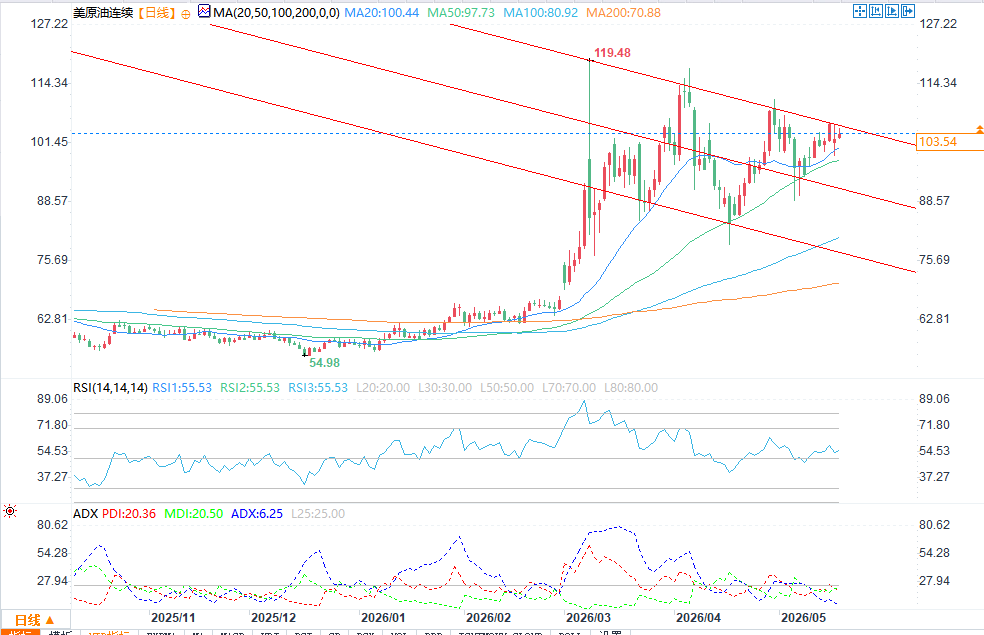
(WTI crude oil daily chart source: FX678)
July WTI crude oil futures stabilized after a weak opening, with narrow-range fluctuations reflecting investor caution and suggesting significant market volatility is imminent. Based on trend charts and the 50-day moving average, the overall trend for crude oil remains upward. The trend charts indicate that if oil prices stabilize above $105.21, the upward trend will resume, with the next target at $110.93. If prices continue to weaken during the day, the first target will be the psychological level of $100. A break below $86.13 would completely reverse the overall upward trend for crude oil.
If the $100 level is breached, bearish forces will intensify, pushing oil prices down to a short-term low of $95.12. A break below this level would signal a formal shift to a downtrend, with the key support level to watch being the 50-day moving average at $90.19. Historically, when oil prices fall to this level, it's highly likely to attract bullish investors to buy on the dip.
July Brent crude futures reversed early losses and rose again, after hitting a low of $108.99 overnight. Brent crude maintains an overall upward trend; a break above $112.68 would target $115.24; a hold above this level would solidify the upward trend, potentially leading to a recovery to the $119.09-$119.44 range.
Within the downward range, $107.03-$105.67 represents minor short-term support, while the 50-day moving average at $102.73 is the core strong support determining the short-term trend. Since early March, this moving average has consistently supported oil prices. A decisive break below this moving average would disrupt the short-term upward structure of crude oil, but the long-term 200-day moving average at $75.18 will still provide solid bottom support.
Key areas to watch in the future
Progress in diplomatic negotiations poses a downside risk to oil prices, while a shortage of physical crude oil supply is the core driver of upward price movements. If negotiations proceed smoothly, the oil price premium resulting from de-escalating geopolitical tensions will gradually diminish, leading to a more significant decline in US crude oil prices—a trend currently driven by positive diplomatic news. Conversely, if the pace of crude oil inventory reduction continues to accelerate, and Europe experiences a genuine shortage of refined oil products (rather than simply rising oil prices), this would be the market crisis Jeff Curry warned of, and the financial markets are currently unprepared to address it.
The $100 mark for July WTI crude oil futures is currently a key dividing line between bullish and bearish sentiment. The price action at this level will directly determine future market trends. Holding above $100 will allow oil prices to return to the $105.21 upward range; a decisive break below this level would send prices heading straight for a low of $95.12, with the 50-day moving average at $90.19 becoming the most important reference level going forward.
Brent crude oil had previously approached the $112 mark, and West Texas Intermediate crude oil was nearing $105. Subsequently, as the US suspended military action against Iran, the geopolitical premium for oil prices subsided, and prices subsequently fell. This price drop was solely influenced by sudden news. Even before this news broke, the crude oil supply chain was already under pressure, and inventories were declining rapidly, leaving very little room for market error. The Strait of Hormuz remains the core risk factor affecting oil prices; if transportation disruptions occur in this waterway, the restoration of crude oil production and transportation will be a long and arduous process.
This drop in oil prices is merely a short-term reaction to news and does not represent a trend reversal.
The recent drop in Brent crude oil prices stemmed entirely from the news of the US suspending its actions against Iran. Even before this diplomatic announcement, market traders had already anticipated a shortage of crude oil supply and a tightening supply chain. Simply easing diplomatic tensions cannot quickly fill the market's crude oil gap, nor can it restore stable shipping through the Strait of Hormuz. This oil price sell-off was merely a market reaction to the news; the underlying supply and demand fundamentals remain unchanged.
The Strait of Hormuz crisis cannot be resolved in the short term.
Approximately one-fifth of the world's oil and gas resources are transported through the Strait of Hormuz, making it a core data point of great interest to the entire crude oil market. The impact of disrupted shipping lanes extends far beyond the current shortage of physical crude oil. Delays will occur throughout the entire process, from crude oil transportation and unloading to refinery feedstock replenishment and the delivery of refined products to consumer markets, creating a cascading effect that will continue to unfold. Even if the situation improves later, market inventories will remain under pressure during the recovery phase, a long-term concern that short-term speculators have not factored into their market forecasts.
Global crude oil inventories are already at a low level.
Currently, strategic petroleum reserves in various countries have fallen to their lowest levels in recent years, and commercial crude oil inventories are also expected to continue to decline. Even without any sudden supply crisis, the market inventory situation is already severe. Jeff Currie, an analyst at Abacs Commodity Exchange, did not focus on oil price fluctuations but emphasized the problem of tight physical crude oil supply. He believes that the shortage of crude oil and refined products in Europe will erupt much faster than the market expects, and traders have seriously underestimated the actual size of the current inventory gap. While oil prices reaching $112 can be managed through market adjustments, if there is a situation of high demand but no supply, and crude oil supply is disrupted, refineries will directly shut down, quickly triggering turmoil throughout the entire fuel supply chain. Financial markets often struggle to predict such physical crises in advance.
The peak season for seasonal demand coincides with the period when market supply is at its weakest.
The crude oil market is emerging from a period of sluggish demand and welcoming a consumption boom driven by the peak travel season. Demand for refined oil products such as gasoline and diesel is rising simultaneously. However, available market inventories are dwindling, making it difficult for new crude oil to quickly enter the market. Already scarce reserves are simply unable to absorb the seasonal surge in demand, and coupled with a potential supply-side crisis, the market tension is expected to escalate further.
The positive effects were limited, and market selling pressure remained low.
Iran's proposals for a comprehensive de-escalation of the situation and the US's extension of sanctions waivers for some countries importing Russian seaborne crude oil only provided a minor respite for market sentiment. However, the market has experienced frequent fluctuations in the short term, leading to a cautious investor sentiment and preventing a large-scale sell-off of crude oil despite the positive news. Diplomatic easing can only temporarily alleviate the situation and cannot fundamentally solve the physical crude oil supply problem, a fact well understood by the market.
Technical Analysis
(WTI crude oil daily chart source: FX678)
July WTI crude oil futures stabilized after a weak opening, with narrow-range fluctuations reflecting investor caution and suggesting significant market volatility is imminent. Based on trend charts and the 50-day moving average, the overall trend for crude oil remains upward. The trend charts indicate that if oil prices stabilize above $105.21, the upward trend will resume, with the next target at $110.93. If prices continue to weaken during the day, the first target will be the psychological level of $100. A break below $86.13 would completely reverse the overall upward trend for crude oil.
If the $100 level is breached, bearish forces will intensify, pushing oil prices down to a short-term low of $95.12. A break below this level would signal a formal shift to a downtrend, with the key support level to watch being the 50-day moving average at $90.19. Historically, when oil prices fall to this level, it's highly likely to attract bullish investors to buy on the dip.
July Brent crude futures reversed early losses and rose again, after hitting a low of $108.99 overnight. Brent crude maintains an overall upward trend; a break above $112.68 would target $115.24; a hold above this level would solidify the upward trend, potentially leading to a recovery to the $119.09-$119.44 range.
Within the downward range, $107.03-$105.67 represents minor short-term support, while the 50-day moving average at $102.73 is the core strong support determining the short-term trend. Since early March, this moving average has consistently supported oil prices. A decisive break below this moving average would disrupt the short-term upward structure of crude oil, but the long-term 200-day moving average at $75.18 will still provide solid bottom support.
Key areas to watch in the future
Progress in diplomatic negotiations poses a downside risk to oil prices, while a shortage of physical crude oil supply is the core driver of upward price movements. If negotiations proceed smoothly, the oil price premium resulting from de-escalating geopolitical tensions will gradually diminish, leading to a more significant decline in US crude oil prices—a trend currently driven by positive diplomatic news. Conversely, if the pace of crude oil inventory reduction continues to accelerate, and Europe experiences a genuine shortage of refined oil products (rather than simply rising oil prices), this would be the market crisis Jeff Curry warned of, and the financial markets are currently unprepared to address it.
The $100 mark for July WTI crude oil futures is currently a key dividing line between bullish and bearish sentiment. The price action at this level will directly determine future market trends. Holding above $100 will allow oil prices to return to the $105.21 upward range; a decisive break below this level would send prices heading straight for a low of $95.12, with the 50-day moving average at $90.19 becoming the most important reference level going forward.
- Risk Warning and Disclaimer
- The market involves risk, and trading may not be suitable for all investors. This article is for reference only and does not constitute personal investment advice, nor does it take into account certain users’ specific investment objectives, financial situation, or other needs. Any investment decisions made based on this information are at your own risk.