The US dollar is poised for its fourth consecutive rise against the Canadian dollar, driven by the prospects of the US-Iran agreement and the Federal Reserve's policy direction.
2026-05-22 16:44:13
On Friday (May 22), the US dollar strengthened against the Canadian dollar for the fourth consecutive trading day, trading around 1.3790. Since the beginning of May, the USD/CAD pair has experienced a relatively smooth upward trend, gradually climbing from below 1.3600 to its current level of around 1.3790. It is poised for its fourth consecutive day of gains, indicating a clear short-term bullish trend.
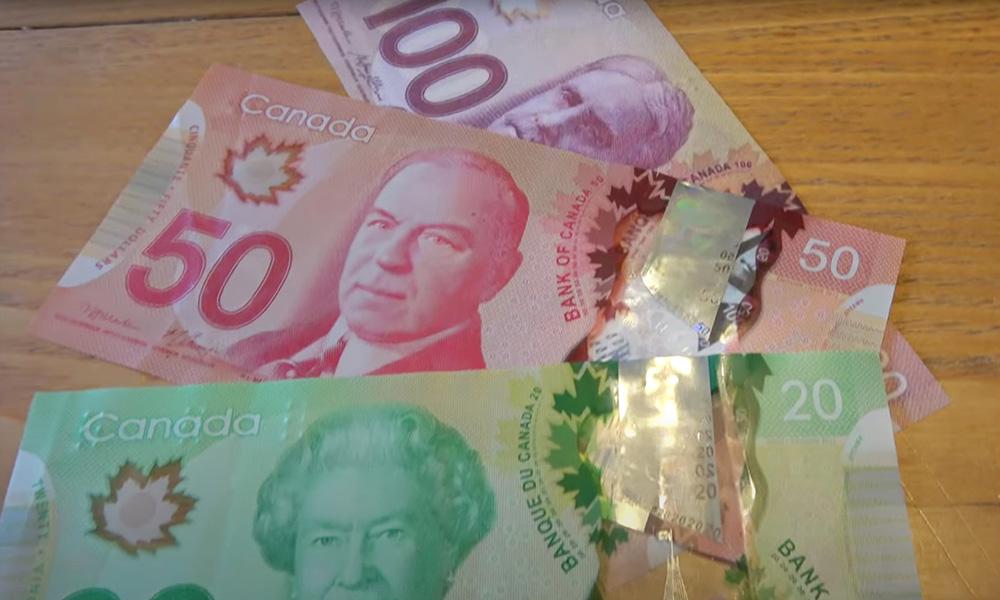
The US dollar was supported by rising market expectations of a hawkish Federal Reserve policy stance. Meanwhile, lower oil prices, as Canada is the largest exporter of crude oil to the US, also weighed on the commodity-linked Canadian dollar.
Traders are pricing in expectations that the Federal Reserve will keep interest rates high, largely due to the long-term energy crisis triggered by the disruption of the Strait of Hormuz, which could potentially impact core consumer prices and inflation expectations in the United States.
Federal Reserve officials are currently keeping the federal funds rate unchanged, and policymakers are gradually moving away from the idea of cutting rates. They are becoming more open to raising rates if inflation fails to cool down.
US President Donald Trump will be sworn in as Federal Reserve Chairman at the White House on Friday, succeeding Jerome Powell. Powell's term expired on Friday, but he has been serving in an interim capacity until the handover is completed.
Oil prices rose as renewed uncertainty about the prospects of US-Iran negotiations fueled renewed supply concerns. Although US Secretary of State Marco Rubio noted some encouraging signs regarding the possibility of an agreement with Iran, senior Iranian officials clarified that no formal agreement had been reached with the US, and while differences had narrowed, core issues remained unresolved.
Market concerns over Iran's handling of enriched uranium and control of the Strait of Hormuz continue to suppress optimism. Iran's Supreme Leader Ayatollah Khamenei has explicitly ordered a ban on the export of highly enriched uranium, while Trump insists the U.S. will "take away and destroy" these nuclear materials. The opposing stances on these core issues render any rumors of an imminent agreement extremely fragile.
The International Energy Agency has warned that global oil inventories are being rapidly depleted as peak summer demand approaches, potentially pushing the market into a "red zone."
Mitsubishi UFJ also predicts that even if an agreement is reached, a full normalization of Middle Eastern oil supplies may not occur until 2027. Supported by expectations of tight supply, oil prices have regained upward momentum.
Canada's April CPI rose 2.8% year-on-year, below the market expectation of 3.1%, and core inflation indicators also generally declined. This data significantly weakened market bets on a Bank of Canada rate hike—the tightening expectation priced in by the swap market this year fell from 54 basis points to about 40 basis points.
"The market's implied pricing of the two rate hikes appears to be misaligned," noted Desjardins' head of macro strategy.
Employment data released in early May showed that Canada lost 17,700 jobs in April, and the unemployment rate rose to a six-month high of 6.9%. This figure was far worse than analysts' expectations of a 15,000-job increase, indicating that the labor market continues to be weak due to trade uncertainty.
CORPAY's chief market strategist pointed out that the Canadian dollar is gradually weakening as traders lower their expectations for monetary policy tightening and interest rate differentials tilt toward the US dollar.
From the daily chart, the USD/CAD pair is currently trading around 1.3790, in a consolidation phase at high levels after a continuous rise, with multiple technical indicators showing bullish signals.
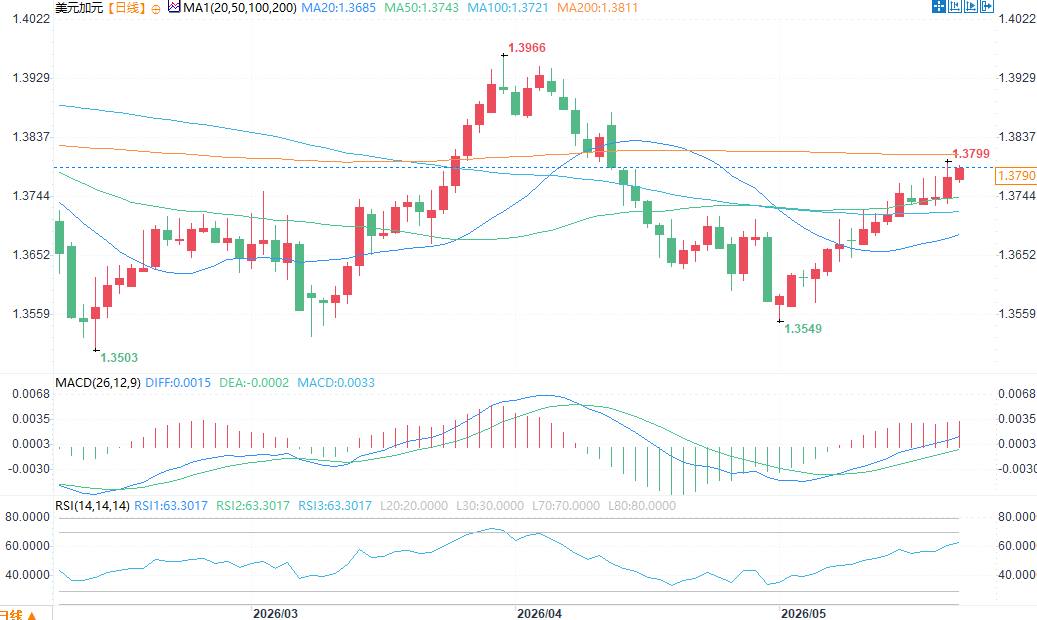
(USD/CAD daily chart, source: EasyForex)
In terms of moving averages, the short-term moving averages MA20 (1.3685), MA50 (1.3743), and MA100 (1.3721) are all below the current price, forming short-term support and showing a bullish alignment. MA200 (1.3811) is above the current price, forming a major resistance level in the near term. This alignment of "price holding above multiple short-term moving averages but limited by MA200" indicates that USD/CAD is in a clear short-term uptrend, but will soon face a key resistance test.
In summary, the USD/CAD pair is currently supported by two factors: firstly, rising expectations of a hawkish stance from the Federal Reserve, with the market pricing in no rate cuts this year and even a possible rate hike, is providing support for the dollar; secondly, persistently lower-than-expected Canadian inflation data has weakened market bets on a Bank of Canada rate hike, further dragging down the Canadian dollar. The market will continue to focus on substantive progress in US-Iran negotiations and subsequent policy signals from the Federal Reserve.
At 16:42 Beijing time on May 22, the US dollar was trading at 1.3785/86 against the Canadian dollar.
The US dollar was supported by rising market expectations of a hawkish Federal Reserve policy stance. Meanwhile, lower oil prices, as Canada is the largest exporter of crude oil to the US, also weighed on the commodity-linked Canadian dollar.
Expectations of a hawkish stance from the Federal Reserve are rising: the energy crisis could push up inflation.
Traders are pricing in expectations that the Federal Reserve will keep interest rates high, largely due to the long-term energy crisis triggered by the disruption of the Strait of Hormuz, which could potentially impact core consumer prices and inflation expectations in the United States.
Federal Reserve officials are currently keeping the federal funds rate unchanged, and policymakers are gradually moving away from the idea of cutting rates. They are becoming more open to raising rates if inflation fails to cool down.
US President Donald Trump will be sworn in as Federal Reserve Chairman at the White House on Friday, succeeding Jerome Powell. Powell's term expired on Friday, but he has been serving in an interim capacity until the handover is completed.
With negotiations showing signs of progress, oil prices have risen instead of falling?
Oil prices rose as renewed uncertainty about the prospects of US-Iran negotiations fueled renewed supply concerns. Although US Secretary of State Marco Rubio noted some encouraging signs regarding the possibility of an agreement with Iran, senior Iranian officials clarified that no formal agreement had been reached with the US, and while differences had narrowed, core issues remained unresolved.
Market concerns over Iran's handling of enriched uranium and control of the Strait of Hormuz continue to suppress optimism. Iran's Supreme Leader Ayatollah Khamenei has explicitly ordered a ban on the export of highly enriched uranium, while Trump insists the U.S. will "take away and destroy" these nuclear materials. The opposing stances on these core issues render any rumors of an imminent agreement extremely fragile.
The International Energy Agency has warned that global oil inventories are being rapidly depleted as peak summer demand approaches, potentially pushing the market into a "red zone."
Mitsubishi UFJ also predicts that even if an agreement is reached, a full normalization of Middle Eastern oil supplies may not occur until 2027. Supported by expectations of tight supply, oil prices have regained upward momentum.
Lower-than-expected inflation weakens expectations of interest rate hikes.
Canada's April CPI rose 2.8% year-on-year, below the market expectation of 3.1%, and core inflation indicators also generally declined. This data significantly weakened market bets on a Bank of Canada rate hike—the tightening expectation priced in by the swap market this year fell from 54 basis points to about 40 basis points.
"The market's implied pricing of the two rate hikes appears to be misaligned," noted Desjardins' head of macro strategy.
Employment data released in early May showed that Canada lost 17,700 jobs in April, and the unemployment rate rose to a six-month high of 6.9%. This figure was far worse than analysts' expectations of a 15,000-job increase, indicating that the labor market continues to be weak due to trade uncertainty.
CORPAY's chief market strategist pointed out that the Canadian dollar is gradually weakening as traders lower their expectations for monetary policy tightening and interest rate differentials tilt toward the US dollar.
USD/CAD Daily Technical Analysis
From the daily chart, the USD/CAD pair is currently trading around 1.3790, in a consolidation phase at high levels after a continuous rise, with multiple technical indicators showing bullish signals.
(USD/CAD daily chart, source: EasyForex)
In terms of moving averages, the short-term moving averages MA20 (1.3685), MA50 (1.3743), and MA100 (1.3721) are all below the current price, forming short-term support and showing a bullish alignment. MA200 (1.3811) is above the current price, forming a major resistance level in the near term. This alignment of "price holding above multiple short-term moving averages but limited by MA200" indicates that USD/CAD is in a clear short-term uptrend, but will soon face a key resistance test.
Hawkish expectations from the Federal Reserve and weaker oil prices are putting pressure on the Canadian dollar.
In summary, the USD/CAD pair is currently supported by two factors: firstly, rising expectations of a hawkish stance from the Federal Reserve, with the market pricing in no rate cuts this year and even a possible rate hike, is providing support for the dollar; secondly, persistently lower-than-expected Canadian inflation data has weakened market bets on a Bank of Canada rate hike, further dragging down the Canadian dollar. The market will continue to focus on substantive progress in US-Iran negotiations and subsequent policy signals from the Federal Reserve.
At 16:42 Beijing time on May 22, the US dollar was trading at 1.3785/86 against the Canadian dollar.
- Risk Warning and Disclaimer
- The market involves risk, and trading may not be suitable for all investors. This article is for reference only and does not constitute personal investment advice, nor does it take into account certain users’ specific investment objectives, financial situation, or other needs. Any investment decisions made based on this information are at your own risk.