Hawkish expectations from the Federal Reserve pushed up the dollar and US Treasury yields, and gold's downward pressure intensified after breaking below key moving averages.
2026-05-22 16:52:29
The international gold market continued its weak trend during Friday's European trading session, with spot gold (XAU/USD) fluctuating around $4,500. Although gold prices temporarily held above this key psychological level, the overall trend remained under pressure. The current market's core logic revolves around "expectations of high interest rates from the Federal Reserve," "a strong dollar," and "uncertainty in the Middle East." As the market gradually accepts that US interest rates will remain high for a longer period, the dollar index has maintained its near six-week high, exerting significant downward pressure on gold.

A stronger dollar and rising US Treasury yields are diminishing the appeal of gold . Since gold itself does not generate interest income, funds typically flow to higher-yielding dollar assets when US Treasury yields continue to rise. At the same time, market expectations for the Federal Reserve's policy path are becoming increasingly hawkish. The minutes of the Fed's April meeting revealed that most officials were concerned about inflation remaining above the 2% target for an extended period and believed that if inflation persists, the Fed may need to further tighten policy.
The market has now largely ruled out the possibility of an interest rate cut in 2026. Currently, the market is even betting on at least one rate hike by the Federal Reserve this year. The market expects a greater than 60% probability of a 25 basis point rate hike by the Fed in December . This expectation has directly driven up US Treasury yields and further strengthened the upward trend of the US dollar.
Furthermore, while uncertainties remain in the Middle East, improved market risk appetite has somewhat dampened safe-haven buying of gold. Negotiations between the US and Iran have continued recently. Although both sides have stated that their differences have narrowed, key issues remain unresolved. Among these, the issues of Iranian uranium enrichment and control of the Strait of Hormuz remain the core obstacles to current negotiations.
U.S. Secretary of State Marco Rubio stated that Iran's attempt to impose fees on ships in the Strait of Hormuz has become a major obstacle to the agreement's progress. Meanwhile, U.S. President Trump also emphasized that the United States will not accept a fee system for the Strait of Hormuz and stated that the U.S. will confiscate Iran's highly enriched uranium stockpile.
While geopolitical risks in the Middle East persist, market risk aversion has cooled somewhat . This means that gold is not currently experiencing a significant influx of safe-haven funds. Meanwhile, high international energy prices are also impacting market expectations for future inflation. There are concerns that if energy prices continue to rise, core inflation in the US could rebound, forcing the Federal Reserve to maintain high interest rates for an extended period.
This environment of "high inflation + high interest rates" is not favorable for gold overall. From a global asset allocation perspective, market funds are still clearly biased towards dollar assets. The dollar index has recently risen to near a six-week high, while US Treasury yields have also remained high.
The return of funds to dollar assets is a major reason for the continued pressure on gold . However, market analysts also point out that there has been no significant panic selling in gold, indicating that some long-term safe-haven funds are still maintaining a wait-and-see attitude. Especially given the unresolved situation in the Middle East, gold still has some safe-haven support.
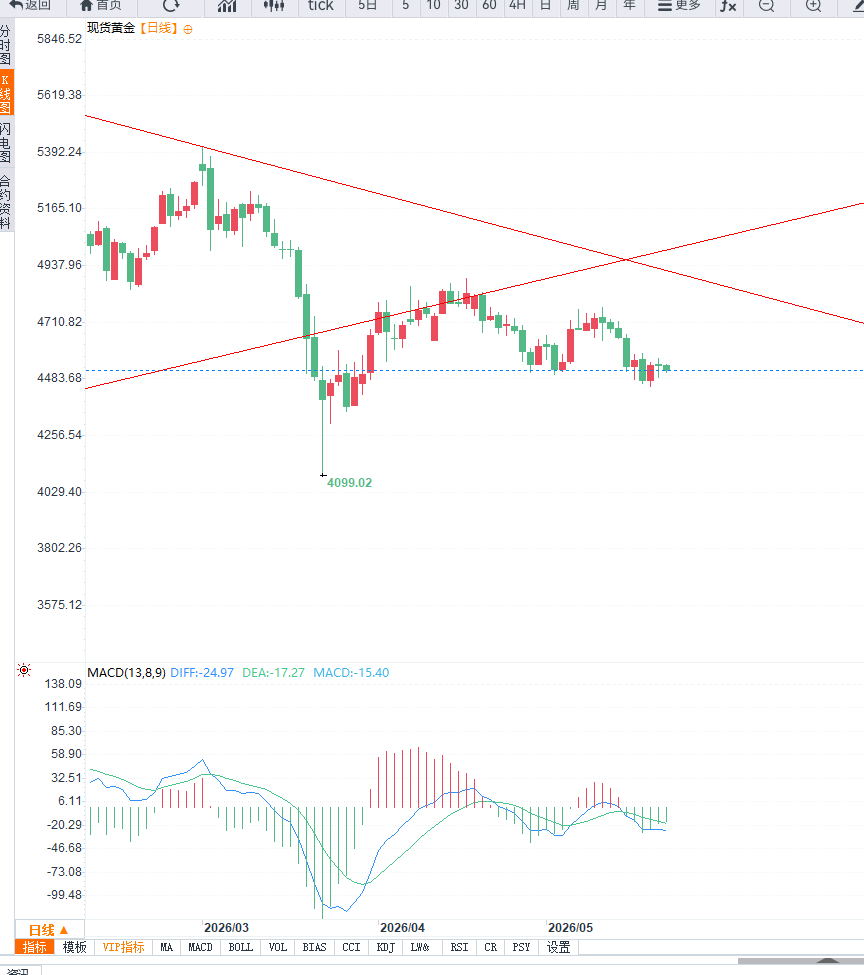
From a technical perspective, gold is currently still trading within a clear downward channel. The daily chart shows that after forming a temporary top near $4700, gold has entered a mid-term correction phase. Currently, gold is consistently trading below major moving averages, indicating that the overall bearish trend remains dominant. The daily MACD indicator has formed a clear death cross, and the green histogram bars are expanding, suggesting that the medium-term downward momentum is still strengthening.
The RSI indicator remains around 45, indicating that while the market is not oversold, it remains generally weak. The key support level is currently around the psychological level of $4500. A break below this level could lead to further declines towards $4420 and the $4360 area. The $4360 area also coincides with the lower trendline of the current descending channel, representing significant technical support. The main resistance level is located in the $4650-$4660 area.
Editor's Summary : The core contradiction in the current gold market lies in the interplay between "geopolitical risk support" and "high interest rate suppression." While uncertainties remain in the Middle East, the market is currently more focused on the risk that the Federal Reserve may maintain high interest rates for an extended period. The simultaneous strengthening of the US dollar and US Treasury yields has significantly diminished the attractiveness of gold as an investment. From a technical perspective, gold remains within a medium-term downtrend channel. Although there are signs of short-term stabilization, the downtrend has not truly reversed. Going forward, the market will focus on US inflation data, Federal Reserve policy expectations, developments in the Middle East, and the US dollar index.
A stronger dollar and rising US Treasury yields are diminishing the appeal of gold . Since gold itself does not generate interest income, funds typically flow to higher-yielding dollar assets when US Treasury yields continue to rise. At the same time, market expectations for the Federal Reserve's policy path are becoming increasingly hawkish. The minutes of the Fed's April meeting revealed that most officials were concerned about inflation remaining above the 2% target for an extended period and believed that if inflation persists, the Fed may need to further tighten policy.
The market has now largely ruled out the possibility of an interest rate cut in 2026. Currently, the market is even betting on at least one rate hike by the Federal Reserve this year. The market expects a greater than 60% probability of a 25 basis point rate hike by the Fed in December . This expectation has directly driven up US Treasury yields and further strengthened the upward trend of the US dollar.
Furthermore, while uncertainties remain in the Middle East, improved market risk appetite has somewhat dampened safe-haven buying of gold. Negotiations between the US and Iran have continued recently. Although both sides have stated that their differences have narrowed, key issues remain unresolved. Among these, the issues of Iranian uranium enrichment and control of the Strait of Hormuz remain the core obstacles to current negotiations.
U.S. Secretary of State Marco Rubio stated that Iran's attempt to impose fees on ships in the Strait of Hormuz has become a major obstacle to the agreement's progress. Meanwhile, U.S. President Trump also emphasized that the United States will not accept a fee system for the Strait of Hormuz and stated that the U.S. will confiscate Iran's highly enriched uranium stockpile.
While geopolitical risks in the Middle East persist, market risk aversion has cooled somewhat . This means that gold is not currently experiencing a significant influx of safe-haven funds. Meanwhile, high international energy prices are also impacting market expectations for future inflation. There are concerns that if energy prices continue to rise, core inflation in the US could rebound, forcing the Federal Reserve to maintain high interest rates for an extended period.
This environment of "high inflation + high interest rates" is not favorable for gold overall. From a global asset allocation perspective, market funds are still clearly biased towards dollar assets. The dollar index has recently risen to near a six-week high, while US Treasury yields have also remained high.
The return of funds to dollar assets is a major reason for the continued pressure on gold . However, market analysts also point out that there has been no significant panic selling in gold, indicating that some long-term safe-haven funds are still maintaining a wait-and-see attitude. Especially given the unresolved situation in the Middle East, gold still has some safe-haven support.
From a technical perspective, gold is currently still trading within a clear downward channel. The daily chart shows that after forming a temporary top near $4700, gold has entered a mid-term correction phase. Currently, gold is consistently trading below major moving averages, indicating that the overall bearish trend remains dominant. The daily MACD indicator has formed a clear death cross, and the green histogram bars are expanding, suggesting that the medium-term downward momentum is still strengthening.
The RSI indicator remains around 45, indicating that while the market is not oversold, it remains generally weak. The key support level is currently around the psychological level of $4500. A break below this level could lead to further declines towards $4420 and the $4360 area. The $4360 area also coincides with the lower trendline of the current descending channel, representing significant technical support. The main resistance level is located in the $4650-$4660 area.
Editor's Summary : The core contradiction in the current gold market lies in the interplay between "geopolitical risk support" and "high interest rate suppression." While uncertainties remain in the Middle East, the market is currently more focused on the risk that the Federal Reserve may maintain high interest rates for an extended period. The simultaneous strengthening of the US dollar and US Treasury yields has significantly diminished the attractiveness of gold as an investment. From a technical perspective, gold remains within a medium-term downtrend channel. Although there are signs of short-term stabilization, the downtrend has not truly reversed. Going forward, the market will focus on US inflation data, Federal Reserve policy expectations, developments in the Middle East, and the US dollar index.
- Risk Warning and Disclaimer
- The market involves risk, and trading may not be suitable for all investors. This article is for reference only and does not constitute personal investment advice, nor does it take into account certain users’ specific investment objectives, financial situation, or other needs. Any investment decisions made based on this information are at your own risk.