Trust the news or trust the inventory? — Brent crude oil is caught between the 20-day and 50-day moving averages, awaiting direction.
2026-05-22 17:05:15
ING analysts Warren Paterson and Eva Mantej said that oil traders remain focused on the US-Iran negotiations, with uncertainty surrounding a potential agreement and issues such as uranium enrichment and proposed tolls for passage through the Strait of Hormuz exacerbating market volatility.

Despite significant volatility driven by news, ICE Brent crude oil closed down 2.3% yesterday, falling below $103 per barrel, its lowest closing price since early May. In the refined product market, gasoline and jet fuel supply remained tight, while Singapore inventories rose slightly.
Analysts point out: "The market is still looking for signs of progress on a potential US-Iran agreement. While some optimistic signals have emerged, uncertainty remains dominant. This isn't the first time an agreement seemed close to being reached only to subsequently break down. Therefore, a large portion of market participants are skeptical of the positive signals we're seeing. Although Iran has stated that the gap between the two sides' demands has narrowed, the issue of uranium enrichment and its uranium stockpile remain the crux of the matter." The uncertainty surrounding the potential agreement is already reflected in oil prices, with the market fluctuating wildly due to various news events.
Brent crude is currently up about 0.7% at $105.61 a barrel.
Analysts say the strong jet fuel crack spread has prompted global refineries to increase jet fuel production. This crack spread has surged to extreme levels of $80 to $100 per barrel, a record high since the Russia-Ukraine conflict. With the current closure of the Strait of Hormuz reducing global crude oil supply by over 12 million barrels per day, Middle Eastern refined product exports have also lost approximately 4.7 million barrels per day, creating a severe bottleneck for global refining capacity.
The allocation of refining capacity is essentially a zero-sum game—under the physical constraints of refining, producing more of one type of fuel inevitably means producing less of another. U.S. refineries have increased jet fuel production by about 2 percentage points and pushed jet fuel exports to record levels to capture excess profits. However, the cost is a decrease in gasoline production of approximately 340,000 barrels per day compared to the same period last year. Meanwhile, U.S. gasoline inventories have fallen to their lowest level since 2014, and gasoline imports have also hit a new low for this century.
In Singapore, petroleum product inventories rose only slightly by 38,000 barrels last week to 45.4 million barrels. This increase was primarily driven by fuel oil inventories, which rose by 1.42 million barrels due to a 4.5% increase in imports to approximately 983,000 tons. Despite Singapore's fuel oil inventories reaching a near one-month high, the fundamentals of spot demand in the Asian fuel oil market remain weak. The strength of jet fuel crack spreads and the ripple effects of refinery capacity switching are reshaping the supply and demand landscape of the global refined product market.
The crude oil market is currently experiencing significant volatility due to geopolitical news. Uncertainty surrounding the US-Iran negotiations—including key disagreements such as uranium enrichment and the proposed toll for passage through the Strait of Hormuz—is the primary driver of oil price fluctuations. Market skepticism about the prospects of an agreement has led to a rebound in Brent crude oil prices of approximately 0.7% to around $105.61, reflecting the extreme fragility of market sentiment.
Meanwhile, structural tightness in the refined oil market provided fundamental support for oil prices. Jet fuel crack spreads have surged to extreme levels of $80-100 per barrel, a new high since the Russia-Ukraine conflict, prompting global refineries to significantly increase jet fuel production. However, the "zero-sum game" of refining capacity has led to a reduction in gasoline production, with US gasoline inventories falling to their lowest level since 2014. While Singapore's oil product inventories have risen slightly due to increased fuel oil imports, overall inventories remain low. Caught between geopolitical risks and tight supply, oil prices are expected to continue their high-level fluctuation pattern in the short term.
From the daily chart, Brent crude oil is currently trading around $105.60, in a consolidation phase after a recent pullback from its highs, with multiple technical indicators showing a tug-of-war between bulls and bears.
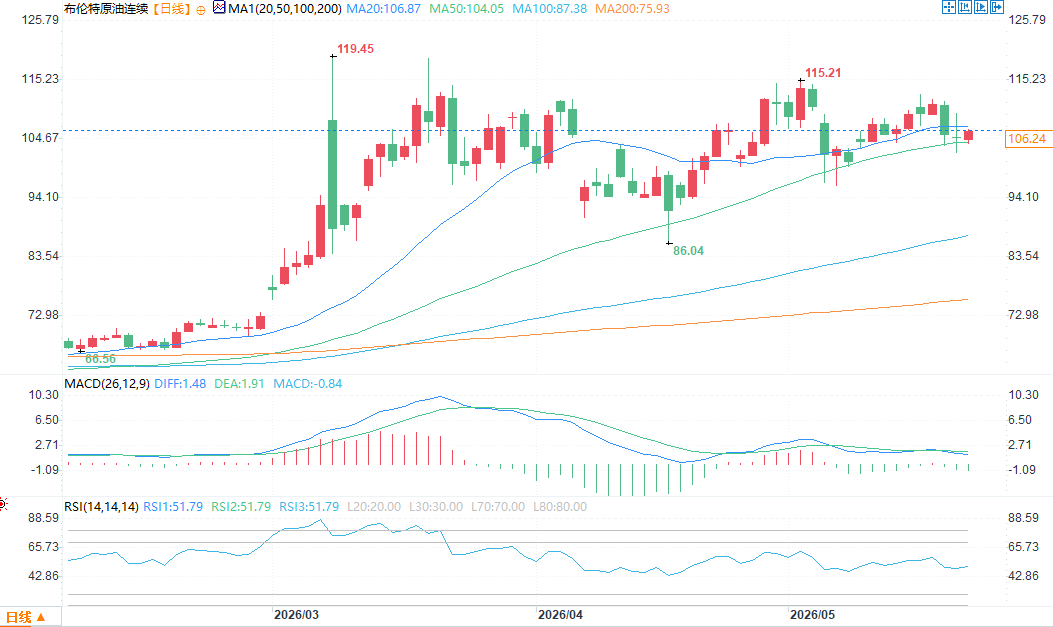
(Brent crude oil futures daily chart, source: FX678)
Regarding the moving average system, the short-term moving averages MA20 (106.87) and MA50 (104.05) are roughly in sync with the current price, forming a focal point of contention between bulls and bears. The current price is slightly below MA20 but above MA50, indicating short-term pressure but still having medium-term support. The long-term moving averages MA100 (87.38) and MA200 (75.93) are significantly lower than the current price, suggesting that the long-term upward trend has not yet been broken.
At 16:40 Beijing time on May 22, Brent crude oil futures were trading at $105.8 per barrel.
Despite significant volatility driven by news, ICE Brent crude oil closed down 2.3% yesterday, falling below $103 per barrel, its lowest closing price since early May. In the refined product market, gasoline and jet fuel supply remained tight, while Singapore inventories rose slightly.
US-Iran negotiations dominated oil market sentiment, with the market remaining skeptical of optimistic signals.
Analysts point out: "The market is still looking for signs of progress on a potential US-Iran agreement. While some optimistic signals have emerged, uncertainty remains dominant. This isn't the first time an agreement seemed close to being reached only to subsequently break down. Therefore, a large portion of market participants are skeptical of the positive signals we're seeing. Although Iran has stated that the gap between the two sides' demands has narrowed, the issue of uranium enrichment and its uranium stockpile remain the crux of the matter." The uncertainty surrounding the potential agreement is already reflected in oil prices, with the market fluctuating wildly due to various news events.
Brent crude is currently up about 0.7% at $105.61 a barrel.
Refined oil market: Aviation fuel crack spreads are strong, and Singapore inventories have risen slightly.
Analysts say the strong jet fuel crack spread has prompted global refineries to increase jet fuel production. This crack spread has surged to extreme levels of $80 to $100 per barrel, a record high since the Russia-Ukraine conflict. With the current closure of the Strait of Hormuz reducing global crude oil supply by over 12 million barrels per day, Middle Eastern refined product exports have also lost approximately 4.7 million barrels per day, creating a severe bottleneck for global refining capacity.
The allocation of refining capacity is essentially a zero-sum game—under the physical constraints of refining, producing more of one type of fuel inevitably means producing less of another. U.S. refineries have increased jet fuel production by about 2 percentage points and pushed jet fuel exports to record levels to capture excess profits. However, the cost is a decrease in gasoline production of approximately 340,000 barrels per day compared to the same period last year. Meanwhile, U.S. gasoline inventories have fallen to their lowest level since 2014, and gasoline imports have also hit a new low for this century.
In Singapore, petroleum product inventories rose only slightly by 38,000 barrels last week to 45.4 million barrels. This increase was primarily driven by fuel oil inventories, which rose by 1.42 million barrels due to a 4.5% increase in imports to approximately 983,000 tons. Despite Singapore's fuel oil inventories reaching a near one-month high, the fundamentals of spot demand in the Asian fuel oil market remain weak. The strength of jet fuel crack spreads and the ripple effects of refinery capacity switching are reshaping the supply and demand landscape of the global refined product market.
Geopolitical news drives short-term fluctuations, while the fundamentals of refined oil products provide support.
The crude oil market is currently experiencing significant volatility due to geopolitical news. Uncertainty surrounding the US-Iran negotiations—including key disagreements such as uranium enrichment and the proposed toll for passage through the Strait of Hormuz—is the primary driver of oil price fluctuations. Market skepticism about the prospects of an agreement has led to a rebound in Brent crude oil prices of approximately 0.7% to around $105.61, reflecting the extreme fragility of market sentiment.
Meanwhile, structural tightness in the refined oil market provided fundamental support for oil prices. Jet fuel crack spreads have surged to extreme levels of $80-100 per barrel, a new high since the Russia-Ukraine conflict, prompting global refineries to significantly increase jet fuel production. However, the "zero-sum game" of refining capacity has led to a reduction in gasoline production, with US gasoline inventories falling to their lowest level since 2014. While Singapore's oil product inventories have risen slightly due to increased fuel oil imports, overall inventories remain low. Caught between geopolitical risks and tight supply, oil prices are expected to continue their high-level fluctuation pattern in the short term.
Daily Technical Analysis
From the daily chart, Brent crude oil is currently trading around $105.60, in a consolidation phase after a recent pullback from its highs, with multiple technical indicators showing a tug-of-war between bulls and bears.
(Brent crude oil futures daily chart, source: FX678)
Regarding the moving average system, the short-term moving averages MA20 (106.87) and MA50 (104.05) are roughly in sync with the current price, forming a focal point of contention between bulls and bears. The current price is slightly below MA20 but above MA50, indicating short-term pressure but still having medium-term support. The long-term moving averages MA100 (87.38) and MA200 (75.93) are significantly lower than the current price, suggesting that the long-term upward trend has not yet been broken.
At 16:40 Beijing time on May 22, Brent crude oil futures were trading at $105.8 per barrel.
- Risk Warning and Disclaimer
- The market involves risk, and trading may not be suitable for all investors. This article is for reference only and does not constitute personal investment advice, nor does it take into account certain users’ specific investment objectives, financial situation, or other needs. Any investment decisions made based on this information are at your own risk.