Gold's "Double Sweep": Expectations of US-Iran peace talks versus a surge in bets on interest rate hikes; this week's PCE may set the direction.
2026-05-25 08:36:30
Gold prices rose to around $4,578 in early Asian trading on Monday (May 25). The dollar weakened slightly, supported by reports of progress in US-Iran negotiations and the potential reopening of the Strait of Hormuz.
The market remains cautiously optimistic about renewed US-Iran talks. According to Saudi media reports on the 24th, the initial agreement between the two sides would be a memorandum of understanding, which Pakistan would announce without the presence of any of the negotiating parties. Following this, the two sides will negotiate a final agreement, with the next round of talks potentially taking place on June 5th.
However, US President Trump said on the 24th that the agreement between the US and Iran was "not fully finalized," accusing some uninformed people of "making unwarranted criticisms." Trump posted on social media, "If I reach an agreement with Iran, it will be a good, appropriate agreement." "Nobody has seen it or knows what it's about. It's not fully finalized. So don't listen to the losers who are criticizing something they don't understand." According to US media reports, although the draft agreement has not been publicly released, some in the US have fiercely criticized it, saying it actually undermines the goals set by the Trump administration itself. White House officials told the media that day that the US and Iran are "still several days away" from signing an agreement.
On May 24, local time, Iran stated that previous reports in Israeli media that Iran would not receive facilitation to unfreeze its funds before beginning the transfer of its enriched uranium reserves were incorrect. Iran is unwilling to link the unfreezing of assets with the nuclear materials issue, and has not yet made any commitments regarding the details of the nuclear issue. Iran indicated that once an understanding can be announced, some frozen assets should be unfrozen immediately, ensuring Iran's full access to these assets. According to Iranian sources, failure to unfreeze the assets would cross one of Iran's red lines, making a consensus impossible. Iran also stated that due to various reasons, including US obstruction of unfreezing Iranian assets, the content of the memorandum of understanding has not yet been finalized, thus raising the possibility of a failure to reach an agreement.
The stalemate in the Middle East and the hawkish shift within the Federal Reserve are occurring simultaneously; the former is pushing up inflation expectations, while the latter is opening the door to interest rate hikes. Last Friday, Federal Reserve Governor Waller explicitly stated his support for removing the phrase "dovish bias" from the policy statement, paving the way for possible future rate hikes.
Waller, a highly influential policymaker and a long-time advocate for interest rate cuts, pointed out that inflation was not moving in the right direction—the PCE rose to 3.8% in April, and the increase had spread from goods to services. "With inflation consistently above target and a stable job market, saying 'we can start discussing rate cuts soon' is almost insane," Waller stated bluntly. His remarks quickly spurred market bets on rate hikes: futures markets showed the probability of a 25-basis-point rate hike by the Fed in October rose to about two-thirds, and the probability of a rate hike at the September meeting was nearly 50/50, whereas the market had previously expected the first rate hike to be no earlier than December.
Furthermore, Kevin Warsh was officially sworn in as Federal Reserve Chairman last Friday, at a time when the US economy faces a complex situation: the Iran war pushing up oil prices, high inflation, and consumer confidence plummeting to historic lows. While urging Warsh to be "completely independent," Trump also hoped he would recognize that "growth does not mean inflation." Warsh pledged to lead a "reform-oriented" Fed, learning from past experiences and adhering to integrity and performance standards. However, he faces multiple challenges, including AI technological changes, persistently high inflation, and soaring global bond market interest rates. Fed Governor Waller has clearly stated his support for removing the "accommodative bias," opening room for interest rate hikes, with the market betting on a possible rate hike as early as October.
Traders are closely watching the U.S. April Personal Consumption Expenditures Price Index (PCE) report, due Thursday evening Beijing time, which is the Federal Reserve's preferred inflation gauge. Previously released April CPI and PPI data both exceeded expectations, exacerbating market concerns about inflationary pressures and creating significant upside risks for this PCE data release.
If the core PCE rate rises by more than 0.3% month-on-month in April, market bets on a Fed rate hike this year could intensify further.
For gold, higher-than-expected PCE data will reinforce expectations of "higher and longer" interest rates, potentially pushing US Treasury yields higher and putting pressure on gold, a non-interest-bearing asset. Conversely, if the data meets or falls short of expectations, it may temporarily alleviate market anxiety about interest rate hikes, providing breathing room for gold prices. The direction of inflation data will be a key variable determining the short-term direction of gold prices.
Gold prices are currently supported by positive progress in US-Iran negotiations, with expectations of easing geopolitical risks driving prices higher.
Meanwhile, the market is holding its breath awaiting Thursday's US PCE inflation data. If inflation exceeds expectations, expectations of a Fed rate hike may further intensify, thus suppressing gold prices. In the short term, gold prices may fluctuate within the $4,550-$4,600 range, with the direction depending on substantial progress in US-Iran negotiations and US inflation data.
From the daily chart, spot gold is currently trading around $4,578, in a weak consolidation phase after its recent pullback from highs.
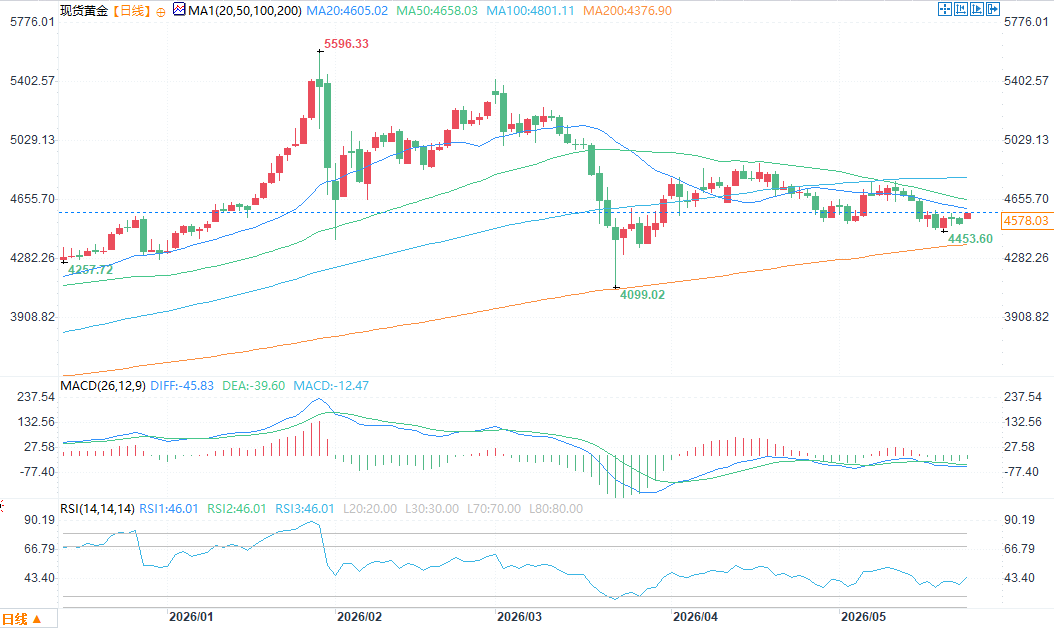
(Spot gold daily chart, source: FX678)
In terms of moving averages, the current price has broken below the 20-day moving average (MA20) (4605.02) and the 50-day moving average (MA50) (4658.03), indicating significant short-term pressure. The 100-day moving average (MA100) (4801.11) is above the current price, forming medium-term resistance; while the 200-day moving average (MA200) is below the current price, forming long-term support. This arrangement of "price breaking below short-term moving averages but still holding above the 200-day moving average" suggests that gold is in a short-term correction phase, but the long-term upward trend has not been completely broken.
The RSI is 46.01, slightly below the 50 neutral dividing line, indicating that the bears have a slight advantage, but the advantage is not significant. It is still far from the oversold area of 30, which means that the price still has room to fall further and has not yet reached the extreme conditions for a technical rebound.
At 7:42 AM Beijing time on May 22, spot gold was trading at $4,578.63 per ounce.
The White House responded: Signing is "still several days away".
The market remains cautiously optimistic about renewed US-Iran talks. According to Saudi media reports on the 24th, the initial agreement between the two sides would be a memorandum of understanding, which Pakistan would announce without the presence of any of the negotiating parties. Following this, the two sides will negotiate a final agreement, with the next round of talks potentially taking place on June 5th.
However, US President Trump said on the 24th that the agreement between the US and Iran was "not fully finalized," accusing some uninformed people of "making unwarranted criticisms." Trump posted on social media, "If I reach an agreement with Iran, it will be a good, appropriate agreement." "Nobody has seen it or knows what it's about. It's not fully finalized. So don't listen to the losers who are criticizing something they don't understand." According to US media reports, although the draft agreement has not been publicly released, some in the US have fiercely criticized it, saying it actually undermines the goals set by the Trump administration itself. White House officials told the media that day that the US and Iran are "still several days away" from signing an agreement.
On May 24, local time, Iran stated that previous reports in Israeli media that Iran would not receive facilitation to unfreeze its funds before beginning the transfer of its enriched uranium reserves were incorrect. Iran is unwilling to link the unfreezing of assets with the nuclear materials issue, and has not yet made any commitments regarding the details of the nuclear issue. Iran indicated that once an understanding can be announced, some frozen assets should be unfrozen immediately, ensuring Iran's full access to these assets. According to Iranian sources, failure to unfreeze the assets would cross one of Iran's red lines, making a consensus impossible. Iran also stated that due to various reasons, including US obstruction of unfreezing Iranian assets, the content of the memorandum of understanding has not yet been finalized, thus raising the possibility of a failure to reach an agreement.
Market bets on interest rate hikes surge
The stalemate in the Middle East and the hawkish shift within the Federal Reserve are occurring simultaneously; the former is pushing up inflation expectations, while the latter is opening the door to interest rate hikes. Last Friday, Federal Reserve Governor Waller explicitly stated his support for removing the phrase "dovish bias" from the policy statement, paving the way for possible future rate hikes.
Waller, a highly influential policymaker and a long-time advocate for interest rate cuts, pointed out that inflation was not moving in the right direction—the PCE rose to 3.8% in April, and the increase had spread from goods to services. "With inflation consistently above target and a stable job market, saying 'we can start discussing rate cuts soon' is almost insane," Waller stated bluntly. His remarks quickly spurred market bets on rate hikes: futures markets showed the probability of a 25-basis-point rate hike by the Fed in October rose to about two-thirds, and the probability of a rate hike at the September meeting was nearly 50/50, whereas the market had previously expected the first rate hike to be no earlier than December.
Furthermore, Kevin Warsh was officially sworn in as Federal Reserve Chairman last Friday, at a time when the US economy faces a complex situation: the Iran war pushing up oil prices, high inflation, and consumer confidence plummeting to historic lows. While urging Warsh to be "completely independent," Trump also hoped he would recognize that "growth does not mean inflation." Warsh pledged to lead a "reform-oriented" Fed, learning from past experiences and adhering to integrity and performance standards. However, he faces multiple challenges, including AI technological changes, persistently high inflation, and soaring global bond market interest rates. Fed Governor Waller has clearly stated his support for removing the "accommodative bias," opening room for interest rate hikes, with the market betting on a possible rate hike as early as October.
Market focus shifts to US PCE inflation data
Traders are closely watching the U.S. April Personal Consumption Expenditures Price Index (PCE) report, due Thursday evening Beijing time, which is the Federal Reserve's preferred inflation gauge. Previously released April CPI and PPI data both exceeded expectations, exacerbating market concerns about inflationary pressures and creating significant upside risks for this PCE data release.
If the core PCE rate rises by more than 0.3% month-on-month in April, market bets on a Fed rate hike this year could intensify further.
For gold, higher-than-expected PCE data will reinforce expectations of "higher and longer" interest rates, potentially pushing US Treasury yields higher and putting pressure on gold, a non-interest-bearing asset. Conversely, if the data meets or falls short of expectations, it may temporarily alleviate market anxiety about interest rate hikes, providing breathing room for gold prices. The direction of inflation data will be a key variable determining the short-term direction of gold prices.
Expectations of easing geopolitical tensions boosted gold prices, but inflation data could trigger fluctuations.
Gold prices are currently supported by positive progress in US-Iran negotiations, with expectations of easing geopolitical risks driving prices higher.
Meanwhile, the market is holding its breath awaiting Thursday's US PCE inflation data. If inflation exceeds expectations, expectations of a Fed rate hike may further intensify, thus suppressing gold prices. In the short term, gold prices may fluctuate within the $4,550-$4,600 range, with the direction depending on substantial progress in US-Iran negotiations and US inflation data.
Spot Gold Daily Technical Analysis
From the daily chart, spot gold is currently trading around $4,578, in a weak consolidation phase after its recent pullback from highs.
(Spot gold daily chart, source: FX678)
In terms of moving averages, the current price has broken below the 20-day moving average (MA20) (4605.02) and the 50-day moving average (MA50) (4658.03), indicating significant short-term pressure. The 100-day moving average (MA100) (4801.11) is above the current price, forming medium-term resistance; while the 200-day moving average (MA200) is below the current price, forming long-term support. This arrangement of "price breaking below short-term moving averages but still holding above the 200-day moving average" suggests that gold is in a short-term correction phase, but the long-term upward trend has not been completely broken.
The RSI is 46.01, slightly below the 50 neutral dividing line, indicating that the bears have a slight advantage, but the advantage is not significant. It is still far from the oversold area of 30, which means that the price still has room to fall further and has not yet reached the extreme conditions for a technical rebound.
At 7:42 AM Beijing time on May 22, spot gold was trading at $4,578.63 per ounce.
- Risk Warning and Disclaimer
- The market involves risk, and trading may not be suitable for all investors. This article is for reference only and does not constitute personal investment advice, nor does it take into account certain users’ specific investment objectives, financial situation, or other needs. Any investment decisions made based on this information are at your own risk.