Institutions: Gold's long-term bullish trend remains unchanged; gold is expected to challenge the $8,000 mark before 2030.
2026-05-28 10:43:07
A new cycle for commodities has fully begun, with precious metals leading the gains.
Doug Moglia, macro strategist at Rockefeller Global Investment Management, points out that even with recent fluctuations in gold and silver prices, gold's position as a ballast in portfolios remains solid, and the multi-year bull market has not ended. Multiple global factors continue to support precious metals, leading to divergent price movements in gold and silver, while related mining stocks are seeing a revaluation opportunity, making the medium- to long-term investment logic clear.
Driven by multiple factors such as industrial transformation, energy security, and insufficient industry investment, commodities have returned to investors' attention, with precious metals performing far ahead.
Doug Moglia stated that gold has risen by 92% since 2025, while silver has seen an even more dramatic increase of 152%. Since the sanctions imposed on foreign exchange reserves in 2022, global central banks have continuously increased their gold purchases, with annual purchases exceeding 1,000 tons for three consecutive years from 2022 to 2024, accounting for 20% to 25% of global annual mined gold production. Central banks have recognized the geopolitical risks inherent in a single foreign exchange system, and gold's lack of counterparty risk has made it highly sought after. This has led to a continuous decrease in the sensitivity of gold prices to traditional influencing factors such as interest rates and the US dollar.
In 2025, the market style shifted, with central bank gold purchases falling to 863 tons. However, Western investors entered the market in large numbers through ETFs and other channels, with global gold ETF holdings increasing by nearly 20%, exceeding 3,000 tons. While the influx of off-exchange funds boosted the market, it also exacerbated short-term price volatility. By the end of January 2026, precious metals experienced a significant correction due to excessive speculative leverage.
This round of gold price increases is defined as the third long-term bull market, triggered by the Russia-Ukraine conflict and rule changes brought about by foreign exchange reserve sanctions. Historically, the previous two long bull markets lasted nearly a decade, while the current bull market is only in its fourth year, indicating ample room for further upward movement. Market concerns about the Federal Reserve's independence, global fiscal risks, and geopolitical conflicts such as the situation in Iran are continuously strengthening the safe-haven demand for gold.
Mogliar predicts that gold prices could reach $5,500 per ounce by 2027, and possibly $8,000 per ounce by 2030, with the possibility of even hitting $10,000 per ounce in extreme market conditions. Currently, there are no signs of a market reversal, the trend of gold replacing traditional foreign exchange assets continues, and the conditions for the end of the bull market have not yet been met.
Silver has also benefited from this bull market, often attracting capital inflows in the later stages due to its greater volatility. The silver market has been experiencing a supply shortage since 2021, driven by sustained growth in industrial demand from sectors such as photovoltaics, new energy vehicles, and semiconductors. However, 70% of silver production is a byproduct of other metal mining, making it difficult for supply to increase rapidly in line with price increases.
Looking at the gold-silver ratio, it once reached 100 in May 2025, indicating that silver was severely undervalued. After this round of fluctuations, the ratio has returned to the historical normal range of 50 to 60. Silver's short-term advantage over gold no longer exists, and it will mainly follow the market trend in the future.
Compared to the increasingly volatile spot gold and silver markets, the investment value of gold and silver mining stocks is becoming increasingly prominent. Currently, mining stocks are only slightly outperforming spot precious metals, and the sector's valuation remains low. Related companies have strong operating data, with the industry's overall operating profit margin reaching multi-year highs. Leading companies have ample cash flow, and dividend and share buyback programs are being implemented continuously.
Mining stocks, with their stable production costs, can both benefit from rising gold prices and generate sustainable income, compensating for the shortcomings of physical gold, such as the lack of interest and the risk of deterioration during holding. Although individual stocks carry operational risks and relatively high volatility, in the context of a medium- to long-term upward trend in gold prices, pullbacks in the sector present buying opportunities.
In summary, the long-term bull market trend for gold will not be altered by short-term fluctuations, with central bank allocation needs, geopolitical risks, and concerns about the financial system providing solid support. Silver's fundamentals are sound, but its short-term upside is weakening. Meanwhile, gold and silver mining stocks, with their valuation advantages and operational leverage, have become preferred targets in this market rally.
In diversified commodity portfolios, gold remains a core pillar for protecting asset portfolios.
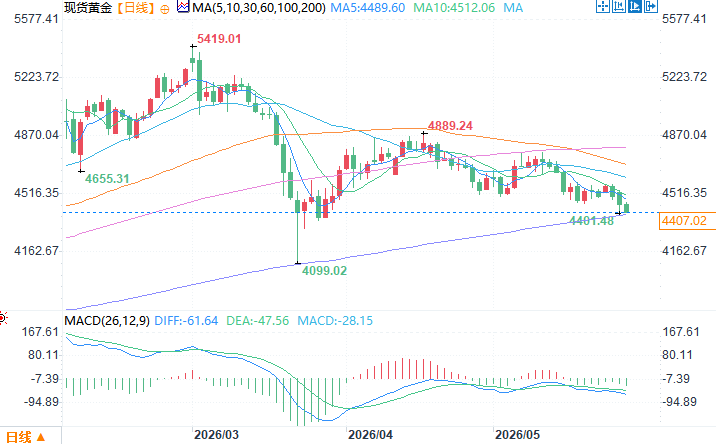
Spot gold daily chart source: EasyForex
At 10:42 AM Beijing time on May 28, spot gold was trading at $4404.82 per ounce.
Doug Moglia, macro strategist at Rockefeller Global Investment Management, points out that even with recent fluctuations in gold and silver prices, gold's position as a ballast in portfolios remains solid, and the multi-year bull market has not ended. Multiple global factors continue to support precious metals, leading to divergent price movements in gold and silver, while related mining stocks are seeing a revaluation opportunity, making the medium- to long-term investment logic clear.
Precious metals lead the market, central bank gold purchases lay a long-term foundation
Driven by multiple factors such as industrial transformation, energy security, and insufficient industry investment, commodities have returned to investors' attention, with precious metals performing far ahead.
Doug Moglia stated that gold has risen by 92% since 2025, while silver has seen an even more dramatic increase of 152%. Since the sanctions imposed on foreign exchange reserves in 2022, global central banks have continuously increased their gold purchases, with annual purchases exceeding 1,000 tons for three consecutive years from 2022 to 2024, accounting for 20% to 25% of global annual mined gold production. Central banks have recognized the geopolitical risks inherent in a single foreign exchange system, and gold's lack of counterparty risk has made it highly sought after. This has led to a continuous decrease in the sensitivity of gold prices to traditional influencing factors such as interest rates and the US dollar.
In 2025, the market style shifted, with central bank gold purchases falling to 863 tons. However, Western investors entered the market in large numbers through ETFs and other channels, with global gold ETF holdings increasing by nearly 20%, exceeding 3,000 tons. While the influx of off-exchange funds boosted the market, it also exacerbated short-term price volatility. By the end of January 2026, precious metals experienced a significant correction due to excessive speculative leverage.
The bullish trend continues, and the medium- to long-term target for gold prices is clear.
This round of gold price increases is defined as the third long-term bull market, triggered by the Russia-Ukraine conflict and rule changes brought about by foreign exchange reserve sanctions. Historically, the previous two long bull markets lasted nearly a decade, while the current bull market is only in its fourth year, indicating ample room for further upward movement. Market concerns about the Federal Reserve's independence, global fiscal risks, and geopolitical conflicts such as the situation in Iran are continuously strengthening the safe-haven demand for gold.
Mogliar predicts that gold prices could reach $5,500 per ounce by 2027, and possibly $8,000 per ounce by 2030, with the possibility of even hitting $10,000 per ounce in extreme market conditions. Currently, there are no signs of a market reversal, the trend of gold replacing traditional foreign exchange assets continues, and the conditions for the end of the bull market have not yet been met.
Gold and silver prices diverged, with silver's short-term upside potential narrowing.
Silver has also benefited from this bull market, often attracting capital inflows in the later stages due to its greater volatility. The silver market has been experiencing a supply shortage since 2021, driven by sustained growth in industrial demand from sectors such as photovoltaics, new energy vehicles, and semiconductors. However, 70% of silver production is a byproduct of other metal mining, making it difficult for supply to increase rapidly in line with price increases.
Looking at the gold-silver ratio, it once reached 100 in May 2025, indicating that silver was severely undervalued. After this round of fluctuations, the ratio has returned to the historical normal range of 50 to 60. Silver's short-term advantage over gold no longer exists, and it will mainly follow the market trend in the future.
Mining stocks are showing value and becoming high-quality investment targets.
Compared to the increasingly volatile spot gold and silver markets, the investment value of gold and silver mining stocks is becoming increasingly prominent. Currently, mining stocks are only slightly outperforming spot precious metals, and the sector's valuation remains low. Related companies have strong operating data, with the industry's overall operating profit margin reaching multi-year highs. Leading companies have ample cash flow, and dividend and share buyback programs are being implemented continuously.
Mining stocks, with their stable production costs, can both benefit from rising gold prices and generate sustainable income, compensating for the shortcomings of physical gold, such as the lack of interest and the risk of deterioration during holding. Although individual stocks carry operational risks and relatively high volatility, in the context of a medium- to long-term upward trend in gold prices, pullbacks in the sector present buying opportunities.
Summarize
In summary, the long-term bull market trend for gold will not be altered by short-term fluctuations, with central bank allocation needs, geopolitical risks, and concerns about the financial system providing solid support. Silver's fundamentals are sound, but its short-term upside is weakening. Meanwhile, gold and silver mining stocks, with their valuation advantages and operational leverage, have become preferred targets in this market rally.
In diversified commodity portfolios, gold remains a core pillar for protecting asset portfolios.
Spot gold daily chart source: EasyForex
At 10:42 AM Beijing time on May 28, spot gold was trading at $4404.82 per ounce.
- Risk Warning and Disclaimer
- The market involves risk, and trading may not be suitable for all investors. This article is for reference only and does not constitute personal investment advice, nor does it take into account certain users’ specific investment objectives, financial situation, or other needs. Any investment decisions made based on this information are at your own risk.