













Silver prices have continued to decline, approaching a three-week low; be wary of a downward breakout.
2026-05-28 14:25:37
On Thursday during the European trading session, spot silver (XAG/USD) continued its downward trend, falling to around $72.90, its lowest level since May 6. As military tensions between the US and Iran escalated further, risk aversion in global markets rapidly increased, causing the US dollar index and international oil prices to strengthen in tandem, putting significant pressure on the dollar-denominated precious metals market.
The U.S. military launched another military operation against Iran on Wednesday evening, striking a military target and shooting down four Iranian attack drones believed to threaten security in the Strait of Hormuz. Market concerns that a further deterioration in the Middle East could disrupt the global energy supply chain led to a rapid rebound in international oil prices.
The Strait of Hormuz handles approximately 20% of global seaborne crude oil transport, so any security risks involving the region can quickly impact global market risk appetite. With WTI crude oil prices climbing back above $89, market concerns about a resurgence of global inflation have clearly intensified.
Against this backdrop, the US dollar index has continued to strengthen. Because the US dollar serves as both a global reserve currency and a safe-haven asset, international capital typically flows into dollar-denominated assets when market risk sentiment deteriorates. The US dollar index has recently risen to a one-week high, and the strengthening dollar has generally put downward pressure on dollar-denominated commodities.
Meanwhile, market expectations for the Federal Reserve to maintain high interest rates are also rising. Following the rise in international oil prices, investors are concerned that US inflation may rebound, forcing the Fed to maintain its hawkish policy for an extended period. Since silver, like gold, is a non-interest-bearing asset, it typically faces some pressure in a high-interest-rate environment.
Market focus has now shifted to the US April PCE price index data to be released later tonight. The market expects the US PCE inflation rate to rise to 3.8% annually, up from the previous 3.5%; the core PCE annual rate is expected to rise to 3.3%. Since the PCE is one of the most closely watched inflation indicators by the Federal Reserve, this data could directly influence market expectations regarding the future path of interest rates.
If PCE data exceeds market expectations, bets on the Federal Reserve maintaining high interest rates or even raising them further may strengthen, thus further pressuring silver prices. Conversely, if inflation data shows a slowdown, it could alleviate market concerns about high interest rates and drive a temporary rebound in the precious metals market.
From a market structure perspective, silver is currently performing significantly weaker than gold. Analysts believe that in addition to interest rate factors, concerns about global economic growth are also putting pressure on silver. Because silver possesses both precious metal and industrial metal attributes, it tends to be more susceptible to downward pressure than gold when the market worries about a slowdown in global manufacturing demand.
From a daily chart perspective, XAG/USD is currently still trading below the 100-day moving average and the 20-day Bollinger Band, maintaining an overall bearish technical structure. Although the price rebounded from its lows earlier, the overall recovery was limited, and the downtrend has not yet clearly reversed. The RSI indicator is currently around 41.76, below the 50 midline, indicating that the market still faces downward pressure, and the bulls have not yet formed a valid reversal signal. The MACD indicator also remains weak, reflecting a cautious short-term market sentiment.
The first major resistance level is currently near the 20-day Bollinger Band moving average, around $73. If a technical rebound occurs, the next resistance levels to watch are $73.83 and the $75.30 area near the 100-day moving average. On the downside, the first support level to watch is the $71.22 area near the April 30 low. A break below this level could test the psychological level of $70. Further downside targets are the $69 area near the lower Bollinger Band; a break below this could open up more downside potential on the daily chart.
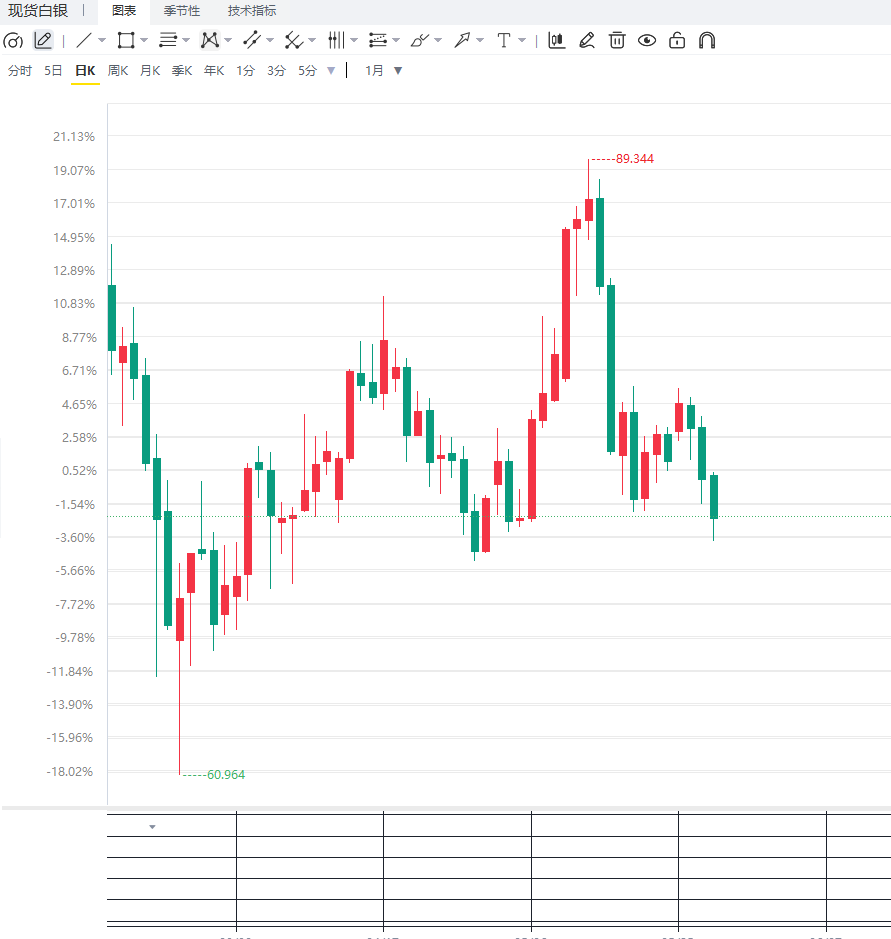
Furthermore, the recent high yields on US Treasury bonds are also putting pressure on silver. Following the rise in the yield on 10-year US Treasury bonds, funds are more inclined to allocate to high-yield dollar assets, thus weakening the attractiveness of precious metals. Overall, the silver market is currently under the dual pressure of a strong dollar and high interest rate expectations, and US PCE data and changes in the Middle East situation will be key variables determining the next stage of its price movement.
Editor's Summary : The current spot silver price trend is clearly weak, with the core pressures primarily stemming from a stronger US dollar, high US Treasury yields, and renewed market bets on a hawkish Federal Reserve policy. Meanwhile, escalating tensions in the Middle East have pushed up international oil prices, reinforcing market concerns about rising inflation and further weakening the precious metals market. Technically, silver has broken below several key moving average supports, indicating a short-term bearish overall structure. If US PCE data continues to exceed expectations, market bets on high interest rates may intensify, and silver may continue to test the key support level around $70. However, given the still high risk aversion in the market, a further deterioration in the Middle East situation could still lead to a temporary safe-haven rebound in the precious metals market. Investors should pay close attention to US inflation data, changes in Federal Reserve policy, and the trend of the US dollar index.
The U.S. military launched another military operation against Iran on Wednesday evening, striking a military target and shooting down four Iranian attack drones believed to threaten security in the Strait of Hormuz. Market concerns that a further deterioration in the Middle East could disrupt the global energy supply chain led to a rapid rebound in international oil prices.
The Strait of Hormuz handles approximately 20% of global seaborne crude oil transport, so any security risks involving the region can quickly impact global market risk appetite. With WTI crude oil prices climbing back above $89, market concerns about a resurgence of global inflation have clearly intensified.
Against this backdrop, the US dollar index has continued to strengthen. Because the US dollar serves as both a global reserve currency and a safe-haven asset, international capital typically flows into dollar-denominated assets when market risk sentiment deteriorates. The US dollar index has recently risen to a one-week high, and the strengthening dollar has generally put downward pressure on dollar-denominated commodities.
Meanwhile, market expectations for the Federal Reserve to maintain high interest rates are also rising. Following the rise in international oil prices, investors are concerned that US inflation may rebound, forcing the Fed to maintain its hawkish policy for an extended period. Since silver, like gold, is a non-interest-bearing asset, it typically faces some pressure in a high-interest-rate environment.
Market focus has now shifted to the US April PCE price index data to be released later tonight. The market expects the US PCE inflation rate to rise to 3.8% annually, up from the previous 3.5%; the core PCE annual rate is expected to rise to 3.3%. Since the PCE is one of the most closely watched inflation indicators by the Federal Reserve, this data could directly influence market expectations regarding the future path of interest rates.
If PCE data exceeds market expectations, bets on the Federal Reserve maintaining high interest rates or even raising them further may strengthen, thus further pressuring silver prices. Conversely, if inflation data shows a slowdown, it could alleviate market concerns about high interest rates and drive a temporary rebound in the precious metals market.
From a market structure perspective, silver is currently performing significantly weaker than gold. Analysts believe that in addition to interest rate factors, concerns about global economic growth are also putting pressure on silver. Because silver possesses both precious metal and industrial metal attributes, it tends to be more susceptible to downward pressure than gold when the market worries about a slowdown in global manufacturing demand.
From a daily chart perspective, XAG/USD is currently still trading below the 100-day moving average and the 20-day Bollinger Band, maintaining an overall bearish technical structure. Although the price rebounded from its lows earlier, the overall recovery was limited, and the downtrend has not yet clearly reversed. The RSI indicator is currently around 41.76, below the 50 midline, indicating that the market still faces downward pressure, and the bulls have not yet formed a valid reversal signal. The MACD indicator also remains weak, reflecting a cautious short-term market sentiment.
The first major resistance level is currently near the 20-day Bollinger Band moving average, around $73. If a technical rebound occurs, the next resistance levels to watch are $73.83 and the $75.30 area near the 100-day moving average. On the downside, the first support level to watch is the $71.22 area near the April 30 low. A break below this level could test the psychological level of $70. Further downside targets are the $69 area near the lower Bollinger Band; a break below this could open up more downside potential on the daily chart.
Furthermore, the recent high yields on US Treasury bonds are also putting pressure on silver. Following the rise in the yield on 10-year US Treasury bonds, funds are more inclined to allocate to high-yield dollar assets, thus weakening the attractiveness of precious metals. Overall, the silver market is currently under the dual pressure of a strong dollar and high interest rate expectations, and US PCE data and changes in the Middle East situation will be key variables determining the next stage of its price movement.
Editor's Summary : The current spot silver price trend is clearly weak, with the core pressures primarily stemming from a stronger US dollar, high US Treasury yields, and renewed market bets on a hawkish Federal Reserve policy. Meanwhile, escalating tensions in the Middle East have pushed up international oil prices, reinforcing market concerns about rising inflation and further weakening the precious metals market. Technically, silver has broken below several key moving average supports, indicating a short-term bearish overall structure. If US PCE data continues to exceed expectations, market bets on high interest rates may intensify, and silver may continue to test the key support level around $70. However, given the still high risk aversion in the market, a further deterioration in the Middle East situation could still lead to a temporary safe-haven rebound in the precious metals market. Investors should pay close attention to US inflation data, changes in Federal Reserve policy, and the trend of the US dollar index.
- Risk Warning and Disclaimer
- The market involves risk, and trading may not be suitable for all investors. This article is for reference only and does not constitute personal investment advice, nor does it take into account certain users’ specific investment objectives, financial situation, or other needs. Any investment decisions made based on this information are at your own risk.

