Silver is fluctuating around $76, awaiting a directional move.
2026-05-29 15:20:44
Spot silver (XAG/USD) remained range-bound in early Asian and European trading on Friday, fluctuating around $76. Despite a rebound from a four-week low near $71.80, the market lacked a clear direction, and prices failed to hold above $76.
The core drivers of the current market remain the US-Iran ceasefire agreement, Federal Reserve interest rate expectations, and global risk aversion. The US and Iran have reached a preliminary framework for extending the ceasefire for 60 days, and both sides may allow the Strait of Hormuz to resume normal energy transport. This news has significantly eased previous market concerns about disruptions to global energy supplies.
The Strait of Hormuz handles approximately 20% of global maritime energy transport, making any shifts in geopolitical risks in the region highly sensitive to impacting international financial markets and precious metal prices. With rising expectations of easing tensions in the Middle East, market risk appetite has improved significantly, leading to a decline in demand for the US dollar as a safe haven. On Thursday, the US dollar index retreated rapidly from a seven-week high, while global stock markets and risk assets generally rebounded.
Generally, a weaker dollar benefits precious metals like silver, as dollar-denominated metal prices become more attractive to overseas buyers. However, the current silver rebound has been significantly weaker than some market expectations, primarily due to investor caution regarding the long-term viability of the US-Iran agreement. Market analysts believe the current ceasefire is more of a temporary measure than a final, comprehensive peace agreement.
In addition, the latest US inflation data also had a complex impact on silver prices. Data released by the US Department of Commerce showed that the PCE price index rose 3.8% year-on-year in April, one of the fastest growth rates in nearly three years; the core PCE rose 3.3% year-on-year, still significantly higher than the Federal Reserve's long-term target of 2%.
Resurgence in US inflation is reinforcing market expectations that the Federal Reserve will maintain high interest rates. The market has significantly reduced bets on rate cuts this year, with some investors even beginning to anticipate further rate hikes by the Fed at the end of this year or early 2026. High interest rates typically put downward pressure on silver, as it does not generate interest income, while rising US Treasury yields increase the attractiveness of holding dollar-denominated assets. However, unlike gold, silver also possesses industrial attributes; therefore, its price movement is influenced not only by safe-haven demand and interest rates but also by expectations of global economic and industrial demand.
Analysts point out that the silver market is currently in a balancing act between a decline in its safe-haven appeal and support from industrial demand. This is a key reason why silver has maintained a wide range of fluctuations recently, without experiencing a one-sided decline. At the same time, the high-interest-rate environment of global central banks continues to limit the overall upside potential of precious metals. Although market expectations for a Federal Reserve rate cut have cooled somewhat, signs of a global economic slowdown also exist, making the market cautious about the future demand outlook for silver.
From the daily chart, silver is currently in a clear sideways consolidation pattern. Prices are generally trading within the $72 to $79 range, and a clear trend breakout has not yet formed. On the daily chart, the $76 area has become the most critical central resistance level. Previously, this area was a significant support level, but after being broken, it has now become short-term resistance.
If silver can effectively break through $76, the next stage may see a further test of the $78.75 to $78.90 area, which corresponds to the previous high in May and is also the current top of the range. On the downside, $71.79 remains a key short-term support level. A break below this level could open up further downside potential and retest the $68 area. If the dollar continues to weaken and the market re-bets on future Fed rate cuts, silver may break through $76 and retest the $79 area; however, if US economic data remains strong and US Treasury yields rise again, silver may fall back to test the $72 support level.
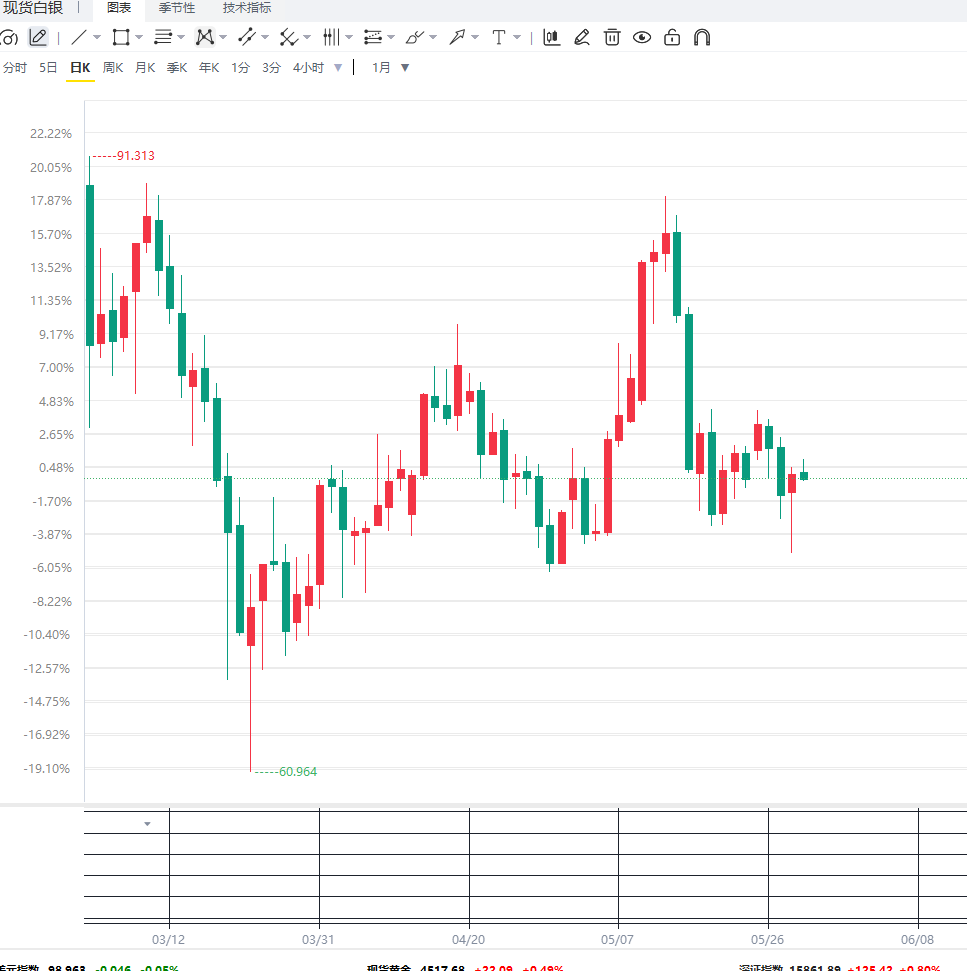
Overall, the current trend of silver is awaiting new macroeconomic catalysts, while the market may continue to maintain a high-volatility oscillation pattern in the short term.
Editor's Summary : Silver has recently maintained a wide range of fluctuations, with the market seeking a new balance between easing risk aversion and expectations of high interest rates from the Federal Reserve. While the US-Iran ceasefire agreement has alleviated market demand for safe-haven assets, persistently high US inflation has led the market to reassess the Fed's future policy path. Meanwhile, the outlook for industrial demand for silver remains relatively robust, providing some support for prices. From a technical perspective, $72 to $79 has become the current core trading range, and the short-term market direction remains unclear. Future US economic data, changes in Fed policy, and global geopolitical situations will continue to be key factors determining the next breakout direction for silver.
The core drivers of the current market remain the US-Iran ceasefire agreement, Federal Reserve interest rate expectations, and global risk aversion. The US and Iran have reached a preliminary framework for extending the ceasefire for 60 days, and both sides may allow the Strait of Hormuz to resume normal energy transport. This news has significantly eased previous market concerns about disruptions to global energy supplies.
The Strait of Hormuz handles approximately 20% of global maritime energy transport, making any shifts in geopolitical risks in the region highly sensitive to impacting international financial markets and precious metal prices. With rising expectations of easing tensions in the Middle East, market risk appetite has improved significantly, leading to a decline in demand for the US dollar as a safe haven. On Thursday, the US dollar index retreated rapidly from a seven-week high, while global stock markets and risk assets generally rebounded.
Generally, a weaker dollar benefits precious metals like silver, as dollar-denominated metal prices become more attractive to overseas buyers. However, the current silver rebound has been significantly weaker than some market expectations, primarily due to investor caution regarding the long-term viability of the US-Iran agreement. Market analysts believe the current ceasefire is more of a temporary measure than a final, comprehensive peace agreement.
In addition, the latest US inflation data also had a complex impact on silver prices. Data released by the US Department of Commerce showed that the PCE price index rose 3.8% year-on-year in April, one of the fastest growth rates in nearly three years; the core PCE rose 3.3% year-on-year, still significantly higher than the Federal Reserve's long-term target of 2%.
Resurgence in US inflation is reinforcing market expectations that the Federal Reserve will maintain high interest rates. The market has significantly reduced bets on rate cuts this year, with some investors even beginning to anticipate further rate hikes by the Fed at the end of this year or early 2026. High interest rates typically put downward pressure on silver, as it does not generate interest income, while rising US Treasury yields increase the attractiveness of holding dollar-denominated assets. However, unlike gold, silver also possesses industrial attributes; therefore, its price movement is influenced not only by safe-haven demand and interest rates but also by expectations of global economic and industrial demand.
Analysts point out that the silver market is currently in a balancing act between a decline in its safe-haven appeal and support from industrial demand. This is a key reason why silver has maintained a wide range of fluctuations recently, without experiencing a one-sided decline. At the same time, the high-interest-rate environment of global central banks continues to limit the overall upside potential of precious metals. Although market expectations for a Federal Reserve rate cut have cooled somewhat, signs of a global economic slowdown also exist, making the market cautious about the future demand outlook for silver.
From the daily chart, silver is currently in a clear sideways consolidation pattern. Prices are generally trading within the $72 to $79 range, and a clear trend breakout has not yet formed. On the daily chart, the $76 area has become the most critical central resistance level. Previously, this area was a significant support level, but after being broken, it has now become short-term resistance.
If silver can effectively break through $76, the next stage may see a further test of the $78.75 to $78.90 area, which corresponds to the previous high in May and is also the current top of the range. On the downside, $71.79 remains a key short-term support level. A break below this level could open up further downside potential and retest the $68 area. If the dollar continues to weaken and the market re-bets on future Fed rate cuts, silver may break through $76 and retest the $79 area; however, if US economic data remains strong and US Treasury yields rise again, silver may fall back to test the $72 support level.
Overall, the current trend of silver is awaiting new macroeconomic catalysts, while the market may continue to maintain a high-volatility oscillation pattern in the short term.
Editor's Summary : Silver has recently maintained a wide range of fluctuations, with the market seeking a new balance between easing risk aversion and expectations of high interest rates from the Federal Reserve. While the US-Iran ceasefire agreement has alleviated market demand for safe-haven assets, persistently high US inflation has led the market to reassess the Fed's future policy path. Meanwhile, the outlook for industrial demand for silver remains relatively robust, providing some support for prices. From a technical perspective, $72 to $79 has become the current core trading range, and the short-term market direction remains unclear. Future US economic data, changes in Fed policy, and global geopolitical situations will continue to be key factors determining the next breakout direction for silver.
- Risk Warning and Disclaimer
- The market involves risk, and trading may not be suitable for all investors. This article is for reference only and does not constitute personal investment advice, nor does it take into account certain users’ specific investment objectives, financial situation, or other needs. Any investment decisions made based on this information are at your own risk.