Expectations of a US-Iran peace agreement boosted market sentiment, causing silver prices to rebound slightly.
2026-06-01 15:57:40
Spot silver (XAG/USD) continued its rebound during Monday's European trading session, rising approximately 0.26% to around $75.50. Improved market risk sentiment and positive progress in negotiations between the US and Iran provided some support to the precious metals market.
Recently, market expectations for a long-term peace agreement between the United States and Iran have increased. US President Trump posted on social media that Iran urgently wants an agreement, but emphasized that military options remain. Earlier over the weekend, Trump stated in a media interview that some terms of the US-Iran agreement have been adjusted, including key provisions such as the destruction of Iranian nuclear materials and the reopening of the Strait of Hormuz.
The market believes that if an agreement is ultimately reached, it will help reduce long-term geopolitical risks in the Middle East, thereby improving global market risk appetite. However, significant uncertainty remains regarding whether an agreement will be reached. The two sides still have clear differences on core issues such as their nuclear programs and control of the Strait of Hormuz, therefore the market remains cautious.
Meanwhile, the situation in the Middle East remains complex. Renewed military conflict between Israel and Lebanon has driven a rebound in international oil prices from previous lows. Rising energy prices have reignited concerns about global inflationary pressures. Investors are beginning to reassess the future policy paths of major central banks, particularly the Federal Reserve.
Historically, silver and oil prices have tended to have a negative correlation in the current market environment. Rising oil prices mean higher energy costs, which could drive inflation back up, thus forcing the Federal Reserve to maintain high interest rates for a longer period.
A high-interest-rate environment is generally unfavorable for the performance of non-interest-bearing assets such as silver; therefore, the rebound in oil prices has limited the upside potential of silver to some extent. Currently, market expectations regarding Federal Reserve policy are undergoing subtle changes. As the situation in the Middle East leads to increased volatility in energy prices, some investors are beginning to lower their expectations for future easing policies.
If inflation in the US recurs in the future, the Federal Reserve may need to maintain higher interest rates for a longer period, which is not a positive factor for the precious metals market, such as gold and silver. Some market analysts point out: "The silver market is currently in a balance between safe-haven demand and interest rate pressure, and its short-term trend depends more on the performance of US economic data."
The market's focus will now shift to the US May non-farm payrolls report, to be released this Friday. The performance of the job market will directly influence market expectations regarding the future policy direction of the Federal Reserve. If the number of new jobs significantly exceeds expectations, it could strengthen market expectations of a prolonged period of high interest rates, thus putting pressure on silver; conversely, if the employment data slows, it could potentially boost the precious metals market. In addition, the US ISM Manufacturing PMI data and the latest developments in the Middle East will continue to influence market risk appetite and capital flows.
From the daily chart, silver prices are currently maintaining a wide-range consolidation pattern. Over the past two weeks, prices have mainly traded within the range of $71.79 to $78.83. Although there was a rebound on Monday, prices remain below the 20-day exponential moving average at $76.92. The short-term trend remains weak, and the market has not yet formed a clear breakout signal. Technically, the RSI is hovering around 47, slightly below the neutral level of 50, indicating that bullish momentum remains insufficient. The MACD indicator remains near the zero line, showing that the market is in a directional decision-making phase. A break above the $78.83 resistance area is needed to alleviate current downward pressure and create conditions for a further challenge of $83.88. If prices fall below the $71.79 support level again, it could trigger a deeper correction, potentially testing the $68.28 area. Longer-term support lies around $61.01.
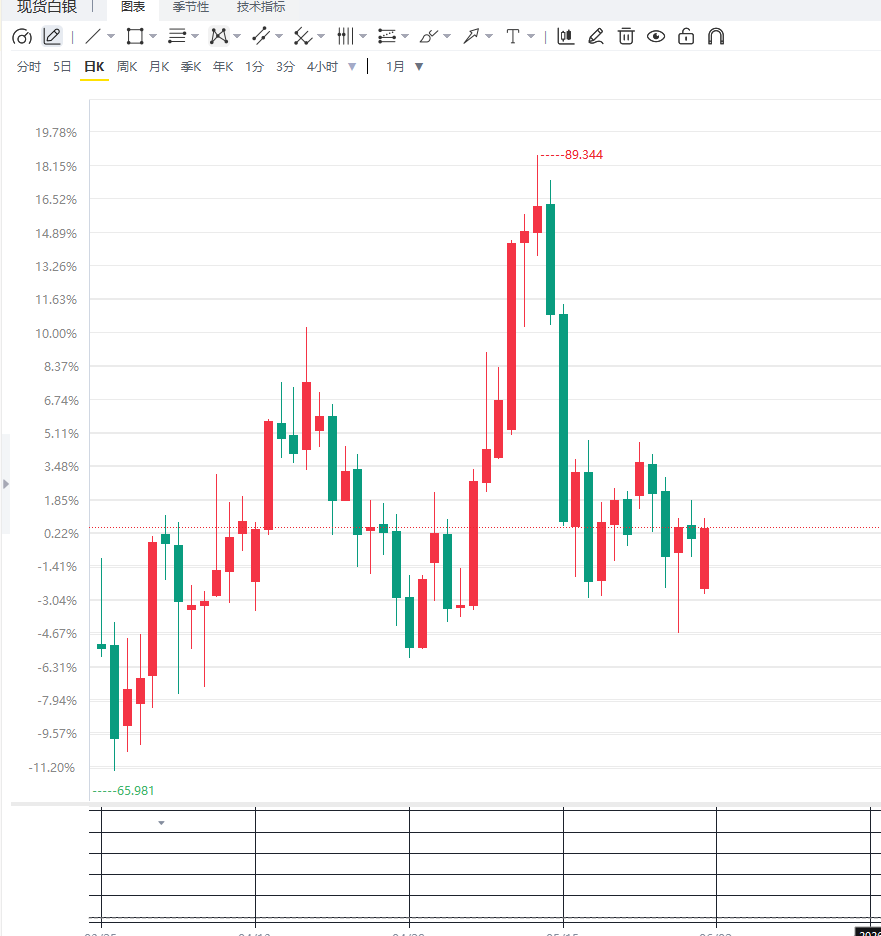
Overall, silver is currently still in a period of consolidation and adjustment. Short-term market direction will primarily depend on US economic data, expectations regarding Federal Reserve policy, and developments in the Middle East.
Editor's Summary : The silver market is currently influenced by a triple factor: geopolitical expectations, energy price volatility, and the outlook for Federal Reserve policy. Improved expectations of a US-Iran peace agreement have boosted market risk sentiment, providing temporary support for silver. However, inflation concerns triggered by the rebound in oil prices have weakened market expectations for future easing policies. From a core market logic perspective, the short-term upward momentum for silver comes from improved risk sentiment, while the main pressure comes from expectations that the Federal Reserve may maintain high interest rates. In the coming week, US non-farm payroll data, changes in Federal Reserve policy expectations, and progress in US-Iran negotiations will be key variables affecting silver's price movement. Before the release of major data, the market is likely to maintain a range-bound trading pattern.
Recently, market expectations for a long-term peace agreement between the United States and Iran have increased. US President Trump posted on social media that Iran urgently wants an agreement, but emphasized that military options remain. Earlier over the weekend, Trump stated in a media interview that some terms of the US-Iran agreement have been adjusted, including key provisions such as the destruction of Iranian nuclear materials and the reopening of the Strait of Hormuz.
The market believes that if an agreement is ultimately reached, it will help reduce long-term geopolitical risks in the Middle East, thereby improving global market risk appetite. However, significant uncertainty remains regarding whether an agreement will be reached. The two sides still have clear differences on core issues such as their nuclear programs and control of the Strait of Hormuz, therefore the market remains cautious.
Meanwhile, the situation in the Middle East remains complex. Renewed military conflict between Israel and Lebanon has driven a rebound in international oil prices from previous lows. Rising energy prices have reignited concerns about global inflationary pressures. Investors are beginning to reassess the future policy paths of major central banks, particularly the Federal Reserve.
Historically, silver and oil prices have tended to have a negative correlation in the current market environment. Rising oil prices mean higher energy costs, which could drive inflation back up, thus forcing the Federal Reserve to maintain high interest rates for a longer period.
A high-interest-rate environment is generally unfavorable for the performance of non-interest-bearing assets such as silver; therefore, the rebound in oil prices has limited the upside potential of silver to some extent. Currently, market expectations regarding Federal Reserve policy are undergoing subtle changes. As the situation in the Middle East leads to increased volatility in energy prices, some investors are beginning to lower their expectations for future easing policies.
If inflation in the US recurs in the future, the Federal Reserve may need to maintain higher interest rates for a longer period, which is not a positive factor for the precious metals market, such as gold and silver. Some market analysts point out: "The silver market is currently in a balance between safe-haven demand and interest rate pressure, and its short-term trend depends more on the performance of US economic data."
The market's focus will now shift to the US May non-farm payrolls report, to be released this Friday. The performance of the job market will directly influence market expectations regarding the future policy direction of the Federal Reserve. If the number of new jobs significantly exceeds expectations, it could strengthen market expectations of a prolonged period of high interest rates, thus putting pressure on silver; conversely, if the employment data slows, it could potentially boost the precious metals market. In addition, the US ISM Manufacturing PMI data and the latest developments in the Middle East will continue to influence market risk appetite and capital flows.
From the daily chart, silver prices are currently maintaining a wide-range consolidation pattern. Over the past two weeks, prices have mainly traded within the range of $71.79 to $78.83. Although there was a rebound on Monday, prices remain below the 20-day exponential moving average at $76.92. The short-term trend remains weak, and the market has not yet formed a clear breakout signal. Technically, the RSI is hovering around 47, slightly below the neutral level of 50, indicating that bullish momentum remains insufficient. The MACD indicator remains near the zero line, showing that the market is in a directional decision-making phase. A break above the $78.83 resistance area is needed to alleviate current downward pressure and create conditions for a further challenge of $83.88. If prices fall below the $71.79 support level again, it could trigger a deeper correction, potentially testing the $68.28 area. Longer-term support lies around $61.01.
Overall, silver is currently still in a period of consolidation and adjustment. Short-term market direction will primarily depend on US economic data, expectations regarding Federal Reserve policy, and developments in the Middle East.
Editor's Summary : The silver market is currently influenced by a triple factor: geopolitical expectations, energy price volatility, and the outlook for Federal Reserve policy. Improved expectations of a US-Iran peace agreement have boosted market risk sentiment, providing temporary support for silver. However, inflation concerns triggered by the rebound in oil prices have weakened market expectations for future easing policies. From a core market logic perspective, the short-term upward momentum for silver comes from improved risk sentiment, while the main pressure comes from expectations that the Federal Reserve may maintain high interest rates. In the coming week, US non-farm payroll data, changes in Federal Reserve policy expectations, and progress in US-Iran negotiations will be key variables affecting silver's price movement. Before the release of major data, the market is likely to maintain a range-bound trading pattern.
- Risk Warning and Disclaimer
- The market involves risk, and trading may not be suitable for all investors. This article is for reference only and does not constitute personal investment advice, nor does it take into account certain users’ specific investment objectives, financial situation, or other needs. Any investment decisions made based on this information are at your own risk.