Silver fell more than 1.5%: Middle East conflict failed to boost safe-haven demand; interest rate hike expectations were the main reason.
2026-06-05 16:46:23
On Friday (June 5) during the European session, silver prices fell by more than 1.5% after a slight increase in the previous trading day, currently trading around $72.50 per ounce. The ongoing US-Iran conflict has brought inflation risks and interest rate concerns to the market's focus, putting pressure on silver.
Hezbollah militias, backed by Iran, rejected a newly proposed ceasefire in Lebanon on Thursday, and Israel also made it clear that it would not withdraw its troops from southern Lebanon, thwarting Trump's efforts to simultaneously end the Lebanese war and reach a US-Iran peace agreement. Iran had previously made a ceasefire in Lebanon a precondition for negotiations with Washington and hinted at direct intervention if Israel continued its attacks, but Hezbollah leader Qassem Soleimani rejected the US-brokered agreement, citing his lack of involvement in the negotiations.
Meanwhile, on Wednesday, Iran and the U.S. military clashed in the Persian Gulf region, the fiercest exchange of fire since April—an Iranian attack on a Kuwaiti airport that killed one person and injured more than 60, while the U.S. military launched airstrikes near the Strait of Hormuz, further escalating regional tensions.
Despite the escalating military conflict, Trump has left a window open for diplomatic negotiations.
US President Donald Trump said on Thursday that he would not rule out a meeting with Iran's new Supreme Leader if the US and Iran ultimately reach an agreement. He reiterated that the US would never allow Iran to possess nuclear weapons, and stated that previous US strikes on Iranian nuclear facilities had "completely destroyed" those facilities.
The ongoing tensions in the Middle East should theoretically support safe-haven assets, but current safe-haven funds are flowing more towards the US dollar than silver. Therefore, silver is under pressure and declining amid geopolitical risks, failing to benefit from the tensions.
Silver faces another challenge: the recent strong performance of the US labor market has solidified market expectations for a Federal Reserve rate hike before the end of the year. Traders are currently awaiting the upcoming US May non-farm payroll report for new directional guidance. The market currently forecasts 85,000 new jobs in the US in May, with the unemployment rate expected to remain stable at 4.3%.
Any unexpected upside surprise or signs of further strength in the labor market could prompt traders to bet that the Federal Reserve will maintain higher interest rates for a longer period—which would put continued pressure on silver, a non-interest-bearing asset.
The industrial demand for silver is undergoing a structural shift. On the one hand, AI data centers and high-end chip packaging are bringing new incremental demand. A single NVIDIA H100 server contains approximately 1.2 kg of silver, far exceeding the 0.5 kg of traditional servers, and silver usage related to AI is projected to increase significantly by 55% to 65% year-on-year in 2025.
On the other hand, the photovoltaic industry is being forced to accelerate its silver reduction efforts due to high silver prices. The amount of silver paste consumed per solar cell has decreased from approximately 130 milligrams per cell in 2019 to approximately 65 milligrams per cell in 2023, and the reduction in photovoltaic silver paste and copper substitution is continuing. The World Silver Institute predicts that industrial silver processing will decline by 2% in 2026, to a four-year low of 650 million ounces.
However, the inelastic demand from AI data centers, electric vehicles, and high-end electronics sectors remains, and the silver supply-demand gap is expected to persist for the sixth consecutive year. Overall, short-term demand is under pressure, but long-term structural support remains.
UBS recently significantly lowered its silver price forecast, reducing its target for the end of June from $100 to $85, September to $85, December to $80, and March 2027 to $75. This adjustment is primarily based on: cooling investment demand (ETF holdings have plummeted by nearly 70 million ounces this year), weakened photovoltaic demand due to high prices, suppressed demand for silver jewelry due to high prices, and a recovery in mine supply (estimated to be close to 850 million ounces). UBS expects the silver supply deficit to narrow significantly from its previous estimate of 300 million ounces to 60-70 million ounces by 2026.
However, UBS also pointed out that gold prices still provide an important anchor for silver, and the gold-silver ratio is expected to move towards the 75-80 range, which means that silver still has room to catch up with gold.
JPMorgan Chase maintained a relatively positive view on silver in a recent internal meeting, predicting that the price of silver will be around $90 per ounce by the end of the year. The institution pointed out that high prices have significantly suppressed demand for silver in the photovoltaic industry, and has excluded about 60 million ounces of photovoltaic demand from its model. It expects the market to move towards near balance or a slight oversupply by 2026.
JPMorgan Chase emphasizes that silver will not completely decouple from gold, and gold will remain the primary pricing driver for silver. The current gold-silver ratio is already high, limiting silver's continued outperformance relative to gold. If gold falls by 1%, silver could experience a significant pullback of 5-6%.
Silver prices fell to around $72.50, mainly as the ongoing conflict in the Middle East brought inflation risks and interest rate concerns to the market's focus. The market is awaiting Friday's non-farm payroll report; any data exceeding expectations could further reinforce the "higher and longer" interest rate outlook, putting additional pressure on silver.
Spot silver prices initially surged to 121.48 before falling back. This rebound encountered resistance at 89.34 and subsequently retreated, with the current price falling below the MA50. The price has held firmly above the 200-day moving average support, indicating that the long-term upward trend remains intact. In the short term, prices are consolidating in a narrow range near the yearly moving average.
The MACD is below the zero line, the DIFF is below the DEA, and the green bars are running steadily with a slight downward trend, indicating mild bearish momentum. Short-term resistance is at the MA50 line, while support is based on the 200-day moving average. Short-term range-bound trading is expected. A rebound can only resume if the price rises above the short-term moving average, while a break below the yearly moving average would open up further downside potential.
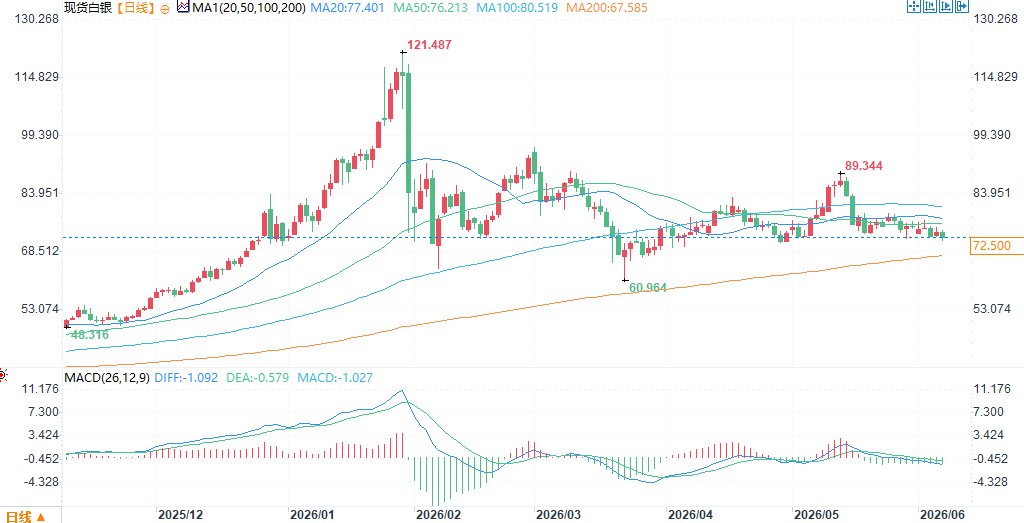
(Spot silver daily chart, source: EasyForex)
At 16:09 Beijing time on June 5, spot silver was trading at $72.45 per ounce.
Tensions in the Middle East persist, and risk aversion has failed to boost silver prices.
Hezbollah militias, backed by Iran, rejected a newly proposed ceasefire in Lebanon on Thursday, and Israel also made it clear that it would not withdraw its troops from southern Lebanon, thwarting Trump's efforts to simultaneously end the Lebanese war and reach a US-Iran peace agreement. Iran had previously made a ceasefire in Lebanon a precondition for negotiations with Washington and hinted at direct intervention if Israel continued its attacks, but Hezbollah leader Qassem Soleimani rejected the US-brokered agreement, citing his lack of involvement in the negotiations.
Meanwhile, on Wednesday, Iran and the U.S. military clashed in the Persian Gulf region, the fiercest exchange of fire since April—an Iranian attack on a Kuwaiti airport that killed one person and injured more than 60, while the U.S. military launched airstrikes near the Strait of Hormuz, further escalating regional tensions.
Despite the escalating military conflict, Trump has left a window open for diplomatic negotiations.
US President Donald Trump said on Thursday that he would not rule out a meeting with Iran's new Supreme Leader if the US and Iran ultimately reach an agreement. He reiterated that the US would never allow Iran to possess nuclear weapons, and stated that previous US strikes on Iranian nuclear facilities had "completely destroyed" those facilities.
The ongoing tensions in the Middle East should theoretically support safe-haven assets, but current safe-haven funds are flowing more towards the US dollar than silver. Therefore, silver is under pressure and declining amid geopolitical risks, failing to benefit from the tensions.
A strong labor market reinforces expectations of a Fed rate hike.
Silver faces another challenge: the recent strong performance of the US labor market has solidified market expectations for a Federal Reserve rate hike before the end of the year. Traders are currently awaiting the upcoming US May non-farm payroll report for new directional guidance. The market currently forecasts 85,000 new jobs in the US in May, with the unemployment rate expected to remain stable at 4.3%.
Any unexpected upside surprise or signs of further strength in the labor market could prompt traders to bet that the Federal Reserve will maintain higher interest rates for a longer period—which would put continued pressure on silver, a non-interest-bearing asset.
Industrial demand is diverging: AI drives incremental growth, while photovoltaic production is forced to decrease.
The industrial demand for silver is undergoing a structural shift. On the one hand, AI data centers and high-end chip packaging are bringing new incremental demand. A single NVIDIA H100 server contains approximately 1.2 kg of silver, far exceeding the 0.5 kg of traditional servers, and silver usage related to AI is projected to increase significantly by 55% to 65% year-on-year in 2025.
On the other hand, the photovoltaic industry is being forced to accelerate its silver reduction efforts due to high silver prices. The amount of silver paste consumed per solar cell has decreased from approximately 130 milligrams per cell in 2019 to approximately 65 milligrams per cell in 2023, and the reduction in photovoltaic silver paste and copper substitution is continuing. The World Silver Institute predicts that industrial silver processing will decline by 2% in 2026, to a four-year low of 650 million ounces.
However, the inelastic demand from AI data centers, electric vehicles, and high-end electronics sectors remains, and the silver supply-demand gap is expected to persist for the sixth consecutive year. Overall, short-term demand is under pressure, but long-term structural support remains.
Institutional Views
UBS recently significantly lowered its silver price forecast, reducing its target for the end of June from $100 to $85, September to $85, December to $80, and March 2027 to $75. This adjustment is primarily based on: cooling investment demand (ETF holdings have plummeted by nearly 70 million ounces this year), weakened photovoltaic demand due to high prices, suppressed demand for silver jewelry due to high prices, and a recovery in mine supply (estimated to be close to 850 million ounces). UBS expects the silver supply deficit to narrow significantly from its previous estimate of 300 million ounces to 60-70 million ounces by 2026.
However, UBS also pointed out that gold prices still provide an important anchor for silver, and the gold-silver ratio is expected to move towards the 75-80 range, which means that silver still has room to catch up with gold.
JPMorgan Chase maintained a relatively positive view on silver in a recent internal meeting, predicting that the price of silver will be around $90 per ounce by the end of the year. The institution pointed out that high prices have significantly suppressed demand for silver in the photovoltaic industry, and has excluded about 60 million ounces of photovoltaic demand from its model. It expects the market to move towards near balance or a slight oversupply by 2026.
JPMorgan Chase emphasizes that silver will not completely decouple from gold, and gold will remain the primary pricing driver for silver. The current gold-silver ratio is already high, limiting silver's continued outperformance relative to gold. If gold falls by 1%, silver could experience a significant pullback of 5-6%.
Silver prices fell to around $72.50, mainly as the ongoing conflict in the Middle East brought inflation risks and interest rate concerns to the market's focus. The market is awaiting Friday's non-farm payroll report; any data exceeding expectations could further reinforce the "higher and longer" interest rate outlook, putting additional pressure on silver.
Technical Analysis
Spot silver prices initially surged to 121.48 before falling back. This rebound encountered resistance at 89.34 and subsequently retreated, with the current price falling below the MA50. The price has held firmly above the 200-day moving average support, indicating that the long-term upward trend remains intact. In the short term, prices are consolidating in a narrow range near the yearly moving average.
The MACD is below the zero line, the DIFF is below the DEA, and the green bars are running steadily with a slight downward trend, indicating mild bearish momentum. Short-term resistance is at the MA50 line, while support is based on the 200-day moving average. Short-term range-bound trading is expected. A rebound can only resume if the price rises above the short-term moving average, while a break below the yearly moving average would open up further downside potential.
(Spot silver daily chart, source: EasyForex)
At 16:09 Beijing time on June 5, spot silver was trading at $72.45 per ounce.
- Risk Warning and Disclaimer
- The market involves risk, and trading may not be suitable for all investors. This article is for reference only and does not constitute personal investment advice, nor does it take into account certain users’ specific investment objectives, financial situation, or other needs. Any investment decisions made based on this information are at your own risk.