Euro falls to two-month low; US CPI and ECB decision may determine its fate.
2026-06-08 15:10:20
On Monday (June 8), the euro fell to a near two-month low of 1.1506 against the US dollar before rebounding and recovering its losses. The exchange rate then fluctuated at low levels, currently trading around 1.1525. Affected by multiple negative factors, the euro fell more than 0.7% against the US dollar in the previous trading day, recording its largest single-day drop in nearly three months.
Data released by the Federal Statistical Office of Germany on Monday showed that German factory orders fell 3.8% month-on-month in April, ending the previous trend of continuous improvement and far worse than the market expectation of a 1.2% decline.
On the other hand, U.S. nonfarm payrolls increased by 172,000 in May, far exceeding market expectations of 85,000, while the combined figures for the previous two months were revised upwards by 93,000. The unemployment rate remained stable at 4.3%, the lowest level since August of last year, and well below the long-term average of 5.7%. Annual wage growth was 3.4%, indicating that although inflationary pressures from the labor market have eased somewhat, demand for workers remains resilient.
Traders have now fully priced in a 25-basis-point rate hike by the Federal Reserve by the end of the year, a significant shift from expectations a few weeks ago.

New data released by the Federal Statistical Office of Germany on Monday showed that German factory orders fell 3.8% month-on-month in April, ending two consecutive months of improvement and far worse than the market expectation of a 1.2% decline. This sharp weakening reflects that the foundation of Germany's manufacturing recovery, as Europe's largest economy, remains very fragile.
From a broader perspective, German factory orders have fluctuated dramatically since the beginning of the year. A slight rebound in January and February fueled market expectations of a manufacturing recovery. However, March's revised order data still showed weakness, and April saw a precipitous decline, marking the largest monthly drop in the past six months. Analysts point out that soaring energy prices due to the Middle East conflict, slowing global demand, and weak business investment are the main factors dragging down order data. Particularly in the capital goods sector, large industrial orders such as machinery and electrical equipment have decreased significantly, reflecting companies' cautious attitude towards the future economic outlook.
Furthermore, the contraction in overseas orders from non-eurozone countries was particularly pronounced, with a quarter-on-quarter decline exceeding 5%. This indicates that against the backdrop of heightened uncertainty in the global trade environment, Germany's export engine is facing significant headwinds. Economists warn that if factory orders do not recover quickly in the coming months, German industrial output in the second quarter could continue to drag down overall economic performance, and could even derail the already fragile economic recovery. This data also adds a new consideration to the upcoming European Central Bank (ECB) interest rate meeting—given the continued economic pressure, the ECB needs to weigh the risk of a manufacturing recession while raising interest rates to combat inflation.
Market attention has now shifted to Wednesday's release of the U.S. Consumer Price Index (CPI) data, which will be a key variable influencing the Federal Reserve's interest rate path.
Following the unexpected 3.8% annualized CPI in April, the market widely expects inflation to accelerate further to 4.2% in May, influenced by the recent surge in energy prices and the supply chain disruptions caused by the closure of the Strait of Hormuz. If this expectation materializes, it would mean that inflationary pressures in the United States have risen for the second consecutive month, widening the gap between the US and the Federal Reserve's 2% target level.
This data is crucial to market sentiment, as its reading will directly influence investors' judgments on the Federal Reserve's next move.
If the CPI data is higher than expected, it could further strengthen market expectations that the Federal Reserve will need to maintain a restrictive policy stance for a longer period, thereby prolonging the recent rise in the US dollar and putting downward pressure on the euro against the dollar.
Conversely, if inflation data unexpectedly falls short of expectations, it could prompt investors to reconsider the aggressive hawkish pricing driven by the strong jobs report, providing breathing room for non-US currencies such as the euro.
On Thursday, market focus will quickly shift to Frankfurt. A 25-basis-point rate hike by the European Central Bank is widely expected and considered a done deal. Since this decision has already been fully priced in, it is unlikely to trigger significant volatility; investors are really focused on President Lagarde's guidance on the policy path after June in her post-meeting press conference.
Given that inflation remains stubborn in parts of the eurozone, particularly with a significant jump in services inflation in May, policymakers may be reluctant to hint at an imminent pause in interest rate hikes. Any signal that further tightening is still under consideration could provide moderate support for the euro against the dollar, helping the exchange rate stabilize at current levels.
However, overall, the movement of this currency pair will still largely depend on the development of the situation between the United States and Iran. If the conflict in the Middle East escalates further, risk aversion may push up the US dollar again, limiting the euro's rebound potential.
DBS Bank maintains its forecast that the euro will trade in the higher range of 1.15-1.20 against the US dollar in 2026.
The bank noted that although the policy interest rate differential between the US and Europe remains favorable for the dollar, the euro has unexpectedly appreciated by about 10% this year. It expects the European Central Bank to raise interest rates by 25 basis points to 2% at its June meeting as scheduled, hinting that the rate hike cycle is nearing its end. Meanwhile, market concerns about the risk of stagflation in the US economy and the weakening of the dollar's institutional credibility will provide structural support for the euro.
ING views the Eurozone's economic recovery as the core narrative for a stronger euro, predicting the euro will rise quarter by quarter against the US dollar to 1.21 by 2026, with a clear bullish bias. ING states that the Eurozone has available savings, coupled with German fiscal stimulus, which will gradually build economic momentum. Furthermore, a surplus of crude oil and LNG supply in 2026 will depress energy prices and improve the Eurozone's terms of trade.
ING points out that while the euro's rise above 1.20 against the dollar may trigger protests from dovish ECB officials, the pace of appreciation will be slow and controlled. Overall, ING believes the Eurozone is emerging from the shadow of the energy shock, and with fiscal stimulus taking effect, improved terms of trade, and the gradual formation of expectations for monetary policy normalization, the euro has a foundation for steady upward movement in the medium term.
The euro/dollar pair is currently showing a clear downward trend on the daily chart, with the price breaking below the key support level of 1.1550 and hitting a new recent low. The moving average system is in a bearish alignment, with the price breaking below the MA20, MA50, MA100, and MA200. The next support level is the previous low of 1.1500.
In terms of indicators, the MACD's DIFF line and DEA line have formed a death cross, and the green bars have begun to appear, indicating the release of bearish momentum; the RSI value is 48.88, which is in the neutral to weak range and has not yet entered the oversold zone, indicating that there is still room for further decline in the short term.
Overall, the euro is in a weak downward channel against the US dollar in the short term, with technical signals leaning bearish. If it breaks below the 1.1500 support level, the downside potential may open up further, while the upside resistance is concentrated in the 1.1551-1.1600 range.
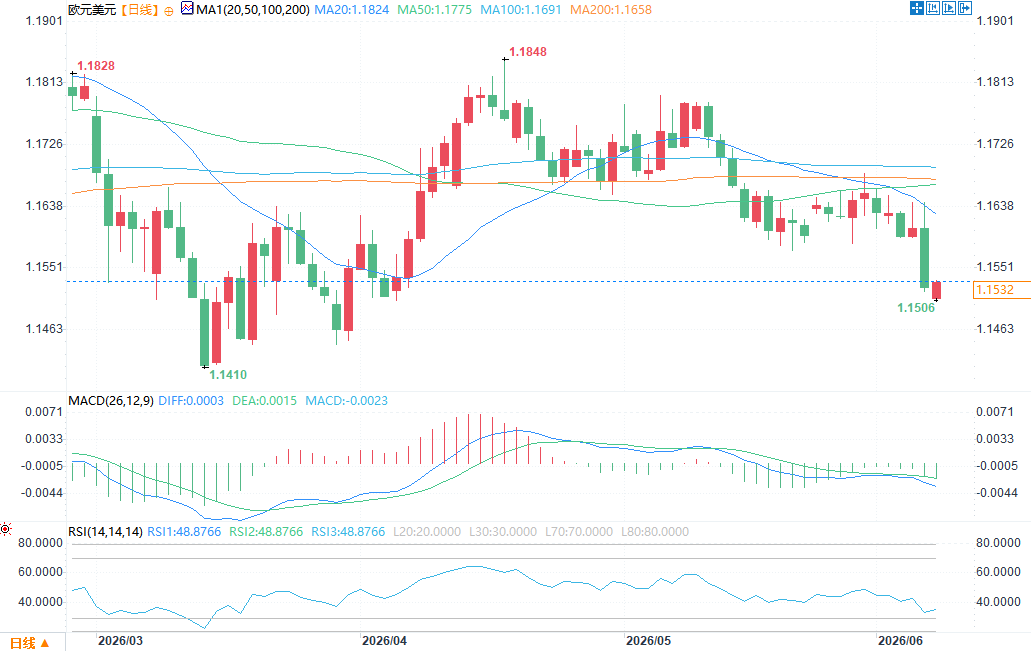
(Euro/USD daily chart, source: FX678)
At 15:09 Beijing time on June 8, the euro was trading at 1.1516/17 against the US dollar.
Data released by the Federal Statistical Office of Germany on Monday showed that German factory orders fell 3.8% month-on-month in April, ending the previous trend of continuous improvement and far worse than the market expectation of a 1.2% decline.
On the other hand, U.S. nonfarm payrolls increased by 172,000 in May, far exceeding market expectations of 85,000, while the combined figures for the previous two months were revised upwards by 93,000. The unemployment rate remained stable at 4.3%, the lowest level since August of last year, and well below the long-term average of 5.7%. Annual wage growth was 3.4%, indicating that although inflationary pressures from the labor market have eased somewhat, demand for workers remains resilient.
Traders have now fully priced in a 25-basis-point rate hike by the Federal Reserve by the end of the year, a significant shift from expectations a few weeks ago.
Factory orders unexpectedly plummeted in April.
New data released by the Federal Statistical Office of Germany on Monday showed that German factory orders fell 3.8% month-on-month in April, ending two consecutive months of improvement and far worse than the market expectation of a 1.2% decline. This sharp weakening reflects that the foundation of Germany's manufacturing recovery, as Europe's largest economy, remains very fragile.
From a broader perspective, German factory orders have fluctuated dramatically since the beginning of the year. A slight rebound in January and February fueled market expectations of a manufacturing recovery. However, March's revised order data still showed weakness, and April saw a precipitous decline, marking the largest monthly drop in the past six months. Analysts point out that soaring energy prices due to the Middle East conflict, slowing global demand, and weak business investment are the main factors dragging down order data. Particularly in the capital goods sector, large industrial orders such as machinery and electrical equipment have decreased significantly, reflecting companies' cautious attitude towards the future economic outlook.
Furthermore, the contraction in overseas orders from non-eurozone countries was particularly pronounced, with a quarter-on-quarter decline exceeding 5%. This indicates that against the backdrop of heightened uncertainty in the global trade environment, Germany's export engine is facing significant headwinds. Economists warn that if factory orders do not recover quickly in the coming months, German industrial output in the second quarter could continue to drag down overall economic performance, and could even derail the already fragile economic recovery. This data also adds a new consideration to the upcoming European Central Bank (ECB) interest rate meeting—given the continued economic pressure, the ECB needs to weigh the risk of a manufacturing recession while raising interest rates to combat inflation.
US CPI Data: A Litmus Test for Interest Rate Hike Expectations
Market attention has now shifted to Wednesday's release of the U.S. Consumer Price Index (CPI) data, which will be a key variable influencing the Federal Reserve's interest rate path.
Following the unexpected 3.8% annualized CPI in April, the market widely expects inflation to accelerate further to 4.2% in May, influenced by the recent surge in energy prices and the supply chain disruptions caused by the closure of the Strait of Hormuz. If this expectation materializes, it would mean that inflationary pressures in the United States have risen for the second consecutive month, widening the gap between the US and the Federal Reserve's 2% target level.
This data is crucial to market sentiment, as its reading will directly influence investors' judgments on the Federal Reserve's next move.
If the CPI data is higher than expected, it could further strengthen market expectations that the Federal Reserve will need to maintain a restrictive policy stance for a longer period, thereby prolonging the recent rise in the US dollar and putting downward pressure on the euro against the dollar.
Conversely, if inflation data unexpectedly falls short of expectations, it could prompt investors to reconsider the aggressive hawkish pricing driven by the strong jobs report, providing breathing room for non-US currencies such as the euro.
European Central Bank decision
On Thursday, market focus will quickly shift to Frankfurt. A 25-basis-point rate hike by the European Central Bank is widely expected and considered a done deal. Since this decision has already been fully priced in, it is unlikely to trigger significant volatility; investors are really focused on President Lagarde's guidance on the policy path after June in her post-meeting press conference.
Given that inflation remains stubborn in parts of the eurozone, particularly with a significant jump in services inflation in May, policymakers may be reluctant to hint at an imminent pause in interest rate hikes. Any signal that further tightening is still under consideration could provide moderate support for the euro against the dollar, helping the exchange rate stabilize at current levels.
However, overall, the movement of this currency pair will still largely depend on the development of the situation between the United States and Iran. If the conflict in the Middle East escalates further, risk aversion may push up the US dollar again, limiting the euro's rebound potential.
Institutional Views
DBS Bank maintains its forecast that the euro will trade in the higher range of 1.15-1.20 against the US dollar in 2026.
The bank noted that although the policy interest rate differential between the US and Europe remains favorable for the dollar, the euro has unexpectedly appreciated by about 10% this year. It expects the European Central Bank to raise interest rates by 25 basis points to 2% at its June meeting as scheduled, hinting that the rate hike cycle is nearing its end. Meanwhile, market concerns about the risk of stagflation in the US economy and the weakening of the dollar's institutional credibility will provide structural support for the euro.
ING views the Eurozone's economic recovery as the core narrative for a stronger euro, predicting the euro will rise quarter by quarter against the US dollar to 1.21 by 2026, with a clear bullish bias. ING states that the Eurozone has available savings, coupled with German fiscal stimulus, which will gradually build economic momentum. Furthermore, a surplus of crude oil and LNG supply in 2026 will depress energy prices and improve the Eurozone's terms of trade.
ING points out that while the euro's rise above 1.20 against the dollar may trigger protests from dovish ECB officials, the pace of appreciation will be slow and controlled. Overall, ING believes the Eurozone is emerging from the shadow of the energy shock, and with fiscal stimulus taking effect, improved terms of trade, and the gradual formation of expectations for monetary policy normalization, the euro has a foundation for steady upward movement in the medium term.
Technical Analysis
The euro/dollar pair is currently showing a clear downward trend on the daily chart, with the price breaking below the key support level of 1.1550 and hitting a new recent low. The moving average system is in a bearish alignment, with the price breaking below the MA20, MA50, MA100, and MA200. The next support level is the previous low of 1.1500.
In terms of indicators, the MACD's DIFF line and DEA line have formed a death cross, and the green bars have begun to appear, indicating the release of bearish momentum; the RSI value is 48.88, which is in the neutral to weak range and has not yet entered the oversold zone, indicating that there is still room for further decline in the short term.
Overall, the euro is in a weak downward channel against the US dollar in the short term, with technical signals leaning bearish. If it breaks below the 1.1500 support level, the downside potential may open up further, while the upside resistance is concentrated in the 1.1551-1.1600 range.
(Euro/USD daily chart, source: FX678)
At 15:09 Beijing time on June 8, the euro was trading at 1.1516/17 against the US dollar.
- Risk Warning and Disclaimer
- The market involves risk, and trading may not be suitable for all investors. This article is for reference only and does not constitute personal investment advice, nor does it take into account certain users’ specific investment objectives, financial situation, or other needs. Any investment decisions made based on this information are at your own risk.