Gold prices face a double test as the benefits of the US-Iran ceasefire are realized and SpaceX goes public.
2026-06-12 16:00:28
On Friday (June 12), during the Asian and European sessions, spot gold experienced a surge followed by a pullback after the initial positive news was priced in. This was due to two main factors: firstly, profit-taking following fragile geopolitical news; and secondly, the upcoming SPACEX IPO tonight, priced at $135 per share, setting a record for the largest IPO in history, which could potentially shrink overall market risk appetite.
US President Donald Trump announced on Thursday that he had shelved plans for a new round of military strikes against Iran, a statement signaling a geopolitical breakthrough in negotiations to end the conflict between the US and Iran.
Sources say Iran will pledge in the memorandum of understanding not to seek nuclear weapons and to resolve the uranium enrichment crisis.
Just hours earlier, he had made a strong statement on social media, threatening to launch a "high-intensity strike" against Iran and seeking to gain full control of its core oil industry. This rapid shift in policy stance has once again drawn international attention.
The extension of the ceasefire will give the US more time for geopolitical negotiations, with the core target of the game being Iran's nuclear program. This is also the main reasoning supporting Trump and Israeli Prime Minister Netanyahu's initiation of this conflict.

In recent weeks, Trump has repeatedly stated that the two sides in the conflict are only one step away from reaching a reconciliation agreement, but no substantial consensus has been reached.
Until Thursday afternoon, during an event in the Oval Office of the White House, he stated bluntly: "We have just finalized a major ceasefire consultation framework with Iran."
Although specific details have not been disclosed, Trump anticipates that an agreement will be formally signed in the coming days, extending the fragile ceasefire that began in April of this year.
Sources revealed that Iran will pledge in the memorandum of understanding not to seek nuclear weapons and to address the uranium enrichment crisis, which is a core issue of long-standing concern to the US and Israel.
The framework for this ceasefire agreement was reached against the backdrop of two consecutive days of military confrontation between the US and Iran. The situation had already significantly increased the geopolitical risk premium in the Middle East, and market expectations for a full-scale war continued to rise.
The conflict initially began with the confrontation between Iran and Israel, and then evolved into two rounds of direct military clashes between the US and Iran, affecting countries where US troops are stationed. The trigger was Trump's assertion that Iran shot down a US attack helicopter in the airspace over the Strait of Hormuz (both pilots were successfully rescued).
The Iranian Foreign Ministry has commented that the US strikes "effectively undermined the binding force of the ceasefire agreement," but has not officially announced its withdrawal from the ceasefire mechanism.
Iranian Foreign Ministry spokesman Esmail Bagheei confirmed in a televised interview that the main framework of the ceasefire agreement text has been finalized, while noting that "the crux of the problem lies in the US's fluctuating policy stance, which directly disrupts the stability of this round of negotiations."
This assessment is not unfounded. Trump's rapid shift from extreme military deterrence to promoting peace negotiations once again confirms his wavering style in handling Middle East conflicts. In April of this year, he issued an extreme warning to Iran, saying that if it did not accept the US conditions, it would cause irreversible damage, but then chose to extend the ceasefire period.
The two core points of contention in this round of negotiations are clearly visible: one is Iran's nuclear program, with the US and Israel concerned about the risk of weaponizing its highly enriched uranium stockpile, while Iran has always maintained that its nuclear program is only for peaceful purposes.
Secondly, there is the control of shipping in the Strait of Hormuz, a key logistics channel for global oil and gas trade that directly influences the pricing center of energy commodities.
Iran's months-long disruption of navigation through the Strait of Hormuz has led to a tightening of global oil and gas supply, rising refined oil prices, and inflationary pressures being transmitted outwards, resulting in simultaneous increases in the cost of food and basic consumer goods both within and outside the region.
Trump threatened on Thursday to militarily take control of Kharg Island, the core of Iran's oil industry (90% of the country's crude oil exports are transshipped through the island), but later expressed concerns in a Fox News interview: "Frankly, I'm not sure if the United States can bear the combined costs of such an action."
He added, "I have no intention of deploying a large number of ground combat troops, but if the plan is finalized, we can deploy a small number of ground forces to complete the takeover of the hub."
Meanwhile, U.S. Treasury Secretary Scott Bessant stated that the U.S. plans to use frozen Iranian assets outside the country to compensate U.S. allies for losses and to offset the cost impact of Iran's imposition of fees on ships transiting the Strait of Hormuz.
The differences have not been fully bridged: Iran has made it clear that "resolving the confrontation between Hezbollah and Israel in Lebanon" is a bottom line for the end-of-war agreement, while the office of Israeli Prime Minister Netanyahu has clarified that it did not participate in the US-Iran bilateral agreement and that its hardline stance remains unchanged, still intending to completely dismantle Hezbollah.
The ongoing conflict and sanctions have dealt a heavy blow to the Iranian people. A 25-year-old anonymous student in the northern city of Babol revealed that the US-Israeli military strikes, coupled with widespread unemployment and triple-digit food inflation, have increased the pressure on residents' daily purchases. "Various livelihood issues continue to deteriorate, and the public can hardly see any signs of improvement as expected." He is now most concerned about whether his country can "defend its territorial integrity and strategic deterrence capabilities."
The aftershocks of the military confrontation are still being felt. U.S. Central Command disclosed on Thursday that it had struck the Guinea-Bissau-registered oil tanker "Jalville" as it attempted to break through the blockade of an Iranian port, crippling its propulsion system. This is the ninth civilian vessel that the U.S. has taken action to implement the blockade measures.
On Tuesday, the U.S. military attacked the Palau-flagged oil tanker Setbero, killing three Indian crew members. The head of the International Maritime Organization has publicly condemned such attacks.
Gold prices are currently still pegged to real interest rates, or can be observed directly through nominal interest rates, i.e., US Treasury yields. Since the US-Iran peace talks are still in a fragile phase, any announcement of good news is likely to be a selling point for gold.
While the breakthrough in the US-Iran peace talks has eased the immediate risk of escalating geopolitical conflict, the market remains skeptical about the sustainability of the agreement. The Royal Bank of Canada previously warned that the narrative of an "imminent agreement" is clearly ahead of reality, and the potential risks of diplomatic deadlock and military friction have not been eliminated.
This uncertainty is directly reflected in the gold market, which will greatly limit the upside potential of gold.
From a technical perspective, spot gold prices remain in a downward channel, currently suppressed by the 5-day moving average and the downward channel line, and are expected to find support near the middle line of the channel.
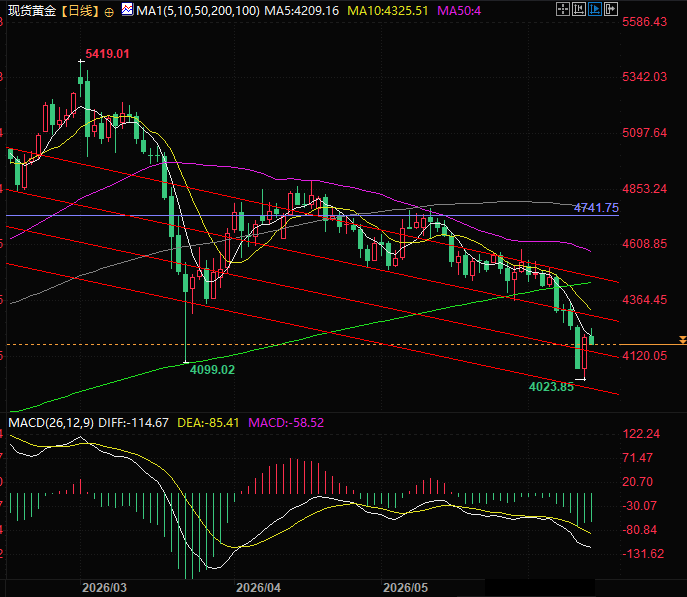
(Spot gold daily chart, source: FX678)
At 15:56 Beijing time, spot gold was trading at $4,182 per ounce.
US President Donald Trump announced on Thursday that he had shelved plans for a new round of military strikes against Iran, a statement signaling a geopolitical breakthrough in negotiations to end the conflict between the US and Iran.
Sources say Iran will pledge in the memorandum of understanding not to seek nuclear weapons and to resolve the uranium enrichment crisis.
Just hours earlier, he had made a strong statement on social media, threatening to launch a "high-intensity strike" against Iran and seeking to gain full control of its core oil industry. This rapid shift in policy stance has once again drawn international attention.
The extension of the ceasefire will give the US more time for geopolitical negotiations, with the core target of the game being Iran's nuclear program. This is also the main reasoning supporting Trump and Israeli Prime Minister Netanyahu's initiation of this conflict.
Negotiations break the ice: Ceasefire framework finalized, ceasefire period to be extended
In recent weeks, Trump has repeatedly stated that the two sides in the conflict are only one step away from reaching a reconciliation agreement, but no substantial consensus has been reached.
Until Thursday afternoon, during an event in the Oval Office of the White House, he stated bluntly: "We have just finalized a major ceasefire consultation framework with Iran."
Although specific details have not been disclosed, Trump anticipates that an agreement will be formally signed in the coming days, extending the fragile ceasefire that began in April of this year.
Sources revealed that Iran will pledge in the memorandum of understanding not to seek nuclear weapons and to address the uranium enrichment crisis, which is a core issue of long-standing concern to the US and Israel.
Background of the conflict: Escalation of military confrontation, with geopolitical risks reaching a high level.
The framework for this ceasefire agreement was reached against the backdrop of two consecutive days of military confrontation between the US and Iran. The situation had already significantly increased the geopolitical risk premium in the Middle East, and market expectations for a full-scale war continued to rise.
The conflict initially began with the confrontation between Iran and Israel, and then evolved into two rounds of direct military clashes between the US and Iran, affecting countries where US troops are stationed. The trigger was Trump's assertion that Iran shot down a US attack helicopter in the airspace over the Strait of Hormuz (both pilots were successfully rescued).
The Iranian Foreign Ministry has commented that the US strikes "effectively undermined the binding force of the ceasefire agreement," but has not officially announced its withdrawal from the ceasefire mechanism.
The crux of the negotiations: the US position has been inconsistent, and Iran has directly accused the process of being disrupted.
Iranian Foreign Ministry spokesman Esmail Bagheei confirmed in a televised interview that the main framework of the ceasefire agreement text has been finalized, while noting that "the crux of the problem lies in the US's fluctuating policy stance, which directly disrupts the stability of this round of negotiations."
This assessment is not unfounded. Trump's rapid shift from extreme military deterrence to promoting peace negotiations once again confirms his wavering style in handling Middle East conflicts. In April of this year, he issued an extreme warning to Iran, saying that if it did not accept the US conditions, it would cause irreversible damage, but then chose to extend the ceasefire period.
Core Game: A Dual Battle Between Nuclear Programs and Control of the Strait
The two core points of contention in this round of negotiations are clearly visible: one is Iran's nuclear program, with the US and Israel concerned about the risk of weaponizing its highly enriched uranium stockpile, while Iran has always maintained that its nuclear program is only for peaceful purposes.
Secondly, there is the control of shipping in the Strait of Hormuz, a key logistics channel for global oil and gas trade that directly influences the pricing center of energy commodities.
Iran's months-long disruption of navigation through the Strait of Hormuz has led to a tightening of global oil and gas supply, rising refined oil prices, and inflationary pressures being transmitted outwards, resulting in simultaneous increases in the cost of food and basic consumer goods both within and outside the region.
Deterrence and Cost Concerns: Contradictory Statements from the US Regarding Iran's Oil Hub
Trump threatened on Thursday to militarily take control of Kharg Island, the core of Iran's oil industry (90% of the country's crude oil exports are transshipped through the island), but later expressed concerns in a Fox News interview: "Frankly, I'm not sure if the United States can bear the combined costs of such an action."
He added, "I have no intention of deploying a large number of ground combat troops, but if the plan is finalized, we can deploy a small number of ground forces to complete the takeover of the hub."
Meanwhile, U.S. Treasury Secretary Scott Bessant stated that the U.S. plans to use frozen Iranian assets outside the country to compensate U.S. allies for losses and to offset the cost impact of Iran's imposition of fees on ships transiting the Strait of Hormuz.
Unresolved Disagreements: Hezbollah Issue Becomes a Stumbling Block to the End-of-War Agreement
The differences have not been fully bridged: Iran has made it clear that "resolving the confrontation between Hezbollah and Israel in Lebanon" is a bottom line for the end-of-war agreement, while the office of Israeli Prime Minister Netanyahu has clarified that it did not participate in the US-Iran bilateral agreement and that its hardline stance remains unchanged, still intending to completely dismantle Hezbollah.
The ongoing conflict and sanctions have dealt a heavy blow to the Iranian people. A 25-year-old anonymous student in the northern city of Babol revealed that the US-Israeli military strikes, coupled with widespread unemployment and triple-digit food inflation, have increased the pressure on residents' daily purchases. "Various livelihood issues continue to deteriorate, and the public can hardly see any signs of improvement as expected." He is now most concerned about whether his country can "defend its territorial integrity and strategic deterrence capabilities."
Military Aftermath: US Blockade Action Draws International Condemnation
The aftershocks of the military confrontation are still being felt. U.S. Central Command disclosed on Thursday that it had struck the Guinea-Bissau-registered oil tanker "Jalville" as it attempted to break through the blockade of an Iranian port, crippling its propulsion system. This is the ninth civilian vessel that the U.S. has taken action to implement the blockade measures.
On Tuesday, the U.S. military attacked the Palau-flagged oil tanker Setbero, killing three Indian crew members. The head of the International Maritime Organization has publicly condemned such attacks.
Summary and Technical Analysis:
Gold prices are currently still pegged to real interest rates, or can be observed directly through nominal interest rates, i.e., US Treasury yields. Since the US-Iran peace talks are still in a fragile phase, any announcement of good news is likely to be a selling point for gold.
While the breakthrough in the US-Iran peace talks has eased the immediate risk of escalating geopolitical conflict, the market remains skeptical about the sustainability of the agreement. The Royal Bank of Canada previously warned that the narrative of an "imminent agreement" is clearly ahead of reality, and the potential risks of diplomatic deadlock and military friction have not been eliminated.
This uncertainty is directly reflected in the gold market, which will greatly limit the upside potential of gold.
From a technical perspective, spot gold prices remain in a downward channel, currently suppressed by the 5-day moving average and the downward channel line, and are expected to find support near the middle line of the channel.
(Spot gold daily chart, source: FX678)
At 15:56 Beijing time, spot gold was trading at $4,182 per ounce.
- Risk Warning and Disclaimer
- The market involves risk, and trading may not be suitable for all investors. This article is for reference only and does not constitute personal investment advice, nor does it take into account certain users’ specific investment objectives, financial situation, or other needs. Any investment decisions made based on this information are at your own risk.