World Gold Council: Private sector selling in major Asian countries in May, while central banks buck the trend with large-scale gold hoarding.
2026-06-15 12:10:42
Overall, the domestic gold market in this major Asian country exhibited a clear divergence in May. Influenced by multiple factors including the international environment and asset rotation, both domestic and international gold prices declined simultaneously. Funds flowed out of gold investment products, and wholesale demand shrank significantly, resulting in weak market trading and consumption. In stark contrast, the country's central bank continued its long-term accumulation strategy, further increasing its gold reserves.
Based on relevant data and industry analysis, the attitudes of different participants in the current gold market vary greatly, and the future market trend faces multiple uncertainties.
Ray Jia, head of Asia's major countries research at the World Gold Council, said that both international and domestic gold prices saw slight declines in May. The London Bullion Market Association's afternoon fixing price fell 1.4% for the month, while the Shanghai Gold Exchange's afternoon benchmark price fell by 2.7%, with the strengthening exchange rate further amplifying downward pressure on domestic gold prices.
Jia Rui analyzed that the continued uncertainty in the Middle East situation in May and the rising concerns about market inflation directly pushed up US Treasury yields and the US dollar index, which was the core reason for the downward pressure on gold prices throughout the month. Under the combined pressure of multiple negative factors, gold prices maintained a weak and volatile trend, making it difficult to break out of the upward trend.
Against the backdrop of weakening prices, the domestic gold investment market in the country has seen a significant decline in activity. In May, domestic gold ETFs experienced their first monthly outflow of funds since August 2025, totaling $1.2 billion. Affected by both falling gold prices and redemptions, the industry's total assets under management shrank by 5% to 289 billion yuan, corresponding to a decrease of 8.3 tons in gold holdings, with total holdings at the end of the month at 293 tons.
Jia Rui pointed out that the domestic stock market continued its upward trend in May, leading to a significant shift of investment funds from the gold market to equity assets. Simultaneously, the lack of a clear direction in gold prices prompted many investors to reduce their holdings of gold ETFs. Gold futures trading on the Shanghai Futures Exchange remained relatively stable, with an average daily trading volume of 301 tons in May, almost identical to the 307 tons averaged in April. The sideways movement in gold prices and the diversion of funds to the stock market limited trading activity in the futures market.
Domestic physical gold wholesale demand in the country experienced a significant decline in May. The Shanghai Gold Exchange saw only 64 tons of physical gold leave for the month, down 38% month-on-month and 36% year-on-year, marking the lowest May figure since 2010.
The continued weakness in gold prices has diminished its safe-haven appeal, while the consumer market remains unfavorable. Although gold prices briefly stabilized during the month, leading to a slight recovery in gold jewelry consumption, limited consumer spending power and related tax burdens continue to constrain the industry's development. Jewelry retailers are generally cautious and lack the willingness to actively replenish their stock. Overall, domestic wholesale gold demand in the country fell to a multi-year low in May.
Amidst overall weak market demand, central banks in major Asian countries have bucked the trend by increasing their gold purchases.
Jia Rui introduced that the central bank of a major Asian country increased its gold reserves for the 19th consecutive month in May, adding 10 tons that month, bringing the total reserves to 2,332 tons, the largest monthly increase since December 2024. So far this year, the central bank has cumulatively increased reserves by 25 tons, and gold reserves account for 8.9% of the major Asian country's foreign exchange reserves. In the past 19 months, official institutions have added a total of 67 tons of gold.
Customs data shows that China's net gold imports in April reached 157 tons, up 10% month-on-month and 40% year-on-year, hitting a new high since March 2024. The positive price difference between domestic and international gold prices is the main driver of import growth.
Regarding the future market trend, Jia Rui stated that based on seasonal patterns, after the initial sluggish consumption, the gold jewelry industry is expected to begin a restocking cycle, with demand gradually stabilizing. While a decline in gold prices could be beneficial for restocking, if prices accelerate their downward trend, jewelers will likely choose to wait and see. In the investment field, insufficient upward momentum in gold prices will continue to suppress market buying sentiment, and the gold market will likely maintain a volatile pattern in the short term.
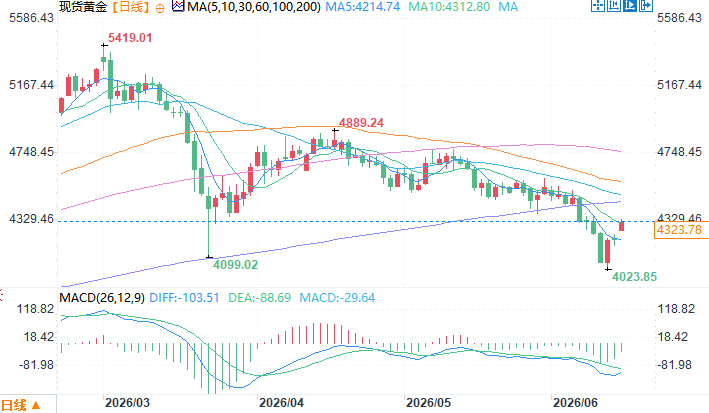
Spot gold daily chart source: EasyForex
At 12:09 Beijing time on June 15, spot gold was trading at $4323.78 per ounce.
Based on relevant data and industry analysis, the attitudes of different participants in the current gold market vary greatly, and the future market trend faces multiple uncertainties.
Gold prices weakened both domestically and internationally, with multiple negative factors suppressing the market.
Ray Jia, head of Asia's major countries research at the World Gold Council, said that both international and domestic gold prices saw slight declines in May. The London Bullion Market Association's afternoon fixing price fell 1.4% for the month, while the Shanghai Gold Exchange's afternoon benchmark price fell by 2.7%, with the strengthening exchange rate further amplifying downward pressure on domestic gold prices.
Jia Rui analyzed that the continued uncertainty in the Middle East situation in May and the rising concerns about market inflation directly pushed up US Treasury yields and the US dollar index, which was the core reason for the downward pressure on gold prices throughout the month. Under the combined pressure of multiple negative factors, gold prices maintained a weak and volatile trend, making it difficult to break out of the upward trend.
Investment funds have withdrawn significantly, leading to a cooling of gold ETF and futures trading.
Against the backdrop of weakening prices, the domestic gold investment market in the country has seen a significant decline in activity. In May, domestic gold ETFs experienced their first monthly outflow of funds since August 2025, totaling $1.2 billion. Affected by both falling gold prices and redemptions, the industry's total assets under management shrank by 5% to 289 billion yuan, corresponding to a decrease of 8.3 tons in gold holdings, with total holdings at the end of the month at 293 tons.
Jia Rui pointed out that the domestic stock market continued its upward trend in May, leading to a significant shift of investment funds from the gold market to equity assets. Simultaneously, the lack of a clear direction in gold prices prompted many investors to reduce their holdings of gold ETFs. Gold futures trading on the Shanghai Futures Exchange remained relatively stable, with an average daily trading volume of 301 tons in May, almost identical to the 307 tons averaged in April. The sideways movement in gold prices and the diversion of funds to the stock market limited trading activity in the futures market.
Wholesale demand in physical stores has plummeted, and the jewelry industry's willingness to replenish inventory is weak.
Domestic physical gold wholesale demand in the country experienced a significant decline in May. The Shanghai Gold Exchange saw only 64 tons of physical gold leave for the month, down 38% month-on-month and 36% year-on-year, marking the lowest May figure since 2010.
The continued weakness in gold prices has diminished its safe-haven appeal, while the consumer market remains unfavorable. Although gold prices briefly stabilized during the month, leading to a slight recovery in gold jewelry consumption, limited consumer spending power and related tax burdens continue to constrain the industry's development. Jewelry retailers are generally cautious and lack the willingness to actively replenish their stock. Overall, domestic wholesale gold demand in the country fell to a multi-year low in May.
The central bank increased its holdings against the trend, and gold imports rebounded in tandem.
Amidst overall weak market demand, central banks in major Asian countries have bucked the trend by increasing their gold purchases.
Jia Rui introduced that the central bank of a major Asian country increased its gold reserves for the 19th consecutive month in May, adding 10 tons that month, bringing the total reserves to 2,332 tons, the largest monthly increase since December 2024. So far this year, the central bank has cumulatively increased reserves by 25 tons, and gold reserves account for 8.9% of the major Asian country's foreign exchange reserves. In the past 19 months, official institutions have added a total of 67 tons of gold.
Customs data shows that China's net gold imports in April reached 157 tons, up 10% month-on-month and 40% year-on-year, hitting a new high since March 2024. The positive price difference between domestic and international gold prices is the main driver of import growth.
Market outlook: Industry recovery remains uncertain.
Regarding the future market trend, Jia Rui stated that based on seasonal patterns, after the initial sluggish consumption, the gold jewelry industry is expected to begin a restocking cycle, with demand gradually stabilizing. While a decline in gold prices could be beneficial for restocking, if prices accelerate their downward trend, jewelers will likely choose to wait and see. In the investment field, insufficient upward momentum in gold prices will continue to suppress market buying sentiment, and the gold market will likely maintain a volatile pattern in the short term.
Spot gold daily chart source: EasyForex
At 12:09 Beijing time on June 15, spot gold was trading at $4323.78 per ounce.
- Risk Warning and Disclaimer
- The market involves risk, and trading may not be suitable for all investors. This article is for reference only and does not constitute personal investment advice, nor does it take into account certain users’ specific investment objectives, financial situation, or other needs. Any investment decisions made based on this information are at your own risk.