Inflation leads the pack, followed closely by an AI bubble—a media investigation reveals the dual risks of Walsh taking over.
2026-06-17 13:49:28
On Wednesday (June 17) during the Asian session, the US dollar index fluctuated narrowly, currently trading around 99.50.
The cautious trading of the US dollar reflects investors' anxious wait for policy signals from the Federal Reserve.
According to media surveys, the market widely expects the Federal Reserve under Kevin Warsh's leadership to refrain from making any interest rate adjustments before 2027. However, as many as 88% of respondents anticipate that this week's meeting will remove the dovish bias from its statement—a wording that has previously suggested the Fed's next move might be a rate cut.
The survey also showed that respondents generally supported Warsh's argument that the Federal Reserve should reduce its communication. The survey covered 32 respondents, including economists, fund managers, and strategists.
Amid high expectations, Kevin Warsh will chair the meeting for the first time as Federal Reserve Chairman, but according to the latest Fed survey conducted by the media, the market expects him not to take any major action, at least in the short term.
As a whole, the 32 respondents (including economists, fund managers, and strategists) expect no interest rate changes at this meeting or at any meetings before 2027. However, 88% of respondents expect the Federal Reserve to remove the dovish bias from its statement at this week's meeting—a statement that has previously signaled to the market that "the next step may be a rate cut."
Warsh was personally nominated by a president who has been pressuring the Federal Reserve for years to cut interest rates. However, high inflation—driven in part by President Trump’s tariff policies and the war with Iran—has temporarily sidelined the option of rate cuts and pushed it out of the forecasting scope of surveys and federal funds futures markets.
Ernst & Young chief economist Gregory Daco noted, "While Warsh is generally considered dovish, the committee he took over has become noticeably more hawkish. Several policymakers have recently argued that raising interest rates should remain an option if inflation persists above target, and concerns about energy-driven inflationary pressures will only reinforce this tendency."
Warsh himself has indicated that interest rates may fall, but he did not specify whether his outlook has changed following the recent surge in inflation and strong employment data. The announcement of a potential peace agreement between the US and Iran (which occurred after this survey) may provide Warsh with the flexibility to cut rates sooner than currently anticipated. For now, respondents do not believe that high oil prices will prompt the Federal Reserve to raise interest rates, but rather expect the federal funds rate to remain unchanged from its current level of 3.62% until 2027.
According to sources, Warsh will have more autonomy in interest rate decisions due to President Trump's trust in him.
On the positive side, the survey shows that the U.S. economy under Warsh's leadership has shown resilience to recent shocks and is expected to maintain this trend. Forecasters have raised their economic growth outlook, lowered the probability of a recession from 33% in April to 25%, and reduced their expectations for the unemployment rate.
Economist Hugh Johnson wrote in his survey, "Improved economic conditions and employment, along with a moderate rise in stock prices, are common features of the current stock market-economy-interest rate cycle. Early warning signs of a bull market ending a recession have not yet appeared."
The US GDP outlook has been revised upward to 2.2% this year (0.25 percentage points higher than previously projected) and 2.3% next year, both figures recovering most of the downward revisions made in the previous survey due to the conflict with Iran. The unemployment rate is expected to remain largely unchanged at the current level of 4.3% this year and next.
Several respondents said that a healthy job market outlook should prompt the Federal Reserve to shift its focus to its mission-driven inflation target, which it has failed to achieve for most of the past six years.
John Ryding, chief economic advisor at Brean Capital, said, "The FOMC should raise interest rates to nip rising inflation expectations in the bud and bring policy closer to a neutral level."
"The short-term labor market fragility has passed, making the central bank mandate more critical on the inflation side than the other," added Guy LeBas, chief fixed income strategist at Janney Montgomery Scott.
Although support for interest rate cuts was low among respondents, Warsh's ideas on reforming the Fed's communication methods gained widespread recognition.
59% of respondents felt that Federal Reserve officials talked too much, compared to only 38% who felt the amount of communication was just right—which generally supports Warsh's "talk less" approach.
However, 59% of respondents expect Walsh to hold a press conference after each meeting—something Walsh did not promise at his Senate confirmation hearing in April.
When discussing the dot plot (a record of officials' expectations for the federal funds rate over the next few years), 53% of respondents believed it should be abolished entirely. Most proposals to reform the dot plot—including releasing it days after the meeting or linking it to individual members' specific economic forecasts—were rejected by the majority of respondents.
While inflation is considered the number one risk to economic growth, the bursting of the AI bubble comes in second by a narrow margin.
A high percentage of respondents (84%) believe that AI stocks are overvalued, although this figure is down 6 percentage points from December of last year. On average, respondents believe AI stocks are overvalued by about 21%. Meanwhile, 69% of respondents believe that stocks overall are overvalued, the lowest level in a year.
Drew Matus, chief market strategist at MetLife Investment Management, stated, "The gap between the reality and belief in AI poses a risk to the stock market and consumers who rely on stock market returns. The wealth effect could be a significant transmission channel for the next economic downturn."
At the same time, respondents' concerns about credit market risks have decreased. Currently, only 53% of respondents believe that systemic risks in the credit market have "slightly increased." In March, this figure reached 75% as concerns about private lending intensified, with another 3% believing the risk was "extremely high."
John Donaldson, head of fixed income at Haverford Trust, said: “Despite some pessimistic forecasts, we do not see a widespread threat to the credit markets. Any weakness is limited to CCC and CC-rated credit. Credit spreads in the financial sector are not showing any pressure whatsoever, which is usually the first sign of problems.”
Despite the absence of systemic threats in the credit markets, the technical chart for the US dollar index points to continued short-term downward pressure. According to the daily chart, the 100.30 level forms a strong resistance point, indicating weak short-term bullish momentum. The key level to watch is the 99.38 level, the low for this week. Holding this support level will likely lead to continued high-level consolidation; a break below this level would likely test the 98.75 support level. The overall trend is bullish in the medium term, but in the short term, it is in a technical correction phase after an upward move.
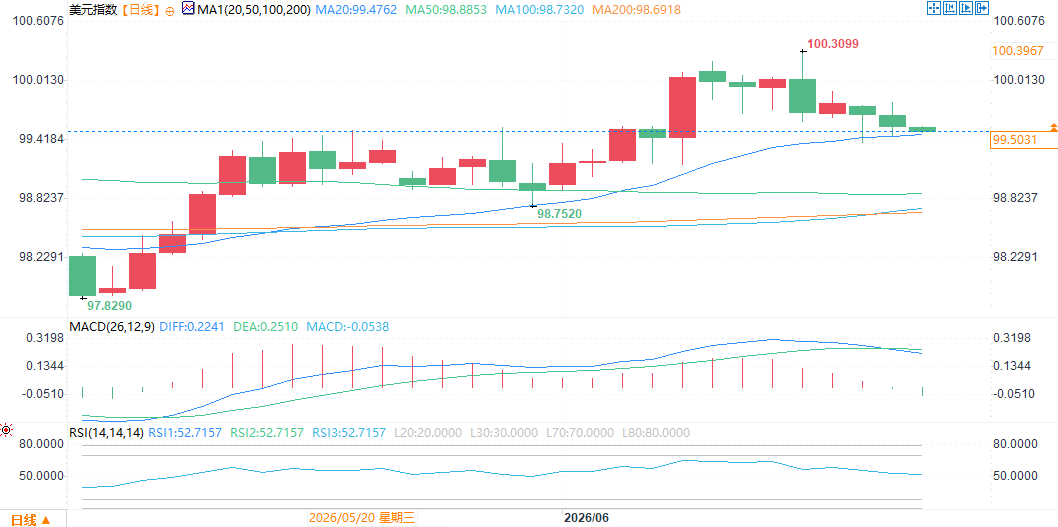
(US Dollar Index Daily Chart, Source: FX678)
At 13:48 Beijing time on June 17, the US dollar index was at 99.50.
The cautious trading of the US dollar reflects investors' anxious wait for policy signals from the Federal Reserve.
According to media surveys, the market widely expects the Federal Reserve under Kevin Warsh's leadership to refrain from making any interest rate adjustments before 2027. However, as many as 88% of respondents anticipate that this week's meeting will remove the dovish bias from its statement—a wording that has previously suggested the Fed's next move might be a rate cut.
The survey also showed that respondents generally supported Warsh's argument that the Federal Reserve should reduce its communication. The survey covered 32 respondents, including economists, fund managers, and strategists.
Interest Rate Path: Holding Rates Steady Until 2027 Becomes a Consensus
Amid high expectations, Kevin Warsh will chair the meeting for the first time as Federal Reserve Chairman, but according to the latest Fed survey conducted by the media, the market expects him not to take any major action, at least in the short term.
As a whole, the 32 respondents (including economists, fund managers, and strategists) expect no interest rate changes at this meeting or at any meetings before 2027. However, 88% of respondents expect the Federal Reserve to remove the dovish bias from its statement at this week's meeting—a statement that has previously signaled to the market that "the next step may be a rate cut."
Warsh was personally nominated by a president who has been pressuring the Federal Reserve for years to cut interest rates. However, high inflation—driven in part by President Trump’s tariff policies and the war with Iran—has temporarily sidelined the option of rate cuts and pushed it out of the forecasting scope of surveys and federal funds futures markets.
FOMC Internals: Warsh leans dovish, but the committee has shifted towards hawkishness.
Ernst & Young chief economist Gregory Daco noted, "While Warsh is generally considered dovish, the committee he took over has become noticeably more hawkish. Several policymakers have recently argued that raising interest rates should remain an option if inflation persists above target, and concerns about energy-driven inflationary pressures will only reinforce this tendency."
Warsh himself has indicated that interest rates may fall, but he did not specify whether his outlook has changed following the recent surge in inflation and strong employment data. The announcement of a potential peace agreement between the US and Iran (which occurred after this survey) may provide Warsh with the flexibility to cut rates sooner than currently anticipated. For now, respondents do not believe that high oil prices will prompt the Federal Reserve to raise interest rates, but rather expect the federal funds rate to remain unchanged from its current level of 3.62% until 2027.
According to sources, Warsh will have more autonomy in interest rate decisions due to President Trump's trust in him.
Economic Outlook: Resilience Remains, Recession Risk Decreases
On the positive side, the survey shows that the U.S. economy under Warsh's leadership has shown resilience to recent shocks and is expected to maintain this trend. Forecasters have raised their economic growth outlook, lowered the probability of a recession from 33% in April to 25%, and reduced their expectations for the unemployment rate.
Economist Hugh Johnson wrote in his survey, "Improved economic conditions and employment, along with a moderate rise in stock prices, are common features of the current stock market-economy-interest rate cycle. Early warning signs of a bull market ending a recession have not yet appeared."
The US GDP outlook has been revised upward to 2.2% this year (0.25 percentage points higher than previously projected) and 2.3% next year, both figures recovering most of the downward revisions made in the previous survey due to the conflict with Iran. The unemployment rate is expected to remain largely unchanged at the current level of 4.3% this year and next.
Policy Divergence: Some respondents called for interest rate hikes to curb inflation.
Several respondents said that a healthy job market outlook should prompt the Federal Reserve to shift its focus to its mission-driven inflation target, which it has failed to achieve for most of the past six years.
John Ryding, chief economic advisor at Brean Capital, said, "The FOMC should raise interest rates to nip rising inflation expectations in the bud and bring policy closer to a neutral level."
"The short-term labor market fragility has passed, making the central bank mandate more critical on the inflation side than the other," added Guy LeBas, chief fixed income strategist at Janney Montgomery Scott.
Walsh's ideas have gained widespread support: talk less, abolish raster graphics?
Although support for interest rate cuts was low among respondents, Warsh's ideas on reforming the Fed's communication methods gained widespread recognition.
59% of respondents felt that Federal Reserve officials talked too much, compared to only 38% who felt the amount of communication was just right—which generally supports Warsh's "talk less" approach.
However, 59% of respondents expect Walsh to hold a press conference after each meeting—something Walsh did not promise at his Senate confirmation hearing in April.
When discussing the dot plot (a record of officials' expectations for the federal funds rate over the next few years), 53% of respondents believed it should be abolished entirely. Most proposals to reform the dot plot—including releasing it days after the meeting or linking it to individual members' specific economic forecasts—were rejected by the majority of respondents.
Market Risks: Inflation Leads the Way, AI Bubble Follows Closely
While inflation is considered the number one risk to economic growth, the bursting of the AI bubble comes in second by a narrow margin.
A high percentage of respondents (84%) believe that AI stocks are overvalued, although this figure is down 6 percentage points from December of last year. On average, respondents believe AI stocks are overvalued by about 21%. Meanwhile, 69% of respondents believe that stocks overall are overvalued, the lowest level in a year.
Drew Matus, chief market strategist at MetLife Investment Management, stated, "The gap between the reality and belief in AI poses a risk to the stock market and consumers who rely on stock market returns. The wealth effect could be a significant transmission channel for the next economic downturn."
Credit market risks cool down
At the same time, respondents' concerns about credit market risks have decreased. Currently, only 53% of respondents believe that systemic risks in the credit market have "slightly increased." In March, this figure reached 75% as concerns about private lending intensified, with another 3% believing the risk was "extremely high."
John Donaldson, head of fixed income at Haverford Trust, said: “Despite some pessimistic forecasts, we do not see a widespread threat to the credit markets. Any weakness is limited to CCC and CC-rated credit. Credit spreads in the financial sector are not showing any pressure whatsoever, which is usually the first sign of problems.”
Despite the absence of systemic threats in the credit markets, the technical chart for the US dollar index points to continued short-term downward pressure. According to the daily chart, the 100.30 level forms a strong resistance point, indicating weak short-term bullish momentum. The key level to watch is the 99.38 level, the low for this week. Holding this support level will likely lead to continued high-level consolidation; a break below this level would likely test the 98.75 support level. The overall trend is bullish in the medium term, but in the short term, it is in a technical correction phase after an upward move.
(US Dollar Index Daily Chart, Source: FX678)
At 13:48 Beijing time on June 17, the US dollar index was at 99.50.
- Risk Warning and Disclaimer
- The market involves risk, and trading may not be suitable for all investors. This article is for reference only and does not constitute personal investment advice, nor does it take into account certain users’ specific investment objectives, financial situation, or other needs. Any investment decisions made based on this information are at your own risk.