Why is WTI still falling despite inventories falling to their lowest level since 2014?
2026-06-25 08:07:41
WTI crude oil futures traded in a narrow range in early Asian trading on Thursday (June 25), currently hovering around $70.
Despite crude oil inventories at Cushing, Oklahoma, a key U.S. oil storage hub, falling to their lowest level since 2014, WTI crude oil prices briefly dipped below $70 a barrel on Wednesday, highlighting the market's reassessment of Cushing's importance as a U.S. crude oil pricing benchmark.
Amid the gradual resumption of tanker traffic in the Strait of Hormuz and easing global supply concerns, WTI crude oil fell as low as $69.63 per barrel on Wednesday before closing at $70.34. This movement contrasts sharply with fundamental signals—Cushing inventories have fallen below their lowest operating levels, which should theoretically provide price support.

The U.S. Energy Information Administration (EIA) reported Wednesday that Cushing crude oil inventories fell to about 19 million barrels last week, the lowest level since 2014. This figure has fallen below the 20 million barrel threshold—a level widely considered by traders and analysts to be the minimum required to maintain normal operations.
Since the outbreak of the war with Iran in late February, US crude oil prices once climbed to $119.48, but the government's release of strategic petroleum reserves helped curb the price surge. Now, even with Cushing inventories running low, oil prices are still falling.
Carl Larry, sales manager at energy market analysis firm Enverus, said, "From a fundamental perspective, considering Cushing inventories, replenishment of damaged crude oil, and the ongoing issues surrounding access to and from the Strait of Hormuz, oil prices should have been higher." He believes the decline in oil prices is more of a continuation of sentiment-driven selling. "Some funds are trying to keep pushing futures prices down to find weak support levels and profit on any rebound."
The sharp decline in Cushing inventories stemmed from a double squeeze on both the supply and demand sides.
On the one hand, export demand from the U.S. Gulf Coast remains strong, continuously drawing inventory from Cushing; on the other hand, unexpected production shutdowns in Canada have reduced U.S. crude oil imports, further exacerbating supply shortages. When crude oil levels in Cushing storage tanks fall below 10% or 20% of capacity, it becomes very difficult to effectively extract the oil. Furthermore, water and sediment tend to accumulate at the bottom of storage tanks, and low inventory levels can also raise concerns about crude oil quality.
A veteran trader stated that the market generally believes the current marginal effect on the oil market comes from Gulf Coast exports, not Cushing. As more crude oil production flows to the Gulf Coast for export, Cushing's importance as a pricing benchmark is gradually diminishing.
Shale oil production in the Permian Basin of Texas and New Mexico continues to surge. However, much of this crude oil is now flowing to storage facilities closer to export ports along the Gulf Coast, or to refineries in the region, rather than to the Cushing storage hub.
James Cordier, head of investment strategy at investment firm OptionSpreaders.com, said, "It seems like only yesterday that people were holding their breath for the Cushing supply report; now it's one of the least watched barometers in the energy sector." This assessment reflects the profound changes taking place in the structure of the U.S. crude oil market.
Analysts and traders expect U.S. oil exports to slow next month, with more crude flowing back to Cushing. They point out that with the interim peace agreement between the U.S. and Iran, tankers stranded in the Strait of Hormuz have been able to leave, releasing more global supply, which could alleviate some of the pressure on U.S. domestic crude demand.
Energy Aspects estimates that Cushing inventories will increase by approximately 800,000 barrels next week. If this expectation materializes, Cushing inventories could see a slight rebound from extremely low levels, but whether they can regain their traditional pricing hub status remains to be seen.
According to the daily chart, US crude oil futures have been declining continuously since the year's high of $119.48, with a clear downtrend on the daily chart. The price has fallen sharply below the short-term and medium-term moving averages of MA20, MA50, and MA100, while the long-term moving average of MA200 (73.93) is above, forming strong resistance. All moving averages are turning downwards in tandem, indicating significant resistance to any rebound.
The MACD indicator's DIFF (-6.31) continues to run below the DEA (-5.02), with the green bearish momentum bars continuing to expand and no significant weakening of downward momentum observed. There is currently no low-level golden cross signal indicating a potential bottom. The RSI indicator has fallen back to 28.04, entering the 20-30 oversold range, indicating a short-term need for minor technical correction, but this is insufficient to reverse the overall downward trend.
In terms of price trend, after reaching a high of 119.48, it peaked and fell back, breaking through the key support platforms of 96 and 83, and tested the low of 69.63. The previous low of 54.98 is the key support in the medium and long term.
The overall market is dominated by bears in the medium term, and the short-term oversold conditions have only triggered a slight rebound. When the price rebounds to the moving average resistance zone, it is advisable to sell short on rallies. If the price breaks below the low of 69.61, the downside potential will be further opened up. Only when the price stabilizes above the 20-day moving average and the MACD forms a golden cross at a low level will a phase of stabilization and recovery occur.
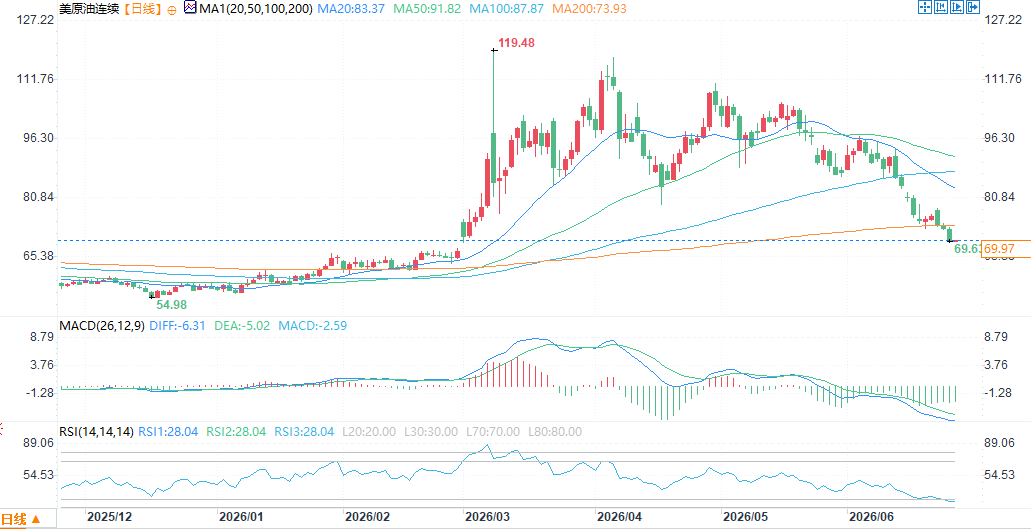
(US crude oil daily chart, source: FX678)
At 7:57 AM Beijing time on June 25, US crude oil futures were trading at $69.99 per barrel.
Despite crude oil inventories at Cushing, Oklahoma, a key U.S. oil storage hub, falling to their lowest level since 2014, WTI crude oil prices briefly dipped below $70 a barrel on Wednesday, highlighting the market's reassessment of Cushing's importance as a U.S. crude oil pricing benchmark.
Amid the gradual resumption of tanker traffic in the Strait of Hormuz and easing global supply concerns, WTI crude oil fell as low as $69.63 per barrel on Wednesday before closing at $70.34. This movement contrasts sharply with fundamental signals—Cushing inventories have fallen below their lowest operating levels, which should theoretically provide price support.
Inventory crisis ignored: Cushing inventory falls to 12-year low
The U.S. Energy Information Administration (EIA) reported Wednesday that Cushing crude oil inventories fell to about 19 million barrels last week, the lowest level since 2014. This figure has fallen below the 20 million barrel threshold—a level widely considered by traders and analysts to be the minimum required to maintain normal operations.
Since the outbreak of the war with Iran in late February, US crude oil prices once climbed to $119.48, but the government's release of strategic petroleum reserves helped curb the price surge. Now, even with Cushing inventories running low, oil prices are still falling.
Carl Larry, sales manager at energy market analysis firm Enverus, said, "From a fundamental perspective, considering Cushing inventories, replenishment of damaged crude oil, and the ongoing issues surrounding access to and from the Strait of Hormuz, oil prices should have been higher." He believes the decline in oil prices is more of a continuation of sentiment-driven selling. "Some funds are trying to keep pushing futures prices down to find weak support levels and profit on any rebound."
Why are inventories running out? A double squeeze from strong exports and hindered imports.
The sharp decline in Cushing inventories stemmed from a double squeeze on both the supply and demand sides.
On the one hand, export demand from the U.S. Gulf Coast remains strong, continuously drawing inventory from Cushing; on the other hand, unexpected production shutdowns in Canada have reduced U.S. crude oil imports, further exacerbating supply shortages. When crude oil levels in Cushing storage tanks fall below 10% or 20% of capacity, it becomes very difficult to effectively extract the oil. Furthermore, water and sediment tend to accumulate at the bottom of storage tanks, and low inventory levels can also raise concerns about crude oil quality.
Cushing's position is weakening: Market focus shifts to the Gulf of Mexico
A veteran trader stated that the market generally believes the current marginal effect on the oil market comes from Gulf Coast exports, not Cushing. As more crude oil production flows to the Gulf Coast for export, Cushing's importance as a pricing benchmark is gradually diminishing.
Shale oil production in the Permian Basin of Texas and New Mexico continues to surge. However, much of this crude oil is now flowing to storage facilities closer to export ports along the Gulf Coast, or to refineries in the region, rather than to the Cushing storage hub.
James Cordier, head of investment strategy at investment firm OptionSpreaders.com, said, "It seems like only yesterday that people were holding their breath for the Cushing supply report; now it's one of the least watched barometers in the energy sector." This assessment reflects the profound changes taking place in the structure of the U.S. crude oil market.
Future Outlook: Export Slowdown May Drive Cushing Inventory Rebuilding
Analysts and traders expect U.S. oil exports to slow next month, with more crude flowing back to Cushing. They point out that with the interim peace agreement between the U.S. and Iran, tankers stranded in the Strait of Hormuz have been able to leave, releasing more global supply, which could alleviate some of the pressure on U.S. domestic crude demand.
Energy Aspects estimates that Cushing inventories will increase by approximately 800,000 barrels next week. If this expectation materializes, Cushing inventories could see a slight rebound from extremely low levels, but whether they can regain their traditional pricing hub status remains to be seen.
Technical Analysis
According to the daily chart, US crude oil futures have been declining continuously since the year's high of $119.48, with a clear downtrend on the daily chart. The price has fallen sharply below the short-term and medium-term moving averages of MA20, MA50, and MA100, while the long-term moving average of MA200 (73.93) is above, forming strong resistance. All moving averages are turning downwards in tandem, indicating significant resistance to any rebound.
The MACD indicator's DIFF (-6.31) continues to run below the DEA (-5.02), with the green bearish momentum bars continuing to expand and no significant weakening of downward momentum observed. There is currently no low-level golden cross signal indicating a potential bottom. The RSI indicator has fallen back to 28.04, entering the 20-30 oversold range, indicating a short-term need for minor technical correction, but this is insufficient to reverse the overall downward trend.
In terms of price trend, after reaching a high of 119.48, it peaked and fell back, breaking through the key support platforms of 96 and 83, and tested the low of 69.63. The previous low of 54.98 is the key support in the medium and long term.
The overall market is dominated by bears in the medium term, and the short-term oversold conditions have only triggered a slight rebound. When the price rebounds to the moving average resistance zone, it is advisable to sell short on rallies. If the price breaks below the low of 69.61, the downside potential will be further opened up. Only when the price stabilizes above the 20-day moving average and the MACD forms a golden cross at a low level will a phase of stabilization and recovery occur.
(US crude oil daily chart, source: FX678)
At 7:57 AM Beijing time on June 25, US crude oil futures were trading at $69.99 per barrel.
- Risk Warning and Disclaimer
- The market involves risk, and trading may not be suitable for all investors. This article is for reference only and does not constitute personal investment advice, nor does it take into account certain users’ specific investment objectives, financial situation, or other needs. Any investment decisions made based on this information are at your own risk.