The easing of US-Iran negotiations and the resulting geopolitical premium, coupled with multiple negative factors, caused US oil prices to briefly fall below the $70 mark.
2026-06-25 13:24:05
Recently, international oil prices have been driven by news, closely following the fluctuations in the US-Iran conflict. With positive progress in the first round of negotiations between the US, Iran, and Switzerland, and the agreement to finalize the agreement within 60 days, market sentiment regarding geopolitical risks has cooled rapidly. Coupled with multiple negative factors, including a significant weakening of crude oil imports from major Asian countries and a technical breakdown, international oil prices have experienced a deep correction.
The current crude oil market is undergoing a reshaping of its bullish and bearish landscape, with clear short-term downward pressure. Meanwhile, the refined oil sector is experiencing significant structural differentiation, and the losses to refining facilities caused by the US-Iran conflict have also created potential supply risks for the future market.
The first round of US-Iran talks in Switzerland concluded successfully, with both sides releasing positive signals and agreeing on a 60-day final negotiation period, significantly alleviating market concerns about disruptions to Middle Eastern energy shipping routes. However, the market generally remains skeptical, as complex issues such as nuclear technology disputes and navigation control in the Strait of Hormuz are unlikely to be resolved completely in the short term. Compared to the nearly 20-month negotiation period for the 2015 Joint Comprehensive Plan of Action (JCPOA), the current short-term implementation will be extremely difficult.
International oil prices have fallen for three consecutive days. On Thursday (June 25) in Asian trading, Brent crude oil briefly fell below $73 per barrel to $72.22 per barrel, while WTI crude oil briefly fell below $70 per barrel to $69.02 per barrel. Both crude oil varieties hit new lows since the US-Iran conflict on February 28 and have entered severely oversold territory, with technical support completely failing.
According to Standard Chartered Bank's analysis, the 200-day moving average of crude oil originally provided some support, but when oil prices fell to the 76.4% Fibonacci retracement level of $73.74 per barrel, the key support was completely breached, triggering systemic selling pressure.
Currently, the relative strength index (RSI) for Brent crude oil is 29.07, and for West Texas Intermediate crude oil it is 28.13, both showing significant oversold characteristics.
Data shows that from June 19 to 21, a total of 71 vessels passed through the Strait of Hormuz, indicating a slight recovery in navigation efficiency. However, most of these were tentative and cautious passages. Coupled with the escalating verbal standoff between the US and Iran during negotiations, the risk of a short-term blockade of the strait remains, and the market anticipates that the oil supply order will be difficult to restore to normal before the third quarter of this year.
The core negative factor driving this round of oil price declines comes from weakening crude oil demand in major Asian countries.
The country has significantly reduced its spot crude oil purchases, instead releasing strategic reserves to fill the oil shortage. Crude oil imports in May fell to their lowest level since February 2018, averaging 7.82 million barrels per day, a sharp decline both year-on-year and month-on-month, and nearly 40% lower than before the US-Iran conflict. At the same time, it has proactively adjusted its import structure, diversifying its purchases of crude oil from non-Gulf regions.
Standard Chartered Bank stated that the timing of major Asian countries resuming large-scale spot crude oil purchases will be a key factor in determining the recovery of global crude oil demand and the trend of oil prices in the second half of the year.
The current refined oil market is showing a clear divergence. Geopolitical risk premiums have generally subsided, and weak industrial demand has put pressure on diesel and gas oil prices. Meanwhile, the peak summer travel season has supported a strong rise in gasoline prices, with gasoline crack spreads hitting multi-year highs.
U.S. gasoline inventories remain low, and although retail oil prices have fallen somewhat, the tight supply and demand situation remains unchanged.
Meanwhile, the ongoing conflict between Russia and Ukraine continues to impact Russia's refining system, with many core refineries suffering continuous damage. The main refinery in Moscow is not expected to resume production until 2027 at the earliest, while the Kabotnia refinery will also be shut down for an extended period. Global refined oil supply will face a long-term structural shortage risk, providing a floor for future oil prices.
In summary, the easing of tensions between the US and Iran and weakening oil demand from major Asian countries have driven the recent deep correction in oil prices, and the oversold market may continue to fluctuate and recover in the short term.
Overall, the crude oil market is under pressure in the short term but supported in the medium to long term. On the one hand, negative factors on the demand side continue to suppress price increases, while on the other hand, the global supply of refined oil products is damaged and the risks in Middle East shipping routes have not been eliminated, which will limit the downside potential of oil prices. The market will fluctuate repeatedly around the supply and demand game and the geopolitical situation.
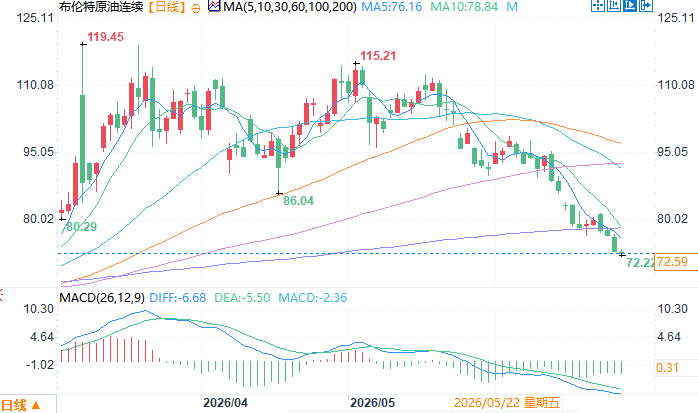
Brent crude oil daily chart source: EasyForex
At 13:23 Beijing time on June 25, Brent crude oil futures were trading at $72.57 per barrel.
The current crude oil market is undergoing a reshaping of its bullish and bearish landscape, with clear short-term downward pressure. Meanwhile, the refined oil sector is experiencing significant structural differentiation, and the losses to refining facilities caused by the US-Iran conflict have also created potential supply risks for the future market.
US-Iran negotiations ease tensions, causing oil prices to plummet to a new low.
The first round of US-Iran talks in Switzerland concluded successfully, with both sides releasing positive signals and agreeing on a 60-day final negotiation period, significantly alleviating market concerns about disruptions to Middle Eastern energy shipping routes. However, the market generally remains skeptical, as complex issues such as nuclear technology disputes and navigation control in the Strait of Hormuz are unlikely to be resolved completely in the short term. Compared to the nearly 20-month negotiation period for the 2015 Joint Comprehensive Plan of Action (JCPOA), the current short-term implementation will be extremely difficult.
International oil prices have fallen for three consecutive days. On Thursday (June 25) in Asian trading, Brent crude oil briefly fell below $73 per barrel to $72.22 per barrel, while WTI crude oil briefly fell below $70 per barrel to $69.02 per barrel. Both crude oil varieties hit new lows since the US-Iran conflict on February 28 and have entered severely oversold territory, with technical support completely failing.
The technical indicators have broken down across the board, and the risks to navigation across the Taiwan Strait have not yet been eliminated.
According to Standard Chartered Bank's analysis, the 200-day moving average of crude oil originally provided some support, but when oil prices fell to the 76.4% Fibonacci retracement level of $73.74 per barrel, the key support was completely breached, triggering systemic selling pressure.
Currently, the relative strength index (RSI) for Brent crude oil is 29.07, and for West Texas Intermediate crude oil it is 28.13, both showing significant oversold characteristics.
Data shows that from June 19 to 21, a total of 71 vessels passed through the Strait of Hormuz, indicating a slight recovery in navigation efficiency. However, most of these were tentative and cautious passages. Coupled with the escalating verbal standoff between the US and Iran during negotiations, the risk of a short-term blockade of the strait remains, and the market anticipates that the oil supply order will be difficult to restore to normal before the third quarter of this year.
Imports in major Asian countries have shrunk significantly, continuing to suppress the upside potential of oil prices.
The core negative factor driving this round of oil price declines comes from weakening crude oil demand in major Asian countries.
The country has significantly reduced its spot crude oil purchases, instead releasing strategic reserves to fill the oil shortage. Crude oil imports in May fell to their lowest level since February 2018, averaging 7.82 million barrels per day, a sharp decline both year-on-year and month-on-month, and nearly 40% lower than before the US-Iran conflict. At the same time, it has proactively adjusted its import structure, diversifying its purchases of crude oil from non-Gulf regions.
Standard Chartered Bank stated that the timing of major Asian countries resuming large-scale spot crude oil purchases will be a key factor in determining the recovery of global crude oil demand and the trend of oil prices in the second half of the year.
Structural differentiation in refined oil products, with geopolitical conflicts concealing supply crises.
The current refined oil market is showing a clear divergence. Geopolitical risk premiums have generally subsided, and weak industrial demand has put pressure on diesel and gas oil prices. Meanwhile, the peak summer travel season has supported a strong rise in gasoline prices, with gasoline crack spreads hitting multi-year highs.
U.S. gasoline inventories remain low, and although retail oil prices have fallen somewhat, the tight supply and demand situation remains unchanged.
Meanwhile, the ongoing conflict between Russia and Ukraine continues to impact Russia's refining system, with many core refineries suffering continuous damage. The main refinery in Moscow is not expected to resume production until 2027 at the earliest, while the Kabotnia refinery will also be shut down for an extended period. Global refined oil supply will face a long-term structural shortage risk, providing a floor for future oil prices.
Summarize
In summary, the easing of tensions between the US and Iran and weakening oil demand from major Asian countries have driven the recent deep correction in oil prices, and the oversold market may continue to fluctuate and recover in the short term.
Overall, the crude oil market is under pressure in the short term but supported in the medium to long term. On the one hand, negative factors on the demand side continue to suppress price increases, while on the other hand, the global supply of refined oil products is damaged and the risks in Middle East shipping routes have not been eliminated, which will limit the downside potential of oil prices. The market will fluctuate repeatedly around the supply and demand game and the geopolitical situation.
Brent crude oil daily chart source: EasyForex
At 13:23 Beijing time on June 25, Brent crude oil futures were trading at $72.57 per barrel.
- Risk Warning and Disclaimer
- The market involves risk, and trading may not be suitable for all investors. This article is for reference only and does not constitute personal investment advice, nor does it take into account certain users’ specific investment objectives, financial situation, or other needs. Any investment decisions made based on this information are at your own risk.