













The era of negative interest rates has been reaffirmed; how will the risks of Tokyo CPI and oil prices influence the Bank of Japan's next move?
2026-06-26 08:20:30
On Friday (June 26) in early Asian trading, the USD/JPY pair traded in a range-bound pattern at high levels, currently hovering around 161.80.
Data released by Japan's Ministry of Internal Affairs and Communications on Friday showed that Tokyo's core consumer price index (CPI) rose 1.7% year-on-year in June, up from 1.4% in the previous month. The core CPI excluding fresh food rose 1.6% year-on-year, in line with market expectations and higher than the previous 1.3%; the core-core CPI, further excluding energy, rose 1.9% year-on-year, higher than the previous 1.6%.

The Tokyo CPI is one of the most important leading indicators of inflation in Japan, as it is released before national data and provides a key reference for the market to judge the national inflation trend and the policy path of the Bank of Japan.
The data shows that the overall CPI rose from 1.4% to 1.7%, and the core-core CPI rose from 1.6% to 1.9%, both showing an accelerating trend. This indicates that inflationary pressures in Japan are rising moderately, not solely driven by energy prices, but also positively influenced by improvements in service prices and consumer demand.
Continued improvement in inflation data will further solidify market expectations that the Bank of Japan will continue to normalize monetary policy, providing medium-term support for the yen.
However, the core CPI, excluding energy, only recorded 1.6%, in line with expectations, indicating that energy prices remain the main contributor to current inflation, and endogenous inflationary momentum has not yet fully stabilized. This also explains to some extent why the yen's gains were limited after the data release.
JPMorgan believes that the Tokyo CPI data is in line with expectations of a moderate rebound, providing important support for the Bank of Japan to continue to normalize its monetary policy.
Overall CPI rose to 1.7%, and core-core CPI rose to 1.9%, indicating that inflationary pressures are no longer solely dependent on energy prices, with improvements in service prices and consumer demand playing a positive role. This aligns with the Bank of Japan's assessment of a "positive underlying inflation trend," helping the market form expectations of further interest rate hikes by the Bank of Japan in the second half of 2026.
Analysts point out that although the core CPI excluding energy only recorded 1.6% (in line with expectations), indicating that endogenous inflationary momentum has not yet fully stabilized, the overall upward trend still provides medium-term support for the yen.
JPMorgan Chase expects the Bank of Japan to consider additional interest rate hikes at its July-October meetings as the wage-price spiral gradually takes shape, raising the target range for the policy rate to 0.75%-1.0%.
However, analysts caution that energy prices remain the primary contributor to inflation, and if easing geopolitical risks lead to a decline in oil prices, the upward trend in inflation may slow.
For USD/JPY, this data is a short-term positive for the yen, but given the strength of the dollar, the exchange rate still faces pressure to fluctuate at high levels.
JPMorgan maintains a neutral-to-bullish view on USD/JPY, advising investors to cautiously go long on the yen above 161, and to pay attention to the national CPI and the Bank of Japan's meeting minutes. If core-core CPI continues to hold above 1.9%, it will strengthen the normalization narrative and drive a phase of yen appreciation.
Overall, this data reinforces Japan's structural shift away from negative interest rates, but policy paths will still rely on data, resulting in high short-term volatility.
Goldman Sachs points out that although the core CPI excluding energy remained flat at 1.6%, indicating that endogenous growth still needs time to consolidate, the overall trend supports the Bank of Japan's gradual tightening of policy in 2026.
Goldman Sachs expects the Bank of Japan to raise interest rates 1-2 times this year, with the final interest rate moving towards the 1.0%-1.5% range. This will narrow the US-Japan interest rate differential, providing support for the yen. However, the current strength of the US dollar and global risk sentiment remain the main constraints.
Goldman Sachs suggests paying attention to the subsequent national CPI and the results of the spring wage negotiations. If stable wage growth translates into service prices, core inflation is expected to break through 2% in the second half of the year. For investors, this data is beneficial to the steepening of the Japanese government bond yield curve and supports the recovery of Japanese stock valuations.
Regarding exchange rates, Goldman Sachs maintains its range-bound trading strategy, expecting the market to continue fluctuating between 158 and 163 in the short term, before gradually declining in the medium term as the Bank of Japan's tightening stance becomes more pronounced. Overall, the accelerating Tokyo CPI provides confirmation of Japan's reflation cycle, but geopolitical and energy risks and global growth uncertainties could still disrupt policy pace, requiring the market to remain flexible.
From the daily chart, the USD/JPY pair maintains a strong bullish trend, currently firmly holding above its medium- and long-term moving averages. The short-term 20-day moving average (MA20) (160.67), medium-term 50-day moving average (MA50) (159.38), 100-day moving average (MA100) (158.47), and long-term 200-day moving average (MA200) (156.36) are all arranged in a bullish upward divergence, forming a multi-layered support zone. The upward structure is complete, with each pullback quickly recovering from the moving averages. The upward trend after the low of 155.03 is clear.
In terms of indicators, the MACD maintains a bullish pattern, with the DIFF (0.700) consistently above the DEA (0.612), and the red bars steadily increasing in volume, indicating no signs of weakening bullish momentum. The RSI1 value is 72.09, approaching the overbought threshold of 80, suggesting a slight pullback to consolidate in the short term, but no clear top divergence has been triggered, and the trend has not reversed.
Overall, the market is dominated by bulls in the medium to long term, with only short-term indicators showing slight overbought conditions and a risk of technical pullback. The recommended strategy is to buy on dips near the moving averages, and to adjust the bullish approach if the price breaks below the 50-day moving average.
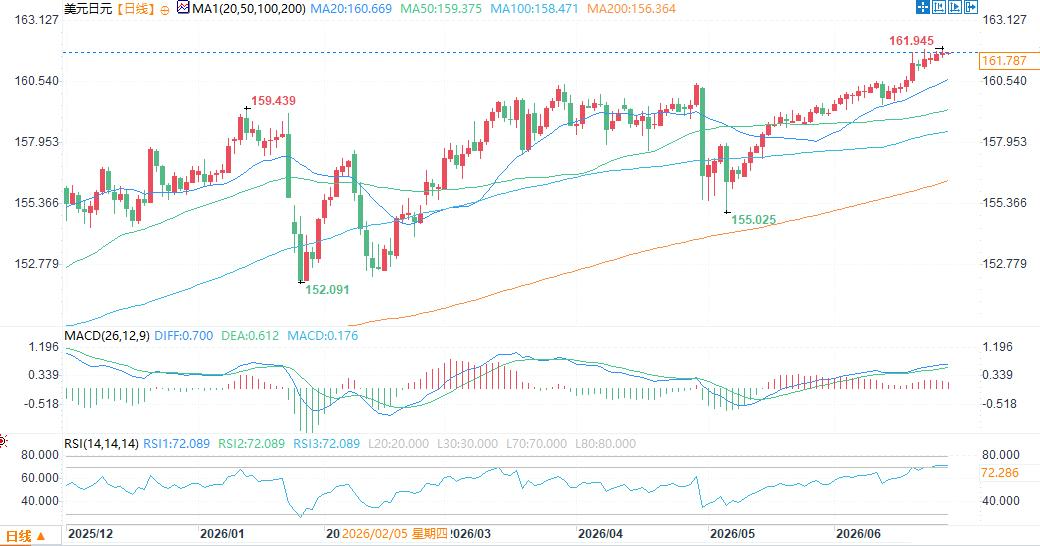
(USD/JPY daily chart, source: FX678)
At 7:57 AM Beijing time on June 26, the USD/JPY exchange rate was 161.80/81.
Data released by Japan's Ministry of Internal Affairs and Communications on Friday showed that Tokyo's core consumer price index (CPI) rose 1.7% year-on-year in June, up from 1.4% in the previous month. The core CPI excluding fresh food rose 1.6% year-on-year, in line with market expectations and higher than the previous 1.3%; the core-core CPI, further excluding energy, rose 1.9% year-on-year, higher than the previous 1.6%.
Interpreting Tokyo CPI Data: Inflation Rises Moderately, Supporting Expectations of Bank of Japan Normalization
The Tokyo CPI is one of the most important leading indicators of inflation in Japan, as it is released before national data and provides a key reference for the market to judge the national inflation trend and the policy path of the Bank of Japan.
The data shows that the overall CPI rose from 1.4% to 1.7%, and the core-core CPI rose from 1.6% to 1.9%, both showing an accelerating trend. This indicates that inflationary pressures in Japan are rising moderately, not solely driven by energy prices, but also positively influenced by improvements in service prices and consumer demand.
Continued improvement in inflation data will further solidify market expectations that the Bank of Japan will continue to normalize monetary policy, providing medium-term support for the yen.
However, the core CPI, excluding energy, only recorded 1.6%, in line with expectations, indicating that energy prices remain the main contributor to current inflation, and endogenous inflationary momentum has not yet fully stabilized. This also explains to some extent why the yen's gains were limited after the data release.
Institutional Views
JPMorgan believes that the Tokyo CPI data is in line with expectations of a moderate rebound, providing important support for the Bank of Japan to continue to normalize its monetary policy.
Overall CPI rose to 1.7%, and core-core CPI rose to 1.9%, indicating that inflationary pressures are no longer solely dependent on energy prices, with improvements in service prices and consumer demand playing a positive role. This aligns with the Bank of Japan's assessment of a "positive underlying inflation trend," helping the market form expectations of further interest rate hikes by the Bank of Japan in the second half of 2026.
Analysts point out that although the core CPI excluding energy only recorded 1.6% (in line with expectations), indicating that endogenous inflationary momentum has not yet fully stabilized, the overall upward trend still provides medium-term support for the yen.
JPMorgan Chase expects the Bank of Japan to consider additional interest rate hikes at its July-October meetings as the wage-price spiral gradually takes shape, raising the target range for the policy rate to 0.75%-1.0%.
However, analysts caution that energy prices remain the primary contributor to inflation, and if easing geopolitical risks lead to a decline in oil prices, the upward trend in inflation may slow.
For USD/JPY, this data is a short-term positive for the yen, but given the strength of the dollar, the exchange rate still faces pressure to fluctuate at high levels.
JPMorgan maintains a neutral-to-bullish view on USD/JPY, advising investors to cautiously go long on the yen above 161, and to pay attention to the national CPI and the Bank of Japan's meeting minutes. If core-core CPI continues to hold above 1.9%, it will strengthen the normalization narrative and drive a phase of yen appreciation.
Overall, this data reinforces Japan's structural shift away from negative interest rates, but policy paths will still rely on data, resulting in high short-term volatility.
Goldman Sachs points out that although the core CPI excluding energy remained flat at 1.6%, indicating that endogenous growth still needs time to consolidate, the overall trend supports the Bank of Japan's gradual tightening of policy in 2026.
Goldman Sachs expects the Bank of Japan to raise interest rates 1-2 times this year, with the final interest rate moving towards the 1.0%-1.5% range. This will narrow the US-Japan interest rate differential, providing support for the yen. However, the current strength of the US dollar and global risk sentiment remain the main constraints.
Goldman Sachs suggests paying attention to the subsequent national CPI and the results of the spring wage negotiations. If stable wage growth translates into service prices, core inflation is expected to break through 2% in the second half of the year. For investors, this data is beneficial to the steepening of the Japanese government bond yield curve and supports the recovery of Japanese stock valuations.
Regarding exchange rates, Goldman Sachs maintains its range-bound trading strategy, expecting the market to continue fluctuating between 158 and 163 in the short term, before gradually declining in the medium term as the Bank of Japan's tightening stance becomes more pronounced. Overall, the accelerating Tokyo CPI provides confirmation of Japan's reflation cycle, but geopolitical and energy risks and global growth uncertainties could still disrupt policy pace, requiring the market to remain flexible.
Technical Analysis
From the daily chart, the USD/JPY pair maintains a strong bullish trend, currently firmly holding above its medium- and long-term moving averages. The short-term 20-day moving average (MA20) (160.67), medium-term 50-day moving average (MA50) (159.38), 100-day moving average (MA100) (158.47), and long-term 200-day moving average (MA200) (156.36) are all arranged in a bullish upward divergence, forming a multi-layered support zone. The upward structure is complete, with each pullback quickly recovering from the moving averages. The upward trend after the low of 155.03 is clear.
In terms of indicators, the MACD maintains a bullish pattern, with the DIFF (0.700) consistently above the DEA (0.612), and the red bars steadily increasing in volume, indicating no signs of weakening bullish momentum. The RSI1 value is 72.09, approaching the overbought threshold of 80, suggesting a slight pullback to consolidate in the short term, but no clear top divergence has been triggered, and the trend has not reversed.
Overall, the market is dominated by bulls in the medium to long term, with only short-term indicators showing slight overbought conditions and a risk of technical pullback. The recommended strategy is to buy on dips near the moving averages, and to adjust the bullish approach if the price breaks below the 50-day moving average.
(USD/JPY daily chart, source: FX678)
At 7:57 AM Beijing time on June 26, the USD/JPY exchange rate was 161.80/81.
- Risk Warning and Disclaimer
- The market involves risk, and trading may not be suitable for all investors. This article is for reference only and does not constitute personal investment advice, nor does it take into account certain users’ specific investment objectives, financial situation, or other needs. Any investment decisions made based on this information are at your own risk.

