Top Wall Street investment banks are collectively bearish on the euro, with the 1.10 level becoming the next target.
2026-06-29 13:26:39
Several leading Wall Street investment banks have recently reversed their previous stance and collectively abandoned their bullish views on the euro. The core logic is that market pricing indicates the Federal Reserve's interest rate hikes in the second half of 2026 will significantly exceed those of the European Central Bank . The euro has already fallen to a one-year low this month, with the euro being pressured by a combination of factors: diverging expectations for US and European monetary policies, increased demand for the US dollar as a safe haven due to geopolitical conflicts with Iran, and the European Central Bank's conservative policy stance.
Major institutions have significantly lowered their targets for the euro against the US dollar, and the options market has also released extremely bearish signals in the medium to long term. Only a few institutions have maintained a neutral view. Funds that were bullish on the euro have continued to withdraw from the market, and the historical pattern that energy shocks are long-term negative factors for the euro has been verified once again.
Leading financial institutions such as JPMorgan Chase, Morgan Stanley, and Bank of New York Mellon unanimously predict that the euro may depreciate by more than 3% against the US dollar, potentially falling to around 1.10. The euro has already fallen to a one-year low this month, with trading funds fully pricing in the possibility of a Federal Reserve rate hike in 2026, and no longer fully betting on the European Central Bank following suit. Market expectations have reversed sharply from the beginning of the year.
In the first half of this year, the euro surged to 1.20, reaching a near five-year high, at a time when European policymakers were still worried that currency appreciation would drag down exports and the economy. However, the conflict in the Iranian region pushed up international oil prices, leading to a concentrated influx of funds into the US dollar as a safe haven. The euro then began its downward trend, and coupled with the European Central Bank's more cautious policy stance, the euro completely lost favor with investors.
David Adams, a member of Morgan Stanley's strategy team, said that medium-term investors are massively closing out their short positions in the US dollar. As the downtrend takes shape, speculative funds will continue to increase their short positions in the euro, and it is highly likely that the euro will easily reach 1.10 against the US dollar.
JPMorgan Chase has directly lowered its mid-2027 exchange rate target to 1.10, while Royal Bank of Canada predicts that this level will be achieved by the end of next year. Bank of America and Wells Fargo have also lowered their forecasts accordingly. Such a large-scale collective downward revision is extremely rare, directly dragging down the market average expectation in a Bloomberg survey, whereas the market consensus had previously favored a rebound in the euro to 1.20 next year.
Options market data further confirms pessimistic market expectations, with medium- to long-term bearish sentiment towards the euro reaching a peak. The one-year risk reversal indicator directly reflects market positions and bullish/bearish bias; currently, this indicator is in the weakest range for the euro since March 2025, requiring traders to bear higher costs to hedge against the risk of continued euro depreciation or bet on further declines.
Wells Fargo analyst Marcus Jennings said, "The dollar may experience slight fluctuations in the short term to digest its gains, but the current upward momentum for the dollar is strong, and going against the trend carries significant risk."
The core driver of the dollar's strength stems from the starkly contrasting policy statements of the Federal Reserve and the European Central Bank . Newly appointed Fed Chairman Kevin Warsh chaired his first policy meeting this month. Prior to this, the market had worried that he would be pressured by the US president to cut interest rates, but Warsh clearly stated that he would not allow high inflation to run rampant, prompting the market to heavily bet on a rate hike this year. In contrast, European Central Bank President Christine Lagarde, after raising rates this month, stated that there was no need for further tightening of policy in response to the economic shocks from Middle East geopolitical events, and that medium- to long-term inflation would naturally return to the control target.
"The ECB's current rate hikes were unnecessary, and the actions have suppressed economic growth potential, further weakening the euro's fundamental support," said Geoff Yu, an analyst at BNY Mellon. "There is a possibility that the euro could fall below 1.10 against the dollar, but we will not blindly short it."
A small number of relatively mild views remain in the market, with some institutions believing the Federal Reserve may abandon rate hikes and optimistic about the resilience of the European economy, thus maintaining a neutral stance on the euro. While Bank of America lowered its exchange rate forecast from 1.20 to 1.15, it did not shift to a unilaterally bearish outlook. Even so, the market sentiment of remaining bullish on the euro is rapidly fading.
Kit Juckes, chief foreign exchange strategist at Societe Generale, said, "The euro's upward trend is basically over, and the energy crisis will naturally put downward pressure on the euro." He cited the situation in 2022 as an example, where soaring energy prices significantly weakened the eurozone's economic vitality, and the logic of the energy shock brought about by the Russia-Ukraine conflict is highly similar to the current situation.
Based on the views of various institutions and market trading data, the misalignment of monetary policy cycles between the US and Europe is the core factor suppressing the euro. Coupled with the safe-haven demand for the US dollar due to geopolitical factors, the medium-term depreciation trend of the euro is clear.
Most investment banks are eyeing the key level of 1.10, and pessimism continues to grow in the options market. Only a few institutions maintain a neutral outlook, and potential shocks in the energy sector continue to limit the euro's upside potential. In the short term, there is a lack of sufficient fundamental support for going long on the euro.
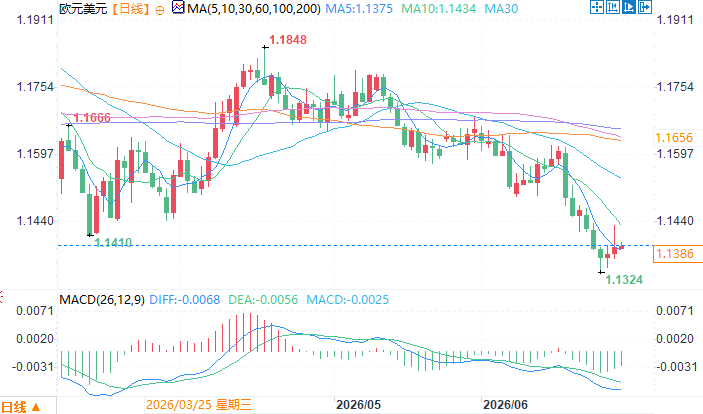
EUR/USD daily chart source: FX678
At 12:05 Beijing time on June 29, the euro was trading at 1.1382/83 against the US dollar.
Major institutions have significantly lowered their targets for the euro against the US dollar, and the options market has also released extremely bearish signals in the medium to long term. Only a few institutions have maintained a neutral view. Funds that were bullish on the euro have continued to withdraw from the market, and the historical pattern that energy shocks are long-term negative factors for the euro has been verified once again.
Investment banks collectively lowered their forecasts, opening up room for the euro to depreciate.
Leading financial institutions such as JPMorgan Chase, Morgan Stanley, and Bank of New York Mellon unanimously predict that the euro may depreciate by more than 3% against the US dollar, potentially falling to around 1.10. The euro has already fallen to a one-year low this month, with trading funds fully pricing in the possibility of a Federal Reserve rate hike in 2026, and no longer fully betting on the European Central Bank following suit. Market expectations have reversed sharply from the beginning of the year.
In the first half of this year, the euro surged to 1.20, reaching a near five-year high, at a time when European policymakers were still worried that currency appreciation would drag down exports and the economy. However, the conflict in the Iranian region pushed up international oil prices, leading to a concentrated influx of funds into the US dollar as a safe haven. The euro then began its downward trend, and coupled with the European Central Bank's more cautious policy stance, the euro completely lost favor with investors.
David Adams, a member of Morgan Stanley's strategy team, said that medium-term investors are massively closing out their short positions in the US dollar. As the downtrend takes shape, speculative funds will continue to increase their short positions in the euro, and it is highly likely that the euro will easily reach 1.10 against the US dollar.
JPMorgan Chase has directly lowered its mid-2027 exchange rate target to 1.10, while Royal Bank of Canada predicts that this level will be achieved by the end of next year. Bank of America and Wells Fargo have also lowered their forecasts accordingly. Such a large-scale collective downward revision is extremely rare, directly dragging down the market average expectation in a Bloomberg survey, whereas the market consensus had previously favored a rebound in the euro to 1.20 next year.
Options sentiment has turned bearish across the board, and the upward momentum of the US dollar is unlikely to reverse.
Options market data further confirms pessimistic market expectations, with medium- to long-term bearish sentiment towards the euro reaching a peak. The one-year risk reversal indicator directly reflects market positions and bullish/bearish bias; currently, this indicator is in the weakest range for the euro since March 2025, requiring traders to bear higher costs to hedge against the risk of continued euro depreciation or bet on further declines.
Wells Fargo analyst Marcus Jennings said, "The dollar may experience slight fluctuations in the short term to digest its gains, but the current upward momentum for the dollar is strong, and going against the trend carries significant risk."
The core driver of the dollar's strength stems from the starkly contrasting policy statements of the Federal Reserve and the European Central Bank . Newly appointed Fed Chairman Kevin Warsh chaired his first policy meeting this month. Prior to this, the market had worried that he would be pressured by the US president to cut interest rates, but Warsh clearly stated that he would not allow high inflation to run rampant, prompting the market to heavily bet on a rate hike this year. In contrast, European Central Bank President Christine Lagarde, after raising rates this month, stated that there was no need for further tightening of policy in response to the economic shocks from Middle East geopolitical events, and that medium- to long-term inflation would naturally return to the control target.
The European Central Bank's interest rate hikes have dragged down the economy, leading to a slight divergence in institutional opinions.
"The ECB's current rate hikes were unnecessary, and the actions have suppressed economic growth potential, further weakening the euro's fundamental support," said Geoff Yu, an analyst at BNY Mellon. "There is a possibility that the euro could fall below 1.10 against the dollar, but we will not blindly short it."
A small number of relatively mild views remain in the market, with some institutions believing the Federal Reserve may abandon rate hikes and optimistic about the resilience of the European economy, thus maintaining a neutral stance on the euro. While Bank of America lowered its exchange rate forecast from 1.20 to 1.15, it did not shift to a unilaterally bearish outlook. Even so, the market sentiment of remaining bullish on the euro is rapidly fading.
Kit Juckes, chief foreign exchange strategist at Societe Generale, said, "The euro's upward trend is basically over, and the energy crisis will naturally put downward pressure on the euro." He cited the situation in 2022 as an example, where soaring energy prices significantly weakened the eurozone's economic vitality, and the logic of the energy shock brought about by the Russia-Ukraine conflict is highly similar to the current situation.
Summarize
Based on the views of various institutions and market trading data, the misalignment of monetary policy cycles between the US and Europe is the core factor suppressing the euro. Coupled with the safe-haven demand for the US dollar due to geopolitical factors, the medium-term depreciation trend of the euro is clear.
Most investment banks are eyeing the key level of 1.10, and pessimism continues to grow in the options market. Only a few institutions maintain a neutral outlook, and potential shocks in the energy sector continue to limit the euro's upside potential. In the short term, there is a lack of sufficient fundamental support for going long on the euro.
EUR/USD daily chart source: FX678
At 12:05 Beijing time on June 29, the euro was trading at 1.1382/83 against the US dollar.
- Risk Warning and Disclaimer
- The market involves risk, and trading may not be suitable for all investors. This article is for reference only and does not constitute personal investment advice, nor does it take into account certain users’ specific investment objectives, financial situation, or other needs. Any investment decisions made based on this information are at your own risk.