Federal Reserve's Barkin: Inflation remains too high, but there are initial signs of easing; moderately restrictive policies are a "reasonable option."
2026-06-29 14:10:25
On Monday (June 29) during the Asian session, the US dollar index fluctuated at high levels, currently trading around 101.30. It had fallen for the previous two trading days.
At this crucial juncture, Barkin's latest remarks have drawn significant market attention, as they may suggest a subtle shift in the Federal Reserve's assessment of the inflation outlook.
Richmond Federal Reserve Bank President Thomas Barkin said on Sunday (June 28) that U.S. inflation remains "too high," but he also noted that there are initial signs that price pressures may be easing soon.
This statement neither denies the necessity of tightening policies nor rules out the possibility of a future policy shift, reflecting the Federal Reserve's ongoing weighing of the delicate balance between "inflation stickiness" and "economic resilience."

In a media interview, Barkin stated bluntly that current inflation data is "too high."
Data released last Thursday showed that the Federal Reserve’s preferred inflation gauge—the personal consumption expenditures (PCE) price index—rose 4.1% in the year ending in May, marking the largest increase since April 2023.
Although the war in Iran has driven up prices for oil and other commodities, Barkin points out that upward pressure on prices has spread more broadly and is not limited to the energy sector.
He admitted, "Without further action from the federal funds rate, the labor market, or other factors that could create anti-inflationary forces, it's difficult to be confident that inflation is returning to 2%."
One positive change Barkin observed in his jurisdiction was that gasoline prices fell rapidly following the recent ceasefire agreement between the US and Iran and the decline in oil prices.
This provided him with a certain "confidence boost," suggesting that geopolitically driven energy inflation may be receding.
However, he also cautioned that other structural factors are still supporting inflation, including capital expenditures and resource demands resulting from the large-scale construction of artificial intelligence infrastructure.
The investment boom in these emerging sectors is becoming a new source of price pressure.
Earlier this month, Federal Reserve policymakers kept the benchmark federal funds rate unchanged, but a growing number of officials have warned that another rate hike may be needed this year to combat renewed inflation.
Barkin agreed, expressing particular concern about changes in corporate pricing behavior in the current high-inflation environment. "Companies will consider current inflation as a factor when setting prices, so I believe inflation has a certain degree of persistence. This is precisely what worries me, and why I believe maintaining a moderately restrictive policy stance is reasonable."
At the same time, he also observed a counterbalancing force: while businesses face higher input costs, consumer resistance to price increases is also increasing, which limits businesses' ability to pass on costs to end consumers.
Some of Barkin's colleagues are particularly wary of rising service prices—inflation in this sector tends to be more sticky and slower to adjust.
In addition, inflation has been above the Federal Reserve's 2% target for more than five consecutive years and has become a hot topic of national discussion. This may subtly affect consumers' inflation expectations, making the Federal Reserve's task of restoring price stability even more difficult.
On the consumption front, despite the impact of tariffs and rising oil prices which should theoretically dampen demand, American spending has remained strong over the past year.
In a consumption-driven economy, this constitutes a major obstacle to bringing inflation fully back to the 2% target.
During a recent visit to western Virginia, Barkin learned that local business leaders have not yet decided on the extent of next year's employee compensation adjustments.
When gasoline prices rose, they considered extraordinary pay raises; but as oil prices have fallen, this pressure has been partially alleviated.
This wait-and-see attitude reflects companies' lack of clear judgment on future inflation trends, which may in turn affect the wage-inflation spiral in the labor market.
From a technical chart perspective, based on the daily chart, the US dollar index is in a strong upward channel in the medium term. It rose steadily from a low of 97.62 to a high of 101.80 before slightly retreating. The moving average system is in a complete bullish alignment, with the 10-day moving average (MA10) providing support and the 20-day and 50-day moving averages (MA20 and MA50) rising in tandem. These multiple moving averages provide multi-layered support, solidifying the foundation of the bullish trend.
From a technical perspective, the MACD is running in bullish territory above the zero line, with the DIFF at 0.6004 consistently above the DEA at 0.5028, and the red bars maintaining positive volume, indicating that bullish momentum is still being released, and there are no obvious bearish divergence reversal signals. The RSI value is 68.79, close to the 70 overbought threshold, suggesting a short-term need for a slight pullback to digest overbought pressure, but it has not entered a deep overbought pullback range and does not change the overall bullish trend in the larger timeframe.
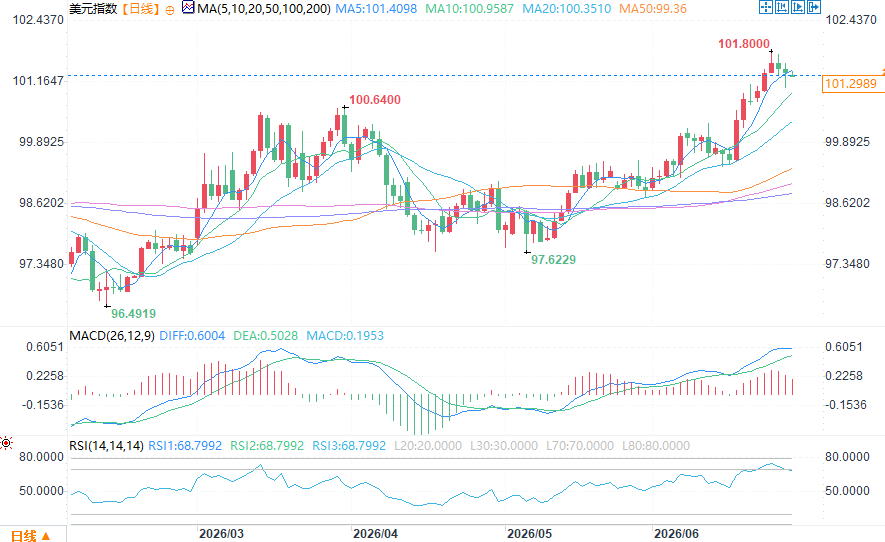
(US Dollar Index Daily Chart, Source: FX678)
At 14:10 Beijing time on June 29, the US dollar index was at 101.29.
At this crucial juncture, Barkin's latest remarks have drawn significant market attention, as they may suggest a subtle shift in the Federal Reserve's assessment of the inflation outlook.
Richmond Federal Reserve Bank President Thomas Barkin said on Sunday (June 28) that U.S. inflation remains "too high," but he also noted that there are initial signs that price pressures may be easing soon.
This statement neither denies the necessity of tightening policies nor rules out the possibility of a future policy shift, reflecting the Federal Reserve's ongoing weighing of the delicate balance between "inflation stickiness" and "economic resilience."
Inflation Status Quo: The PCE rate of 4.1% remains "uncomfortably high".
In a media interview, Barkin stated bluntly that current inflation data is "too high."
Data released last Thursday showed that the Federal Reserve’s preferred inflation gauge—the personal consumption expenditures (PCE) price index—rose 4.1% in the year ending in May, marking the largest increase since April 2023.
Although the war in Iran has driven up prices for oil and other commodities, Barkin points out that upward pressure on prices has spread more broadly and is not limited to the energy sector.
He admitted, "Without further action from the federal funds rate, the labor market, or other factors that could create anti-inflationary forces, it's difficult to be confident that inflation is returning to 2%."
Positive signal: The drop in gasoline prices offers some comfort.
One positive change Barkin observed in his jurisdiction was that gasoline prices fell rapidly following the recent ceasefire agreement between the US and Iran and the decline in oil prices.
This provided him with a certain "confidence boost," suggesting that geopolitically driven energy inflation may be receding.
However, he also cautioned that other structural factors are still supporting inflation, including capital expenditures and resource demands resulting from the large-scale construction of artificial intelligence infrastructure.
The investment boom in these emerging sectors is becoming a new source of price pressure.
Policy stance: A moderately restrictive interest rate is a "reasonable choice"
Earlier this month, Federal Reserve policymakers kept the benchmark federal funds rate unchanged, but a growing number of officials have warned that another rate hike may be needed this year to combat renewed inflation.
Barkin agreed, expressing particular concern about changes in corporate pricing behavior in the current high-inflation environment. "Companies will consider current inflation as a factor when setting prices, so I believe inflation has a certain degree of persistence. This is precisely what worries me, and why I believe maintaining a moderately restrictive policy stance is reasonable."
At the same time, he also observed a counterbalancing force: while businesses face higher input costs, consumer resistance to price increases is also increasing, which limits businesses' ability to pass on costs to end consumers.
Consumer and service inflation: two major concerns
Some of Barkin's colleagues are particularly wary of rising service prices—inflation in this sector tends to be more sticky and slower to adjust.
In addition, inflation has been above the Federal Reserve's 2% target for more than five consecutive years and has become a hot topic of national discussion. This may subtly affect consumers' inflation expectations, making the Federal Reserve's task of restoring price stability even more difficult.
On the consumption front, despite the impact of tariffs and rising oil prices which should theoretically dampen demand, American spending has remained strong over the past year.
In a consumption-driven economy, this constitutes a major obstacle to bringing inflation fully back to the 2% target.
Businesses are taking a wait-and-see approach: Uncertainty surrounding salary decisions
During a recent visit to western Virginia, Barkin learned that local business leaders have not yet decided on the extent of next year's employee compensation adjustments.
When gasoline prices rose, they considered extraordinary pay raises; but as oil prices have fallen, this pressure has been partially alleviated.
This wait-and-see attitude reflects companies' lack of clear judgment on future inflation trends, which may in turn affect the wage-inflation spiral in the labor market.
Technical Analysis
From a technical chart perspective, based on the daily chart, the US dollar index is in a strong upward channel in the medium term. It rose steadily from a low of 97.62 to a high of 101.80 before slightly retreating. The moving average system is in a complete bullish alignment, with the 10-day moving average (MA10) providing support and the 20-day and 50-day moving averages (MA20 and MA50) rising in tandem. These multiple moving averages provide multi-layered support, solidifying the foundation of the bullish trend.
From a technical perspective, the MACD is running in bullish territory above the zero line, with the DIFF at 0.6004 consistently above the DEA at 0.5028, and the red bars maintaining positive volume, indicating that bullish momentum is still being released, and there are no obvious bearish divergence reversal signals. The RSI value is 68.79, close to the 70 overbought threshold, suggesting a short-term need for a slight pullback to digest overbought pressure, but it has not entered a deep overbought pullback range and does not change the overall bullish trend in the larger timeframe.
(US Dollar Index Daily Chart, Source: FX678)
At 14:10 Beijing time on June 29, the US dollar index was at 101.29.
- Risk Warning and Disclaimer
- The market involves risk, and trading may not be suitable for all investors. This article is for reference only and does not constitute personal investment advice, nor does it take into account certain users’ specific investment objectives, financial situation, or other needs. Any investment decisions made based on this information are at your own risk.