Is the influence of the Hormuz waning? Supertankers return to the Persian Gulf, WTI hovers around 70.
2026-07-01 16:23:10
WTI crude oil futures prices remained volatile during the European session on Wednesday (July 1), currently trading below $70 per barrel. Oil prices continued their recent downward trend, with the continued fading of geopolitical risk premiums being the main drag.
The market is awaiting the release of the U.S. Energy Information Administration's (EIA) weekly crude oil inventory report later today for further confirmation of the U.S. supply and demand fundamentals.

According to data from the well-known agency Kpler, approximately 24 cargo ships—including those carrying oil, liquefied natural gas, and bulk cargo—passed through the Strait of Hormuz in both directions on Monday. This trend continued on Tuesday, with a supertanker reappearing in the Persian Gulf, along with several smaller vessels.
This marks the first significant rebound in Strait traffic since the conflict began. The recovery in shipping volume directly alleviated market concerns about oil supply disruptions, becoming a key factor suppressing WTI prices.
U.S. negotiators Jared Kushner and Josip Witkov arrived in Doha on Tuesday, and a Qatari government spokesperson stated they would meet with the Qatari Prime Minister to discuss the ongoing U.S.-Iran negotiations and regional developments. However, no high-level meetings are currently scheduled between the U.S. and Iran, meaning geopolitical risks have not completely dissipated, but the flight data itself is already enough to influence short-term pricing.
Oil prices may find support in the short term if peace talks fail to make progress or if there are any signs of escalating tensions in the Middle East. However, current market pricing clearly points to the continued release of the "peace dividend."
Although the fading geopolitical risk premium has dominated the recent downward trend in oil prices, U.S. crude oil inventory data has sent positive signals on the demand side.
Data released by the American Petroleum Institute (API) on Tuesday showed that U.S. crude oil inventories fell by 6.072 million barrels in the week ending June 26, far exceeding the previous week's drop of 765,000 barrels and also surpassing market expectations of a 4.1 million barrel decline. The larger-than-expected decline in inventories indicates that U.S. refining demand remains strong, providing some floor support for oil prices.
The market is awaiting the official EIA inventory report, due later on Wednesday, to verify the demand strength implied by the API data. If the EIA data confirms a stronger-than-expected inventory reduction, oil prices may gain upward momentum; conversely, an unexpected inventory build-up could exacerbate current downward pressure.
In the short term, the trend of WTI crude oil depends on the interplay of the following variables:
First, the pace of recovery in navigation through the Strait of Hormuz. If navigation volume continues to rebound, geopolitical risk premiums will be further cleared, and oil prices may move towards a lower equilibrium level.
Second, the progress of US-Iran negotiations. Although there is currently no direct meeting, any positive signs could continue to suppress oil prices; conversely, if negotiations break down or new conflicts arise, oil prices will rebound quickly.
Third, verification of inventory data. If the EIA report confirms the significant reduction in API inventories, it will provide some technical support for oil prices around $69.
According to the daily chart, US crude oil futures have been declining continuously since the March high of 119.48, and the medium-term downtrend is clear. The price has broken below the short-term moving averages MA20, MA50, and MA100, and all three moving averages have turned downwards simultaneously, forming resistance. Only the MA200 (74.07) remains above, forming medium- to long-term resistance. The current price is fluctuating closely around the previous low of 68.56.
In terms of indicators, the MACD continues to run below the zero axis, the DIFF (-6.20) is below the DEA (-5.74), the green bars continue, and the bearish momentum has not yet subsided; the RSI value is 29.45, close to the 30 oversold threshold, and there is a short-term technical rebound and repair demand, but no clear bottom reversal signal has appeared.
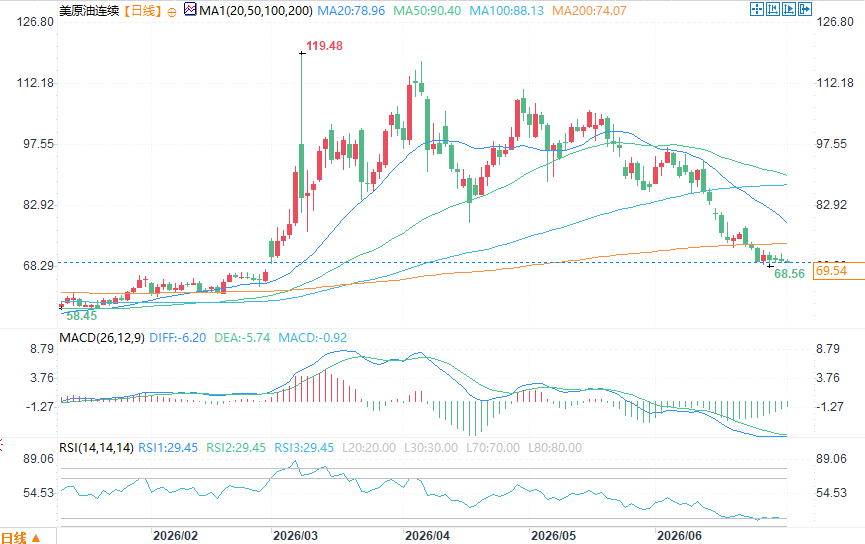
(US crude oil futures daily chart, source: FX678)
At 16:02 Beijing time on July 1, US crude oil futures were trading at $69.38 per barrel.
The market is awaiting the release of the U.S. Energy Information Administration's (EIA) weekly crude oil inventory report later today for further confirmation of the U.S. supply and demand fundamentals.
Supply side: Resurgence of navigation in the Strait of Hormuz suppresses oil prices
According to data from the well-known agency Kpler, approximately 24 cargo ships—including those carrying oil, liquefied natural gas, and bulk cargo—passed through the Strait of Hormuz in both directions on Monday. This trend continued on Tuesday, with a supertanker reappearing in the Persian Gulf, along with several smaller vessels.
This marks the first significant rebound in Strait traffic since the conflict began. The recovery in shipping volume directly alleviated market concerns about oil supply disruptions, becoming a key factor suppressing WTI prices.
U.S. negotiators Jared Kushner and Josip Witkov arrived in Doha on Tuesday, and a Qatari government spokesperson stated they would meet with the Qatari Prime Minister to discuss the ongoing U.S.-Iran negotiations and regional developments. However, no high-level meetings are currently scheduled between the U.S. and Iran, meaning geopolitical risks have not completely dissipated, but the flight data itself is already enough to influence short-term pricing.
Oil prices may find support in the short term if peace talks fail to make progress or if there are any signs of escalating tensions in the Middle East. However, current market pricing clearly points to the continued release of the "peace dividend."
On the demand side: A sharp drop of 6.07 million barrels in API inventories provides bottom support.
Although the fading geopolitical risk premium has dominated the recent downward trend in oil prices, U.S. crude oil inventory data has sent positive signals on the demand side.
Data released by the American Petroleum Institute (API) on Tuesday showed that U.S. crude oil inventories fell by 6.072 million barrels in the week ending June 26, far exceeding the previous week's drop of 765,000 barrels and also surpassing market expectations of a 4.1 million barrel decline. The larger-than-expected decline in inventories indicates that U.S. refining demand remains strong, providing some floor support for oil prices.
The market is awaiting the official EIA inventory report, due later on Wednesday, to verify the demand strength implied by the API data. If the EIA data confirms a stronger-than-expected inventory reduction, oil prices may gain upward momentum; conversely, an unexpected inventory build-up could exacerbate current downward pressure.
Market Outlook
In the short term, the trend of WTI crude oil depends on the interplay of the following variables:
First, the pace of recovery in navigation through the Strait of Hormuz. If navigation volume continues to rebound, geopolitical risk premiums will be further cleared, and oil prices may move towards a lower equilibrium level.
Second, the progress of US-Iran negotiations. Although there is currently no direct meeting, any positive signs could continue to suppress oil prices; conversely, if negotiations break down or new conflicts arise, oil prices will rebound quickly.
Third, verification of inventory data. If the EIA report confirms the significant reduction in API inventories, it will provide some technical support for oil prices around $69.
Technical Analysis
According to the daily chart, US crude oil futures have been declining continuously since the March high of 119.48, and the medium-term downtrend is clear. The price has broken below the short-term moving averages MA20, MA50, and MA100, and all three moving averages have turned downwards simultaneously, forming resistance. Only the MA200 (74.07) remains above, forming medium- to long-term resistance. The current price is fluctuating closely around the previous low of 68.56.
In terms of indicators, the MACD continues to run below the zero axis, the DIFF (-6.20) is below the DEA (-5.74), the green bars continue, and the bearish momentum has not yet subsided; the RSI value is 29.45, close to the 30 oversold threshold, and there is a short-term technical rebound and repair demand, but no clear bottom reversal signal has appeared.
(US crude oil futures daily chart, source: FX678)
At 16:02 Beijing time on July 1, US crude oil futures were trading at $69.38 per barrel.
- Risk Warning and Disclaimer
- The market involves risk, and trading may not be suitable for all investors. This article is for reference only and does not constitute personal investment advice, nor does it take into account certain users’ specific investment objectives, financial situation, or other needs. Any investment decisions made based on this information are at your own risk.