Goldman Sachs warns of escalating risks in the Strait of Hormuz, with disruptions to crude oil supply potentially driving oil prices higher again.
2026-07-09 15:08:53
A recent report by Goldman Sachs points out that the recovery of Middle Eastern crude oil supply remains highly uncertain. If shipping through the Strait of Hormuz is disrupted again, the global oil market could face renewed supply shortages. Goldman Sachs estimates that crude oil production in the Persian Gulf region in June was still approximately 10.5 million barrels per day lower than pre-conflict levels. Although major Middle Eastern oil-producing countries have begun to gradually reopen previously shut-down wells, the increased shipping risks through the Strait of Hormuz could limit the speed of production recovery.

In a report released on July 8, Goldman Sachs analysts stated that recent attacks on oil tankers indicate that the security risks of transiting the Strait of Hormuz remain high. Given the continued uncertainty surrounding the ceasefire, some shipping companies may remain cautious about navigating the area, potentially impacting future crude oil transportation efficiency. As a vital global energy transport route, the stable operation of the Strait of Hormuz has a crucial influence on international oil prices. Disruptions to shipping in the region could disrupt the global crude oil supply chain and drive the market to re-increase supply risk premiums.
Goldman Sachs data shows that following the recent tanker attacks, oil flows in the Persian Gulf have fallen to about 70% of normal levels. Previously, within about 10 days of the Strait of Hormuz reopening, regional oil flows had recovered to over 80% of pre-conflict levels, but recent increases in security risks have slowed the recovery process.
At the same time, the market faces significant two-way risks regarding future oil price trends. On the one hand, if negotiations continue for the next 60 days , shipping companies will receive clearer security guarantees, and restrictions on Iranian crude oil exports will be further eased, potentially leading to a gradual recovery of oil transport traffic in the Persian Gulf by the end of July .
On the other hand, if negotiations fail and tanker attacks escalate, market concerns about supply disruptions could resurface, leading to a continued decline in Persian Gulf oil flows and pushing up international oil prices. In the current market environment, the speed of supply recovery has become a crucial factor influencing oil prices. Although OPEC+ continues to signal increased production, potential supply losses in the Middle East remain significant, and new production in the short term may not fully compensate for the impact of transportation risks.
In addition, international oil prices have recently been affected by both geopolitical risks and inventory changes. Data from the U.S. EIA showed an unexpected increase in commercial crude oil inventories, putting some pressure on prices. However, market focus on supply risks in the Strait of Hormuz has mitigated the negative impact of the inventory situation.
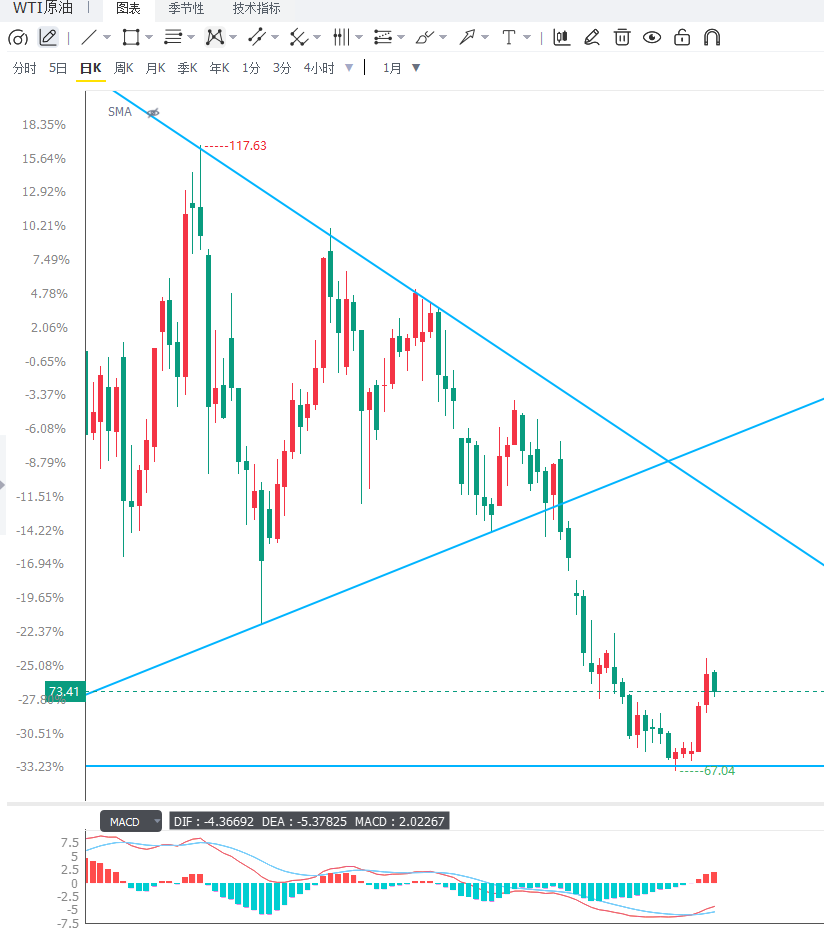
From a technical perspective, WTI crude oil has maintained a slightly bullish trend recently, with prices stabilizing above $74 per barrel . On the daily chart, oil prices remain above short-term moving averages, and the MACD continues its corrective movement, indicating a recovery in bullish momentum. Resistance levels to watch are $75.80 and $77.20 ; a break above these levels could lead to a further test of the $80 mark. Support levels to watch are $73.20 and $71.80 .
From a four-hour chart perspective, WTI is currently in a consolidation phase after an initial rise. Technical indicators suggest that momentum has slowed, but the overall structure remains bullish. If the risks in the Strait of Hormuz continue to escalate, oil prices could quickly break through recent highs; conversely, if shipping resumes smoothly, caution is warranted as the market may re-trade expectations of increased supply, potentially leading to a price pullback.
Editor's Summary : Goldman Sachs' analysis shows that the core issue in the current crude oil market has shifted from simple supply recovery to transportation security risks. While Middle Eastern oil-producing countries are gradually restoring production capacity, uncertainties surrounding shipping in the Strait of Hormuz may still limit the speed of supply recovery. In the short term, oil prices will continue to be dominated by geopolitical tensions. If negotiations progress, supply recovery may suppress oil prices; if transportation risks escalate, the crude oil market may re-enter a tight supply mode. Investors should pay close attention to shipping dynamics in the Strait of Hormuz, Iran's export policies, and OPEC+ production adjustments.
In a report released on July 8, Goldman Sachs analysts stated that recent attacks on oil tankers indicate that the security risks of transiting the Strait of Hormuz remain high. Given the continued uncertainty surrounding the ceasefire, some shipping companies may remain cautious about navigating the area, potentially impacting future crude oil transportation efficiency. As a vital global energy transport route, the stable operation of the Strait of Hormuz has a crucial influence on international oil prices. Disruptions to shipping in the region could disrupt the global crude oil supply chain and drive the market to re-increase supply risk premiums.
Goldman Sachs data shows that following the recent tanker attacks, oil flows in the Persian Gulf have fallen to about 70% of normal levels. Previously, within about 10 days of the Strait of Hormuz reopening, regional oil flows had recovered to over 80% of pre-conflict levels, but recent increases in security risks have slowed the recovery process.
At the same time, the market faces significant two-way risks regarding future oil price trends. On the one hand, if negotiations continue for the next 60 days , shipping companies will receive clearer security guarantees, and restrictions on Iranian crude oil exports will be further eased, potentially leading to a gradual recovery of oil transport traffic in the Persian Gulf by the end of July .
On the other hand, if negotiations fail and tanker attacks escalate, market concerns about supply disruptions could resurface, leading to a continued decline in Persian Gulf oil flows and pushing up international oil prices. In the current market environment, the speed of supply recovery has become a crucial factor influencing oil prices. Although OPEC+ continues to signal increased production, potential supply losses in the Middle East remain significant, and new production in the short term may not fully compensate for the impact of transportation risks.
In addition, international oil prices have recently been affected by both geopolitical risks and inventory changes. Data from the U.S. EIA showed an unexpected increase in commercial crude oil inventories, putting some pressure on prices. However, market focus on supply risks in the Strait of Hormuz has mitigated the negative impact of the inventory situation.
From a technical perspective, WTI crude oil has maintained a slightly bullish trend recently, with prices stabilizing above $74 per barrel . On the daily chart, oil prices remain above short-term moving averages, and the MACD continues its corrective movement, indicating a recovery in bullish momentum. Resistance levels to watch are $75.80 and $77.20 ; a break above these levels could lead to a further test of the $80 mark. Support levels to watch are $73.20 and $71.80 .
From a four-hour chart perspective, WTI is currently in a consolidation phase after an initial rise. Technical indicators suggest that momentum has slowed, but the overall structure remains bullish. If the risks in the Strait of Hormuz continue to escalate, oil prices could quickly break through recent highs; conversely, if shipping resumes smoothly, caution is warranted as the market may re-trade expectations of increased supply, potentially leading to a price pullback.
Editor's Summary : Goldman Sachs' analysis shows that the core issue in the current crude oil market has shifted from simple supply recovery to transportation security risks. While Middle Eastern oil-producing countries are gradually restoring production capacity, uncertainties surrounding shipping in the Strait of Hormuz may still limit the speed of supply recovery. In the short term, oil prices will continue to be dominated by geopolitical tensions. If negotiations progress, supply recovery may suppress oil prices; if transportation risks escalate, the crude oil market may re-enter a tight supply mode. Investors should pay close attention to shipping dynamics in the Strait of Hormuz, Iran's export policies, and OPEC+ production adjustments.
- Risk Warning and Disclaimer
- The market involves risk, and trading may not be suitable for all investors. This article is for reference only and does not constitute personal investment advice, nor does it take into account certain users’ specific investment objectives, financial situation, or other needs. Any investment decisions made based on this information are at your own risk.