From death lists to the resumption of oil supplies: The Middle East situation may be turning around.
2026-03-26 19:31:11
On Thursday (March 26), during the Asian and European sessions, spot gold (XAU/USD) fell sharply to around the $4,400 mark due to renewed geopolitical risks in the Middle East.
Iran's rejection of Trump's ceasefire proposal has reignited tensions in the Middle East, causing a massive sell-off in gold prices. Iranian Foreign Minister Araqchi also made it clear that Tehran has no intention of engaging in any negotiations with the United States, and put forward its core demands: the complete withdrawal of US military bases in the Middle East, and permission for Iran to proceed with its missile development program without restrictions.
According to reports, Iranian Foreign Minister Araqchi stated publicly on Wednesday that Iran is assessing the US-proposed ceasefire in the Gulf, but has no intention of initiating negotiations to end the Middle East conflict. A senior Iranian official also told Al Jazeera that the US proposal is extremely unilateral and unreasonable, and lacks a basis for negotiation.
The core demands of the 15-point proposal put forward by the United States are that Iran limit its nuclear weapons development and completely ban uranium enrichment activities within its borders; while Iran has put forward its own ceasefire conditions, including the closure of all US military bases in the Gulf, compensation for damage to Iranian infrastructure, complete lifting of sanctions against Iran, and the retention of its unrestricted missile development program.
According to traditional financial logic, escalating geopolitical conflicts should drive an influx of safe-haven funds, boosting the prices of safe-haven assets such as gold.
However, the market has moved in the opposite direction this time: the ongoing conflict in the Middle East will keep international oil prices high, which will in turn push up global inflation expectations, forcing central banks around the world to stick to tight monetary policies, significantly reducing the attractiveness of non-interest-bearing assets such as gold, and ultimately causing gold prices to fall under pressure.
However, some details in the news may lead to a turnaround in the current decline in gold prices.
Pakistani officials revealed that after Pakistan mediated and requested the United States not to take action against the individuals involved, Israel removed Iran's Araghchi and Kalibaf from its assassination list. This move sends an important signal of a shift towards easing tensions in the Middle East and lays the groundwork for future diplomatic contacts.
To take it to an extreme, in a corner unseen by us, the US and Iran may have already begun negotiations. This is also the source of Trump's absurd claim that he is communicating with the right parties, who are extremely eager to reach an agreement. You can hardly imagine how strong their desire to reach an agreement is.
While demonstrating goodwill in negotiations, Iran is also working to ease relations with neighboring countries and plans to gradually restore energy supplies to them, breaking the previous deadlock in the energy market.
Iranian Ambassador to Japan, Peman Sidat, spoke in Tokyo, accusing the United States and Israel of hijacking the global energy market and arguing that their use of force clearly violates international law. He stated that Iran will never accept a unilaterally imposed peace plan.
He also stated that Japan is a trustworthy and friendly country to Iran, and that Iran will resolutely defend its rights until the acts of aggression cease, directly accusing the United States and Israel of turning the Hormuz Island into a war zone.
These actions have not only helped ease regional tensions, but have also gradually reversed market expectations of a continued tightening of global energy supply.
Iran's stance on navigation in the Strait of Hormuz has softened. Instead of completely blocking the waterway, Iran plans to prioritize the energy transportation needs of friendly countries. This shift has directly impacted the market logic that high oil prices previously drove up inflation, and has also led to adjustments in the pricing logic of gold.
With the removal of the assassination list, the easing of relations between Iran and its neighboring countries, and the prospect of a recovery in energy supply, the transmission chain of "continued conflict - high oil prices - high inflation - central bank tightening" that had previously suppressed gold prices has begun to loosen.
The future trend of gold prices will depend on the progress of the easing of the situation in the Middle East: if Iran's oil supply to neighboring countries proceeds smoothly, the upside potential of oil prices will be limited, global inflation expectations will cool down, central bank tightening pressure will ease, and the allocation value of gold will rebound.
If the situation recurs, and risk aversion and the logic of high oil prices resurface, gold prices will continue to face volatility.
Overall, the trend of easing tensions in the Middle East has begun to emerge, and gold is gradually shifting from being driven solely by geopolitical safe-haven demand to being driven by inflation and central bank policy expectations, completing a key shift in pricing logic.
From a technical perspective, spot gold is currently oscillating around the key price level of 4426, which is near the 0.500 Fibonacci retracement level of the previous rise. It is also in an upward channel, with the middle line as the resistance level and 4426 as the support level.
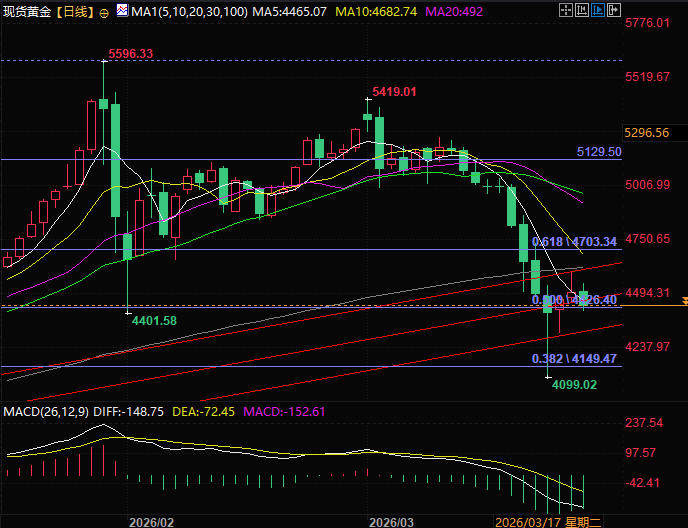
(Spot gold daily chart, source: EasyForex subsidiary)
At 19:29 Beijing time, spot gold was trading at $4,443 per ounce.
Iran's rejection of Trump's ceasefire proposal has reignited tensions in the Middle East, causing a massive sell-off in gold prices. Iranian Foreign Minister Araqchi also made it clear that Tehran has no intention of engaging in any negotiations with the United States, and put forward its core demands: the complete withdrawal of US military bases in the Middle East, and permission for Iran to proceed with its missile development program without restrictions.
According to reports, Iranian Foreign Minister Araqchi stated publicly on Wednesday that Iran is assessing the US-proposed ceasefire in the Gulf, but has no intention of initiating negotiations to end the Middle East conflict. A senior Iranian official also told Al Jazeera that the US proposal is extremely unilateral and unreasonable, and lacks a basis for negotiation.
The core demands of the 15-point proposal put forward by the United States are that Iran limit its nuclear weapons development and completely ban uranium enrichment activities within its borders; while Iran has put forward its own ceasefire conditions, including the closure of all US military bases in the Gulf, compensation for damage to Iranian infrastructure, complete lifting of sanctions against Iran, and the retention of its unrestricted missile development program.
According to traditional financial logic, escalating geopolitical conflicts should drive an influx of safe-haven funds, boosting the prices of safe-haven assets such as gold.
However, the market has moved in the opposite direction this time: the ongoing conflict in the Middle East will keep international oil prices high, which will in turn push up global inflation expectations, forcing central banks around the world to stick to tight monetary policies, significantly reducing the attractiveness of non-interest-bearing assets such as gold, and ultimately causing gold prices to fall under pressure.
However, some details in the news may lead to a turnaround in the current decline in gold prices.
Negotiation signals emerge: Israel removes Iranian official assassination list, easing tensions.
Pakistani officials revealed that after Pakistan mediated and requested the United States not to take action against the individuals involved, Israel removed Iran's Araghchi and Kalibaf from its assassination list. This move sends an important signal of a shift towards easing tensions in the Middle East and lays the groundwork for future diplomatic contacts.
To take it to an extreme, in a corner unseen by us, the US and Iran may have already begun negotiations. This is also the source of Trump's absurd claim that he is communicating with the right parties, who are extremely eager to reach an agreement. You can hardly imagine how strong their desire to reach an agreement is.
Improved relations with neighboring countries: Iran shows goodwill by planning to resume oil supplies to neighboring countries.
While demonstrating goodwill in negotiations, Iran is also working to ease relations with neighboring countries and plans to gradually restore energy supplies to them, breaking the previous deadlock in the energy market.
Iranian Ambassador to Japan, Peman Sidat, spoke in Tokyo, accusing the United States and Israel of hijacking the global energy market and arguing that their use of force clearly violates international law. He stated that Iran will never accept a unilaterally imposed peace plan.
He also stated that Japan is a trustworthy and friendly country to Iran, and that Iran will resolutely defend its rights until the acts of aggression cease, directly accusing the United States and Israel of turning the Hormuz Island into a war zone.
These actions have not only helped ease regional tensions, but have also gradually reversed market expectations of a continued tightening of global energy supply.
Iran's stance on navigation in the Strait of Hormuz has softened. Instead of completely blocking the waterway, Iran plans to prioritize the energy transportation needs of friendly countries. This shift has directly impacted the market logic that high oil prices previously drove up inflation, and has also led to adjustments in the pricing logic of gold.
Future Pricing Trends: With expectations of easing tensions, the safe-haven logic for gold is gradually being restructured.
With the removal of the assassination list, the easing of relations between Iran and its neighboring countries, and the prospect of a recovery in energy supply, the transmission chain of "continued conflict - high oil prices - high inflation - central bank tightening" that had previously suppressed gold prices has begun to loosen.
The future trend of gold prices will depend on the progress of the easing of the situation in the Middle East: if Iran's oil supply to neighboring countries proceeds smoothly, the upside potential of oil prices will be limited, global inflation expectations will cool down, central bank tightening pressure will ease, and the allocation value of gold will rebound.
If the situation recurs, and risk aversion and the logic of high oil prices resurface, gold prices will continue to face volatility.
Overall, the trend of easing tensions in the Middle East has begun to emerge, and gold is gradually shifting from being driven solely by geopolitical safe-haven demand to being driven by inflation and central bank policy expectations, completing a key shift in pricing logic.
From a technical perspective, spot gold is currently oscillating around the key price level of 4426, which is near the 0.500 Fibonacci retracement level of the previous rise. It is also in an upward channel, with the middle line as the resistance level and 4426 as the support level.
(Spot gold daily chart, source: EasyForex subsidiary)
At 19:29 Beijing time, spot gold was trading at $4,443 per ounce.
- Risk Warning and Disclaimer
- The market involves risk, and trading may not be suitable for all investors. This article is for reference only and does not constitute personal investment advice, nor does it take into account certain users’ specific investment objectives, financial situation, or other needs. Any investment decisions made based on this information are at your own risk.