Shipping in the Strait of Hormuz is slowly recovering. When will the normal rate of "125 ships per day" return?
2026-06-23 09:12:26
On Tuesday (June 22) in early Asian trading, US crude oil futures maintained a volatile pattern, currently trading around $74 per barrel.
As the United States announced the temporary lifting of sanctions on Iranian oil and US-Iran negotiations eased geopolitical pressure in the Middle East, international crude oil futures prices fell significantly on the 22nd from a high of over $78 per barrel, reversing their gains and falling by more than 3%.
Shipping data showed that several crude oil and liquefied natural gas (LNG) tankers passed through the Strait of Hormuz on Monday, indicating that shipping activity in the strait is gradually recovering. This followed Iran's renewed closure of the waterway over the weekend, which had initially led to a decrease in vessel traffic.
As the 60-day peace talks between the US and Iran progress, this vital global energy transport artery is slowly getting back on track.
According to Kpler ship tracking data analysis, four Qatari-controlled LNG carriers entered the Persian Gulf and transited the strait on Monday; at the same time, two supertankers also entered the Persian Gulf, one of which reported its destination as the Iraqi port of Basra.
Data from the MarineTraffic platform shows that two smaller crude oil tankers sailed out of the Strait of Hormuz and into the Gulf of Oman on Monday.
"Although daily transit volume remains below the pre-tense level of 125 vessels per day," Clarksons, a ship brokerage firm, said in a report on Monday.
Shipping sources say that more vessels may be transiting the strait with their transponders off, and the AIS system has also reported signal outages, meaning the actual volume of traffic may be higher than publicly reported.
Kpler data shows that five ships passed through the strait on Sunday, down from 26 the previous day – including three Very Large Crude Carriers (VLCCs), each carrying 2 million barrels of Saudi crude oil.
Despite Iran's announcement last Saturday of the closure of the Strait of Hormuz, crude oil exports do not appear to have been completely halted. Hamid Boward, head of the National Iranian Oil Company, said on Sunday that more than 25 million barrels of Iranian crude oil have passed through this "virtual blockade" since last Monday.
Data from the London Stock Exchange Group (LSEG) shows that three sanctioned VLCCs—the Elwa, the Vilgo, and the Vigo—left the Strait of Hormuz on Monday after loading Iranian crude oil from Hargo Island.
The U.S. Central Command stated that 55 merchant ships passed through the strait last Saturday, delivering more than 17 million barrels of oil to global markets.
Faced with the uncertainty of navigation in the Taiwan Strait, Gulf oil-producing countries have begun to take flexible measures.
Abu Dhabi National Oil Company (ADNOC) and Kuwait Oil Company have issued tenders to sell crude oil, offering the option of loading from either the inside or outside of the Strait of Hormuz – an arrangement that allows buyers to secure supplies even if shipping is disrupted.
Meanwhile, data from Kpler and LSEG show that two LNG carriers controlled by ADNOC recently departed the Strait of Hormuz and are carrying cargo to India.
The resumption of shipping in the Strait of Hormuz reflects the initial success of the US-Iran negotiations, but daily traffic volume remains far below normal levels. Stability depends on the implementation of the ceasefire in Lebanon, Israeli actions, and the progress of the subsequent 60-day negotiations. The global energy market needs to continue to monitor the impact of geopolitical risks on oil prices and supply chains.
Q1: What is the current navigation status of the Strait of Hormuz?
A: Kpler data on Monday showed that several LNG and crude oil tankers passed through the Strait, indicating signs of recovery, but the daily average transit volume remains below the pre-conflict level of approximately 125 vessels. Some vessels may have disabled their AIS, so the actual flow may be higher. After Iran announced the blockade, U.S. Central Command confirmed that 55 merchant ships still passed through on Saturday, carrying over 17 million barrels of oil, indicating that navigation was not completely disrupted under the "virtual blockade."
Q2: How affected are Iran's crude oil exports?
A: Despite the announced shutdown, Iran has exported more than 25 million barrels of crude oil. Three sanctioned VLCC tankers continued operating on Monday, departing from Hargh Island after loading. The National Iranian Oil Company emphasized the resilience of its exports, providing Tehran with important economic leverage in negotiations.
Q3: What countermeasures have the Gulf oil-producing countries taken?
A: ADNOC and Kuwait Petroleum Corporation offer loading options both inside and outside the Strait of Hormuz, ensuring supply continuity. Meanwhile, LNG carriers continue to deliver to markets such as India. This flexible strategy helps mitigate the impact of shipping lane uncertainties on global buyers.
Q4: How will the US-Iran negotiations affect navigation in the Taiwan Strait?
A: Under the framework of the interim agreement in June, both sides agreed to advance a comprehensive agreement within 60 days, including a safe passage mechanism in the Strait of Hormuz. Swiss negotiations have established communication channels and technical working groups. Although Iran briefly announced a blockade due to the situation in Lebanon, the overall trend is leaning towards resuming navigation.
Q5: What is the significance of the restoration of the Strait of Hormuz for the global energy market?
A: The Strait of Hormuz handles approximately 20% of global oil shipments; its restoration would alleviate oil price pressures and supply chain tensions. However, full normalization will take several months and depends on the sustainability of the ceasefire and the outcome of negotiations. Investors should pay attention to tanker traffic, Iranian export data, and the potential impact of geopolitical events on crude oil prices.
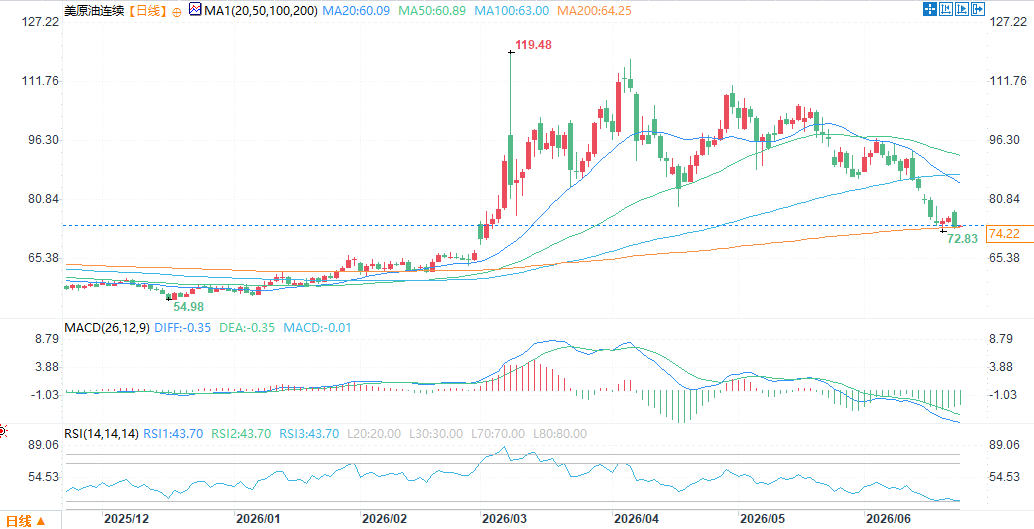
(US crude oil futures daily chart, source: FX678)
At 9:10 AM Beijing time on June 23, US crude oil futures were trading at $73.90 per barrel.
As the United States announced the temporary lifting of sanctions on Iranian oil and US-Iran negotiations eased geopolitical pressure in the Middle East, international crude oil futures prices fell significantly on the 22nd from a high of over $78 per barrel, reversing their gains and falling by more than 3%.
Shipping data showed that several crude oil and liquefied natural gas (LNG) tankers passed through the Strait of Hormuz on Monday, indicating that shipping activity in the strait is gradually recovering. This followed Iran's renewed closure of the waterway over the weekend, which had initially led to a decrease in vessel traffic.
As the 60-day peace talks between the US and Iran progress, this vital global energy transport artery is slowly getting back on track.
Tanker traffic gradually resumes: LNG and crude oil tankers return to the strait
According to Kpler ship tracking data analysis, four Qatari-controlled LNG carriers entered the Persian Gulf and transited the strait on Monday; at the same time, two supertankers also entered the Persian Gulf, one of which reported its destination as the Iraqi port of Basra.
Data from the MarineTraffic platform shows that two smaller crude oil tankers sailed out of the Strait of Hormuz and into the Gulf of Oman on Monday.
"Although daily transit volume remains below the pre-tense level of 125 vessels per day," Clarksons, a ship brokerage firm, said in a report on Monday.
Shipping sources say that more vessels may be transiting the strait with their transponders off, and the AIS system has also reported signal outages, meaning the actual volume of traffic may be higher than publicly reported.
Kpler data shows that five ships passed through the strait on Sunday, down from 26 the previous day – including three Very Large Crude Carriers (VLCCs), each carrying 2 million barrels of Saudi crude oil.
Iranian crude oil exports: 25 million barrels passed through the "virtual blockade line"
Despite Iran's announcement last Saturday of the closure of the Strait of Hormuz, crude oil exports do not appear to have been completely halted. Hamid Boward, head of the National Iranian Oil Company, said on Sunday that more than 25 million barrels of Iranian crude oil have passed through this "virtual blockade" since last Monday.
Data from the London Stock Exchange Group (LSEG) shows that three sanctioned VLCCs—the Elwa, the Vilgo, and the Vigo—left the Strait of Hormuz on Monday after loading Iranian crude oil from Hargo Island.
The U.S. Central Command stated that 55 merchant ships passed through the strait last Saturday, delivering more than 17 million barrels of oil to global markets.
Flexible Market Response: Gulf Oil Producers Offer Loading Options
Faced with the uncertainty of navigation in the Taiwan Strait, Gulf oil-producing countries have begun to take flexible measures.
Abu Dhabi National Oil Company (ADNOC) and Kuwait Oil Company have issued tenders to sell crude oil, offering the option of loading from either the inside or outside of the Strait of Hormuz – an arrangement that allows buyers to secure supplies even if shipping is disrupted.
Meanwhile, data from Kpler and LSEG show that two LNG carriers controlled by ADNOC recently departed the Strait of Hormuz and are carrying cargo to India.
Editor's Summary
The resumption of shipping in the Strait of Hormuz reflects the initial success of the US-Iran negotiations, but daily traffic volume remains far below normal levels. Stability depends on the implementation of the ceasefire in Lebanon, Israeli actions, and the progress of the subsequent 60-day negotiations. The global energy market needs to continue to monitor the impact of geopolitical risks on oil prices and supply chains.
Frequently Asked Questions
Q1: What is the current navigation status of the Strait of Hormuz?
A: Kpler data on Monday showed that several LNG and crude oil tankers passed through the Strait, indicating signs of recovery, but the daily average transit volume remains below the pre-conflict level of approximately 125 vessels. Some vessels may have disabled their AIS, so the actual flow may be higher. After Iran announced the blockade, U.S. Central Command confirmed that 55 merchant ships still passed through on Saturday, carrying over 17 million barrels of oil, indicating that navigation was not completely disrupted under the "virtual blockade."
Q2: How affected are Iran's crude oil exports?
A: Despite the announced shutdown, Iran has exported more than 25 million barrels of crude oil. Three sanctioned VLCC tankers continued operating on Monday, departing from Hargh Island after loading. The National Iranian Oil Company emphasized the resilience of its exports, providing Tehran with important economic leverage in negotiations.
Q3: What countermeasures have the Gulf oil-producing countries taken?
A: ADNOC and Kuwait Petroleum Corporation offer loading options both inside and outside the Strait of Hormuz, ensuring supply continuity. Meanwhile, LNG carriers continue to deliver to markets such as India. This flexible strategy helps mitigate the impact of shipping lane uncertainties on global buyers.
Q4: How will the US-Iran negotiations affect navigation in the Taiwan Strait?
A: Under the framework of the interim agreement in June, both sides agreed to advance a comprehensive agreement within 60 days, including a safe passage mechanism in the Strait of Hormuz. Swiss negotiations have established communication channels and technical working groups. Although Iran briefly announced a blockade due to the situation in Lebanon, the overall trend is leaning towards resuming navigation.
Q5: What is the significance of the restoration of the Strait of Hormuz for the global energy market?
A: The Strait of Hormuz handles approximately 20% of global oil shipments; its restoration would alleviate oil price pressures and supply chain tensions. However, full normalization will take several months and depends on the sustainability of the ceasefire and the outcome of negotiations. Investors should pay attention to tanker traffic, Iranian export data, and the potential impact of geopolitical events on crude oil prices.
(US crude oil futures daily chart, source: FX678)
At 9:10 AM Beijing time on June 23, US crude oil futures were trading at $73.90 per barrel.
- Risk Warning and Disclaimer
- The market involves risk, and trading may not be suitable for all investors. This article is for reference only and does not constitute personal investment advice, nor does it take into account certain users’ specific investment objectives, financial situation, or other needs. Any investment decisions made based on this information are at your own risk.