The US dollar hit a 13-month high, putting pressure on silver; watch for support at the $60 level.
2026-06-24 15:03:37
On Wednesday (June 24) during the Asian session, spot silver prices fluctuated at low levels, once touching $60.70 per ounce, a new low in more than six months. Prices have since rebounded and are trading around $61.70 per ounce.
Market expectations for at least two more Federal Reserve rate hikes this year continue to rise, pushing the dollar index to a 13-month high and putting significant pressure on silver, a non-interest-bearing asset. Investors are awaiting Thursday's release of US core personal consumption expenditure (PCE) inflation data for further guidance on the interest rate outlook.
Market expectations for the Federal Reserve's policy path have undergone a dramatic reversal in just a few months.
According to the CME FedWatch tool, traders are pricing in an 86% probability of a Fed rate hike this year, a stark contrast to the two rate cuts that the market widely expected before the outbreak of the Middle East conflict.
The escalation of the situation in the Middle East has led to a significant increase in global inflationary pressures. Coupled with the unexpected resilience of recent US economic data, the market has had to reassess the Federal Reserve's policy stance.
In theory, a Fed rate hike would have a double negative impact on non-interest-bearing assets such as silver: on the one hand, higher interest rates increase the opportunity cost of holding non-interest-bearing assets, weakening the attractiveness of silver to investors; on the other hand, the expectation of a rate hike would push up the dollar exchange rate, and silver, which is priced in dollars, is usually under pressure when the dollar strengthens.
The US dollar index is currently trading around 101.40, up about 0.1% on the day, reaching its highest level in over a year. This movement reflects the market's repricing of the Federal Reserve's policy path and support from relatively strong US economic data. A stronger dollar directly worsens the risk-reward ratio for silver—dollar-denominated silver becomes more expensive for holders of non-US currencies, thus significantly suppressing both physical and investment demand.
Specifically, when the US dollar index rises to a one-year high, the cost of purchasing silver increases for global buyers, especially those from emerging markets, the Eurozone, and Asia, leading to a decline in physical imports and purchases by jewelry and industrial sectors. Simultaneously, from an investment perspective, the attractiveness of dollar-denominated assets increases, causing funds to flow out of non-dollar-denominated assets such as precious metals, further amplifying downward pressure on silver prices. Historically, the US dollar and silver have shown a clear negative correlation; a strong dollar often corresponds to downward pressure on silver prices.
Currently, the silver market is facing a double squeeze: on the one hand, demand is suppressed by the appreciation of the US dollar, and on the other hand, the easing of geopolitical factors or the possibility that the Fed's hawkish expectations may exacerbate volatility.
Investors need to pay close attention to the US dollar index's breakout and the Federal Reserve's actions. If the US dollar continues to be strong, the short-term risk-reward ratio for silver will remain unfavorable, while in the medium to long term, it will depend on whether industrial demand (such as solar energy and AI) and supply gaps can provide support.
Overall, silver faces significant downside risks in the current environment, and a cautious approach to investment is recommended.
Market focus has shifted to the upcoming release of the U.S. May core PCE price index on Thursday—the Federal Reserve's preferred inflation gauge.
The market expects core PCE to rise from 3.3% in April to 3.4% year-on-year. If the data exceeds expectations, it will further solidify the necessity for the Federal Reserve to raise interest rates, which may push the dollar and Treasury yields to continue to rise, thus putting new pressure on silver.
Conversely, if the PCE data unexpectedly falls short of expectations, it could trigger a reassessment of market expectations for interest rate hikes, leading to a pullback in the US dollar and providing a temporary respite for silver, which is currently in oversold territory.
According to the daily chart, spot silver is currently in a medium-term downtrend channel, with the bears in control. The moving average system forms a downward pressure, with the price effectively breaking below the short-term and medium-term moving averages MA20 (68.72) and MA50 (73.95). Only the long-term moving average MA200 (69.22) provides strong resistance above, and the bearish alignment of the moving averages limits the potential for a rebound.
The MACD indicator's DIFF (-3.206) continues to run below the DEA (-2.707), with the green bars remaining in negative territory, indicating continued bearish momentum and no bullish crossover signal yet. The RSI indicator is at 34.25, close to the low 30 range, suggesting a slight oversold correction in the short term, but it has not reversed the overall downward trend.
In terms of price trend, it has been fluctuating downwards since peaking at 89.34 in May. Recently, it tested a low of 60.71, and the previous historical support level of 60.96 was tested. The 60 level is a key psychological support.
The overall market trend is bearish in the medium term. The low RSI in the short term has only triggered a slight rebound. Short positions can be opened up when the rebound reaches the short-term moving average resistance zone. If the support at 60.70 is effectively broken, the downside potential will be further opened up. Only by stabilizing above the MA20 moving average and the MACD forming a golden cross at a low level can a phase of recovery be initiated.
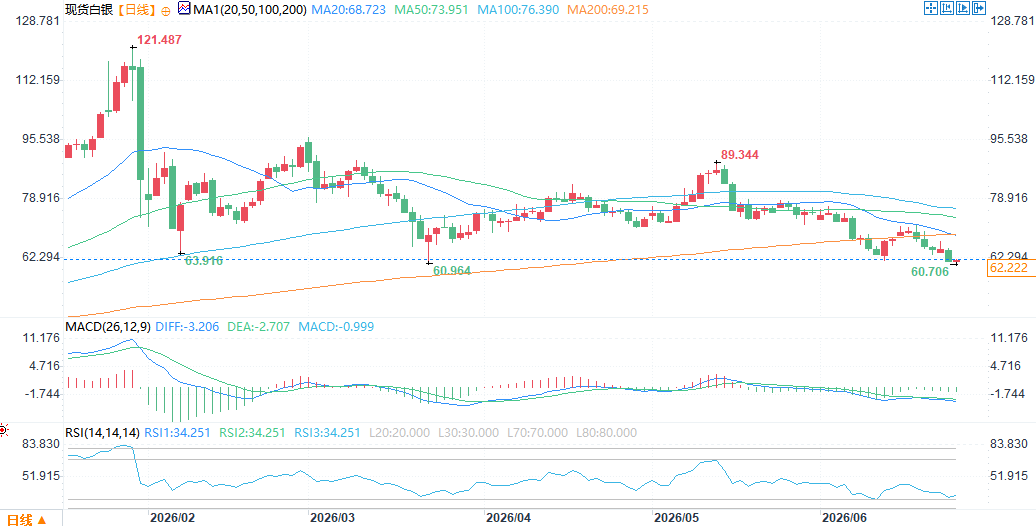
(Spot silver daily chart, source: EasyForex)
At 15:03 Beijing time on June 24, spot silver was trading at $61.73 per ounce.
Market expectations for at least two more Federal Reserve rate hikes this year continue to rise, pushing the dollar index to a 13-month high and putting significant pressure on silver, a non-interest-bearing asset. Investors are awaiting Thursday's release of US core personal consumption expenditure (PCE) inflation data for further guidance on the interest rate outlook.
Fed rate hike expectations shift dramatically: from two rate cuts to an 86% probability of a rate hike.
Market expectations for the Federal Reserve's policy path have undergone a dramatic reversal in just a few months.
According to the CME FedWatch tool, traders are pricing in an 86% probability of a Fed rate hike this year, a stark contrast to the two rate cuts that the market widely expected before the outbreak of the Middle East conflict.
The escalation of the situation in the Middle East has led to a significant increase in global inflationary pressures. Coupled with the unexpected resilience of recent US economic data, the market has had to reassess the Federal Reserve's policy stance.
In theory, a Fed rate hike would have a double negative impact on non-interest-bearing assets such as silver: on the one hand, higher interest rates increase the opportunity cost of holding non-interest-bearing assets, weakening the attractiveness of silver to investors; on the other hand, the expectation of a rate hike would push up the dollar exchange rate, and silver, which is priced in dollars, is usually under pressure when the dollar strengthens.
A strong US dollar and favorable technical factors combine to drive silver's decline.
The US dollar index is currently trading around 101.40, up about 0.1% on the day, reaching its highest level in over a year. This movement reflects the market's repricing of the Federal Reserve's policy path and support from relatively strong US economic data. A stronger dollar directly worsens the risk-reward ratio for silver—dollar-denominated silver becomes more expensive for holders of non-US currencies, thus significantly suppressing both physical and investment demand.
Specifically, when the US dollar index rises to a one-year high, the cost of purchasing silver increases for global buyers, especially those from emerging markets, the Eurozone, and Asia, leading to a decline in physical imports and purchases by jewelry and industrial sectors. Simultaneously, from an investment perspective, the attractiveness of dollar-denominated assets increases, causing funds to flow out of non-dollar-denominated assets such as precious metals, further amplifying downward pressure on silver prices. Historically, the US dollar and silver have shown a clear negative correlation; a strong dollar often corresponds to downward pressure on silver prices.
Currently, the silver market is facing a double squeeze: on the one hand, demand is suppressed by the appreciation of the US dollar, and on the other hand, the easing of geopolitical factors or the possibility that the Fed's hawkish expectations may exacerbate volatility.
Investors need to pay close attention to the US dollar index's breakout and the Federal Reserve's actions. If the US dollar continues to be strong, the short-term risk-reward ratio for silver will remain unfavorable, while in the medium to long term, it will depend on whether industrial demand (such as solar energy and AI) and supply gaps can provide support.
Overall, silver faces significant downside risks in the current environment, and a cautious approach to investment is recommended.
Key data to be released: PCE inflation may be a short-term catalyst.
Market focus has shifted to the upcoming release of the U.S. May core PCE price index on Thursday—the Federal Reserve's preferred inflation gauge.
The market expects core PCE to rise from 3.3% in April to 3.4% year-on-year. If the data exceeds expectations, it will further solidify the necessity for the Federal Reserve to raise interest rates, which may push the dollar and Treasury yields to continue to rise, thus putting new pressure on silver.
Conversely, if the PCE data unexpectedly falls short of expectations, it could trigger a reassessment of market expectations for interest rate hikes, leading to a pullback in the US dollar and providing a temporary respite for silver, which is currently in oversold territory.
Technical Analysis
According to the daily chart, spot silver is currently in a medium-term downtrend channel, with the bears in control. The moving average system forms a downward pressure, with the price effectively breaking below the short-term and medium-term moving averages MA20 (68.72) and MA50 (73.95). Only the long-term moving average MA200 (69.22) provides strong resistance above, and the bearish alignment of the moving averages limits the potential for a rebound.
The MACD indicator's DIFF (-3.206) continues to run below the DEA (-2.707), with the green bars remaining in negative territory, indicating continued bearish momentum and no bullish crossover signal yet. The RSI indicator is at 34.25, close to the low 30 range, suggesting a slight oversold correction in the short term, but it has not reversed the overall downward trend.
In terms of price trend, it has been fluctuating downwards since peaking at 89.34 in May. Recently, it tested a low of 60.71, and the previous historical support level of 60.96 was tested. The 60 level is a key psychological support.
The overall market trend is bearish in the medium term. The low RSI in the short term has only triggered a slight rebound. Short positions can be opened up when the rebound reaches the short-term moving average resistance zone. If the support at 60.70 is effectively broken, the downside potential will be further opened up. Only by stabilizing above the MA20 moving average and the MACD forming a golden cross at a low level can a phase of recovery be initiated.
(Spot silver daily chart, source: EasyForex)
At 15:03 Beijing time on June 24, spot silver was trading at $61.73 per ounce.
- Risk Warning and Disclaimer
- The market involves risk, and trading may not be suitable for all investors. This article is for reference only and does not constitute personal investment advice, nor does it take into account certain users’ specific investment objectives, financial situation, or other needs. Any investment decisions made based on this information are at your own risk.